.svg&w=384&q=75 "logo")
Newcastle United's Shock Departure: Eddie Howe's Exit and Future Plans
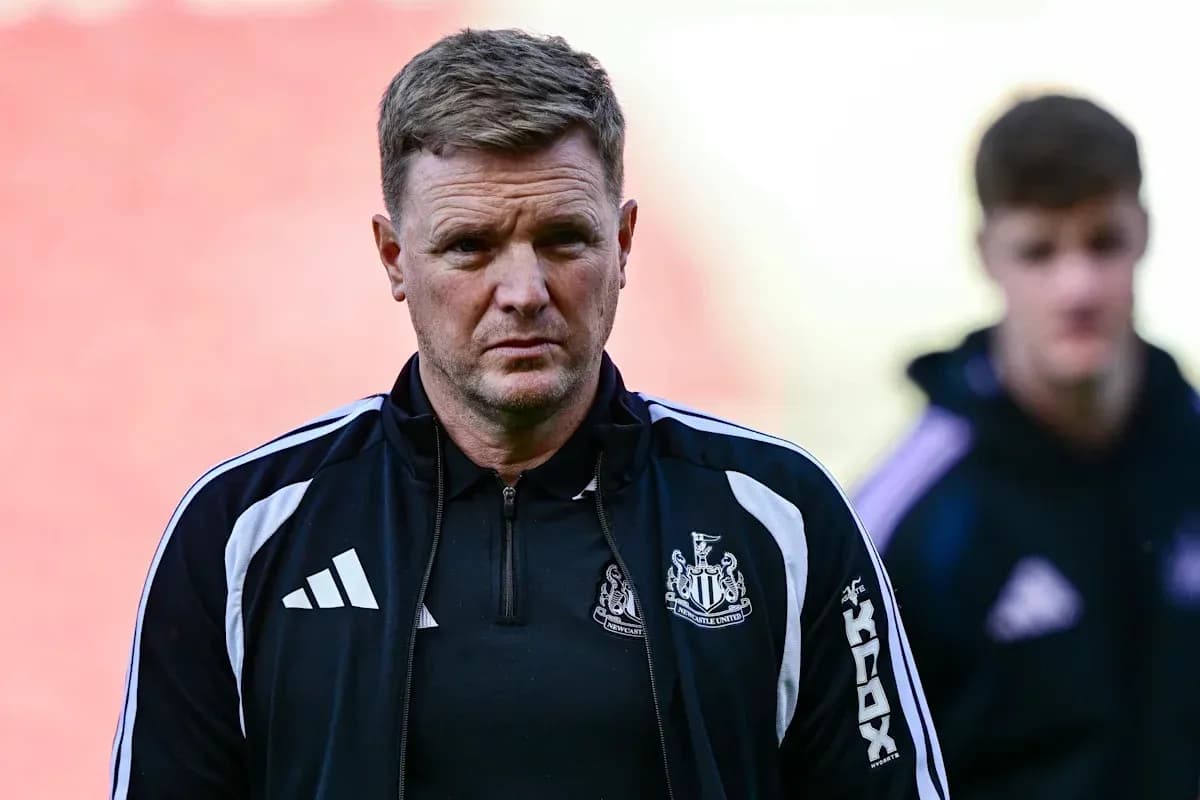
Newcastle United spent most of the summer braced for upheaval on the pitch. Few inside or outside the club, though, saw the real shock coming: Eddie Howe walking away just as pre-season was taking shape and the transfer window was in full swing.
His exit ripped through carefully laid plans, but behind the scenes Newcastle had already started writing the next chapter.
A shock departure, a silent plan
Howe’s decision to quit early in pre-season, right in the middle of a major rebuild, threatened to throw Newcastle’s summer off course. Training schedules, tactical work, recruitment priorities – all of it suddenly had a question mark over it.
At the same time, the club were trying to reshape the squad with a level of investment that underlined the scale of their ambition: up to £300 million spent on eight new signings. It was the kind of window that can define a project. Losing the head coach in the middle of it could easily have turned the whole operation into chaos.
Inside the building, though, the mood was different.
Sporting director Ross Wilson had already prepared for the possibility that this day would come. Speaking to Newcastle’s scouting department, he described the summer workload as “almost like running two transfer windows” – one for players, one, carried out in complete secrecy, for a new head coach.
The search for Howe’s successor ran quietly for two weeks, hidden in plain sight alongside the club’s recruitment drive.
“No, it never felt chaotic inside at all,” Wilson said. “Big respect to Eddie for the job he did for us over a long period of time. Bringing that trophy here means we would all describe him as a club legend.”
Succession in the shadows
Wilson admitted Newcastle had not expected to make a managerial change at that exact point in the summer, especially after Howe had committed to another season at the end of the last campaign. The timing was brutal. The club’s response was not improvised.
The idea of life after Howe had been on the table from the moment Wilson arrived.
“Eddie would tell you, since I came to the club, I’ve been planning in the background for a managerial change,” he said. “Part of our responsibility as leaders of the club is to be prepared.”
That preparation meant profiles, data, conversations, and scenarios already mapped out long before Howe’s resignation. When the moment came, Newcastle were not scrambling for names; they were choosing from a shortlist.
From that work emerged Matthias Jaissle.
Newcastle moved quickly, leaning on the groundwork already done to identify him as the right fit. While the outside world focused on the shock of Howe’s departure, the club were already deep into negotiations and alignment sessions, trying to ensure that the squad being built for this season would not be split between two conflicting visions.
One window, two managers
The challenge was clear: reshape a squad and change the manager without tearing up the blueprint.
Wilson and his team worked through an extensive list of transfer targets, checking them not just against Howe’s ideas but also against Jaissle’s preferences. The aim was continuity through change – players who could thrive under both, and a squad that would not need another expensive overhaul just to suit the new man in the dugout.
“Clearly the timing was not (what) we had planned for,” Wilson said. “But we had a plan in place, which is why we could execute it as quickly as we did.”
The disruption was real. The response was calculated.
Newcastle did not want a revolution every time the head coach changed. This summer was the first real test of that philosophy. They lost a club legend who delivered a long-awaited trophy. They installed a new manager in Jaissle while pushing through a £300 million rebuild.
Now the question hangs over the season ahead: has that quiet succession planning turned a potential crisis into a controlled transition, or will the true cost of such a jarring summer only emerge once the games start to matter?