.svg&w=384&q=75 "logo")
Max Dowman Shines in Arsenal's Under-21s Victory
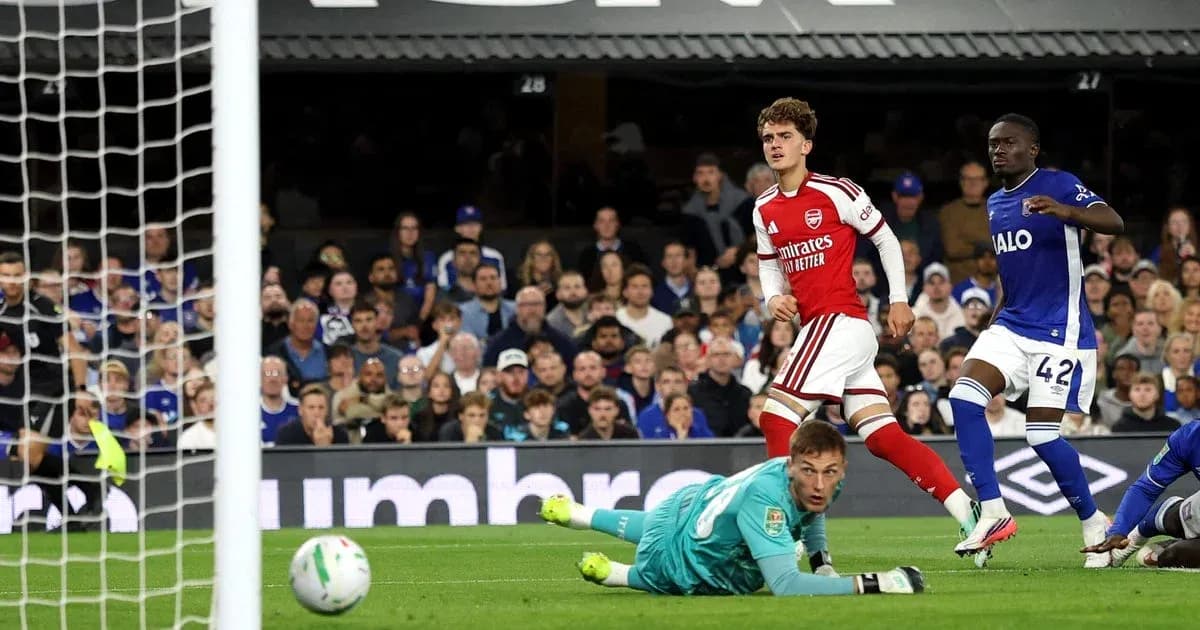
Max Dowman had waited long enough. Ninety minutes with the Under-21s here, an hour there, his name drifting to the fringes while Arsenal’s senior season found its rhythm. On Tuesday night at Portman Road, the 16-year-old needed six minutes to remind everyone why the club are treating him like a once-in-a-generation project.
He did it with a run that felt like a rerun.
Ball at his feet, Dowman exploded through Ipswich’s back line, eating up the turf at full tilt. Two rapid touches with his right, a sharp swivel of the hips, then that familiar glide onto his left. Cedric Kipre toppled to the turf, beaten by the feint, as Dowman paused just long enough to sell Christian Walton the wrong story before rolling a right-footed finish into the near-bottom corner.
It was impossible not to think of Everton in March. Same electricity, same shimmy, same sense of inevitability once he squared up his defender. That day at the Emirates, he became the Premier League’s youngest scorer, dropping Kiernan Dewsbury-Hall in similar fashion before detonating the stadium. Before that, he had danced across a rough Mansfield Town pitch in the FA Cup, moving so quickly that Mikel Arteta called his speed “incredible”.
This is becoming a signature move, the Dowman shimmy — and it is arriving in a league where 16-year-olds simply do not do this.
Arteta, speaking after the 4-2 win over Ipswich, framed it as something innate rather than coached.
“That’s something very natural for him, and he can deliver those actions effortlessly,” he said, before quickly pivoting to the other side of the ball. For Arteta, Dowman’s ability to repeat those explosive actions, and to defend with the same intensity, is what makes this experiment possible. “He’s 16 and he can create moments but consistently to go through the game, every phase with the demands that we put on him… he’s coping better and better and better.”
The second goal underlined that. If the first was a highlight reel in itself, the second added a flourish: a nutmegged finish into the far corner, all composure and calculation, as if this level of decision-making at this age is normal.
It is not.
Dowman’s season technically started before this. He played 90 minutes and laid on an assist for Arsenal Under-21s in a 1-1 draw with Crystal Palace on August 22, then an hour in a bruising 5-0 defeat to Chelsea on September 12. Those outings are not demotions; they are conditioning sessions in a year with fewer early midweek fixtures for the first team. Myles Lewis-Skelly followed a similar path at the start of his own breakthrough campaign.
Arteta had promised that Dowman’s chance would come. On the night the senior side beat Sunderland 2-0 while the Under-21s were being dismantled by Chelsea, the manager insisted the teenager’s time would arrive. When it did, Dowman did more than score.
His pressing set the tone. It was his harrying of Walton that opened the door for Noni Madueke to make it 2-0. Arteta seized on that detail.
“He did the action where he regained the ball and wins it for the first goal, too,” he pointed out. The message is clear: the magic is welcome, but the ticket into this Arsenal side is the work without the ball. “He really wants to do it (pressing). The more he plays, the more he trains with us, and the more ready he is physically to sustain that level, he will do it. And that will help in his attacking phase because he will force errors from the opponent, and then be in a really open situation to exploit his qualities.”
That hunger to be Arsenal’s “first defender” did not fade after half-time. If anything, it grew. Even as the game stretched, Dowman kept snapping into duels, closing angles, hunting loose touches.
His positioning, though, was what really marked this performance out as something different.
Last season, most of his senior minutes came on the right wing, a familiar route for academy attackers trying to squeeze into an elite side. He grew up as a midfielder in the Arsenal system, but the flank offers space, less traffic, fewer bodies to navigate. He did start twice centrally last season — at Mansfield and Crystal Palace — and Arteta went back to that blueprint at Portman Road.
This was not the classic No 10 performance that Martin Odegaard or Ethan Nwaneri have often delivered, operating in defined pockets between the lines. Dowman roamed. He drifted left to give Bruno Guimaraes a clearer passing lane into him, then popped up early in and around the box, always a half-turn away from danger. Late on, as the game loosened and legs tired, he switched to the right wing, yet still found the energy to sprint 60 yards back and shut down Jack Clarke on a counter-attack.
The away end responded with a chant that felt like a statement as much as a song: “Super Max Dowman.”
Arteta knows what that kind of noise can do to a young player. The hype around Dowman is not going away, and the manager is trying to build a protective shell around him without blunting his edge.
“If he does what he does on the pitch, I understand it’s not easy (to quieten the hype),” Arteta said. “We have to look after him. He’s 16. You don’t see that in this league… we need to make sure every time we throw him in, he’s in the right context with the right preparation.”
The context matters because there is no real roadmap for this. Arsenal have blooded prodigies before, but not quite like this, not with this volume of responsibility at this age.
Last season, as a 15 and then 16-year-old, Dowman made 13 first-team appearances. Nwaneri’s debut came at 15 years and 181 days, yet he did not truly break through until he was 17 in the 2024-25 campaign. Barcelona’s Lamine Yamal also stepped onto a senior pitch at 15, but that first taste in April 2023 was a one-off; his real season came at 16, when he played 37 La Liga games. The comparison sounds neat, yet Arteta keeps returning to a key difference: the sheer physicality of the Premier League.
Even the most celebrated teenage breakthroughs carry caveats. Cesc Fabregas, Jack Wilshere and Lionel Messi all debuted at 16, but their first full, sustained senior seasons came a year later. Wayne Rooney’s eruption at Everton in 2002-03, when he played 33 league games and bullied grown men as a 16/17-year-old, stands apart because he was already built like a veteran centre-forward.
Dowman is not that kind of physical outlier. His gifts lie in balance, acceleration, timing — and in his ability to absorb information and survive the weekly grind Arteta keeps referencing.
“You don’t (normally) see players (of Dowman’s age) with the capacity to handle just the physicality of the game,” the manager said. “Not only that, but the demands that you have to put your body through in the week to be able to be in a good condition to compete, the amount of information, the challenges that you have to face. But he’s doing it really well.
“But he will dictate that in terms of how he behaves every single day and how many reasons he gives to play because he’s part of our squad.”
That last line is telling. Dowman is not a guest in this dressing room anymore. He is not a tourist passing through the first team for the odd cup tie. He is part of the squad, with all the expectation and scrutiny that brings, and his own standards will decide how quickly the next steps arrive.
One of those steps could come this week. The first England youth squads of the season are about to be announced, and a move from the Under-19s feels like the natural progression for a player already bending the timeline at club level.
If that call-up comes, it will be another milestone on a journey that has barely begun. If it does not, Arsenal and England still know the same thing: at 16, Max Dowman is already doing things this league is not built to expect. The real question now is how far, and how fast, they dare to let him run.