.svg&w=384&q=75 "logo")
Mauricio Pochettino: The Coach Shaping USA Football After World Cup
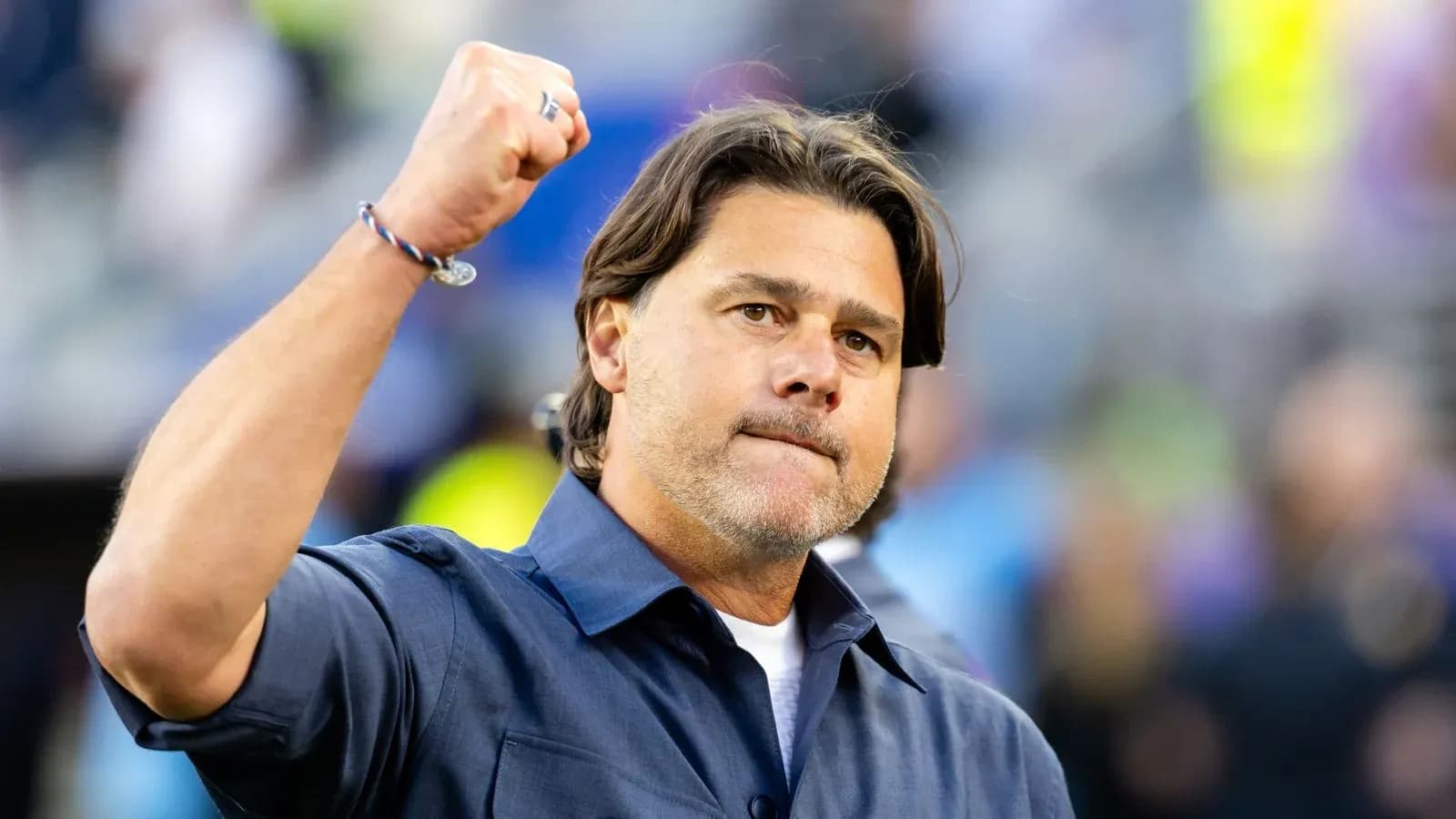
Mauricio Pochettino walks into the room the way he tends to walk into football clubs – arms open, eyes bright, ready to connect. There are hugs, jokes, stories from the summer. His, as it turns out, has been a little more eventful than most.
He has just taken the USA to the last 16 of a home World Cup, a run that ended with a thud against Belgium. On paper, it sounds straightforward. In reality, it was a whirlwind: a host nation under the glare of the world, a president who relishes the camera, a storm around Folarin Balogun, and a coach who somehow became a touchline style icon.
For an Argentine who has worked in some of the most pressurised jobs in European football, this was something else.
A World Cup that changed the coach
Pochettino doesn’t dwell on the heartbreak of going out. He lingers on what he gained.
“We are much better coaches now,” he says, and he means it. The World Cup, with its compressed preparation and brutal spotlight, has sharpened him. He talks about the obsession with detail, the impossibility of getting every decision right, and the unique difficulty of imposing clear ideas on a squad that spends only short, intense bursts together.
“Everything needs to be perfect,” he says. That’s the standard he set for himself and his staff, including long-time assistant Jesus Perez.
Perfect, though, is a fantasy in a tournament where chaos lurks around every corner. This was not just managing at a World Cup; this was managing at a home World Cup in a country where the president was never far from the narrative.
Donald Trump featured heavily in the story of the USA’s campaign, from his presence around the team to the political noise swirling in the background. Pochettino chooses his words carefully, focusing on the support and backing the president gave the squad, not the circus that followed.
The real flashpoint came with Balogun. His suspension, then the suspension of that suspension, dragged FIFA, Trump and the USA into a row that overshadowed the build-up to the Belgium game. Pochettino understood the anger and the accusations of manipulation, but he insists his role remained simple.
“If you pay attention to the noise, you become crazy,” he says. When FIFA’s letter arrived on the eve of the match confirming Balogun was free to play, the decision, he insists, was “straightforward”.
Balogun’s frustration and a coach keeping his distance
Balogun’s name has returned to the headlines since the World Cup, this time for club reasons. His proposed move from Monaco to Everton collapsed late on Deadline Day, leaving the striker stuck where he started.
Pochettino has not called him. That is intentional. He knows the disappointment a failed transfer brings and has chosen to give the forward room to breathe.
He would have liked to see Balogun in the Premier League. He says so. The stage, the intensity, the rhythm of English football – it fits the type of striker Balogun wants to be. For now, though, the forward stays in Monaco, and Pochettino can only hope he finds stability and form in France.
The unexpected four-year call
If the World Cup was frantic, the weeks that followed brought their own twist. As the rumour mill churned and clubs across Europe considered their next moves, Pochettino’s name inevitably surfaced. A coach with his record and profile does not stay out of work long.
Except this time, he did. At least in club terms.
The surprise came when the USA announced he had signed on for four more years. A fresh contract, a clear project, and a commitment that, if honoured, would keep him out of club football until 2030.
Six years away from the day-to-day of club life is a long time for someone who has built his reputation on the training pitch and the weekly grind. Is this, then, the end of his Premier League story?
He shakes his head.
“I have the ambition,” he says. “My dream now is to be in the USA for four years, but after that, why not? We are still young, and I think coming back is always my goal; to win the Premier League, to be in the Premier League and to build a project with the possibility of winning.
“I love the football here. I think to have the chance again is one of my wishes and I hope that happens.”
The door is not just ajar. In his mind, it remains wide open.
Spurs, the call that never really came
Talk of the Premier League brings the conversation, inevitably, back to Tottenham.
Pochettino has never hidden his affection for Spurs or the sense of unfinished business he feels from his time in north London. Eighteen months ago, he spoke openly about his desire to return one day. Since then, the club have lurched from one difficult chapter to another.
Ange Postecoglou’s tenure unravelled. Thomas Frank and Igor Tudor came and went as the club flirted with real danger near the bottom. The idea of Pochettino riding back in to rescue them felt, at times, almost inevitable.
So did the call ever truly come?
“Always I say, one day, why not?” he replies when asked about a return.
But was it close this time?
“People talk and maybe we receive some approach, but it never was close.”
Not now. Not yet.
Suitors kept at arm’s length
Tottenham were not the only club linked. At one point, AC Milan appeared a realistic destination. Others circled quietly, sensing an opportunity if the USA adventure ended after the World Cup.
Pochettino insists he and his staff shut that down early.
“We were not open during the World Cup to talk with different clubs that were interested,” he says. Were there clubs interested? He barely blinks.
“Yes, always,” he replies, as if this is simply the reality of his career. “Yes, always have different, you know, options.”
Did any of those options ever tempt him? Did any come close to turning his head?
“We never gave the opportunity to be close. We always closed the door before it got close.”
The USA project, at least for now, has his full attention.
Watching Spurs from afar
From a distance, Pochettino has watched Spurs reshape themselves. He sees a club spending heavily, targeting players already bedded into the Premier League rather than gambles from abroad.
“They are investing like other clubs,” he says. After a couple of difficult seasons, Tottenham have shifted strategy, backing experience over potential.
It’s hard not to contrast that with his own era, when he pushed Spurs to a Champions League final and a Premier League title race on comparatively modest spending. What would he have done with £300m?
He grins mischievously and feigns ignorance of what that sort of budget feels like.
Will this new approach work?
“You never know,” he replies. “We need time to see if that works or not.
“Like in all the games, when you make a decision like a coach that can work well or not. I think it’s a different strategy and a different way to operate. I always wish the best for Tottenham because it’s in my heart.”
The bond remains. So does the sense that, one day, paths might cross again.
Chelsea, a new direction and an old truth
His other former Premier League club, Chelsea, have also taken a sharp turn. The role he held two years ago has been upgraded in title from head coach to manager. The transfer policy has shifted too, with the club moving away from long-term “projects” towards players ready to compete immediately under Xabi Alonso.
Pochettino avoids direct comparisons with his own spell, but he recognises the intent.
Buying players with Premier League experience, he says, carries a clear message: you expect to fight for the title. You expect to be contenders.
Chelsea’s early defeat to Arsenal has already offered a jolt of reality, yet Pochettino urges patience for Alonso.
“Of course they are disappointed after the defeat against Arsenal, but I think we need to give time to Xabi’s first season after three games in the Premier League,” he says.
“I think we need to give time, and of course for Tottenham the same.”
Time, he knows better than most, is the rarest commodity in elite football. But it remains the foundation of any real project.
Arsenal, and the coach to beat
If Spurs and Chelsea are trying to work out exactly who they are, Arsenal, in Pochettino’s eyes, already know.
“For Pochettino, Arsenal are very much in pole position,” is the simple truth of his assessment.
“Mikel [Arteta] is the best coach in the Premier League today,” he says. “Knowing what he needs to do, it’s going to be tough to beat them.”
From a man who once stood on the other side of the north London divide, that is some endorsement. It also underlines the scale of the challenge for whoever wants to topple Arsenal in the coming years.
Pochettino, for now, will try to do it from afar, building a USA side in his image, honing his craft on the international stage. But he speaks of England with a familiar glint.
The World Cup has changed him. The USA have committed to him. Yet the Premier League still calls.
The only real question is when he decides to answer.