.svg&w=384&q=75 "logo")
Manchester United's Fight to Retain Wonderkid Gabriel Amid European Interest
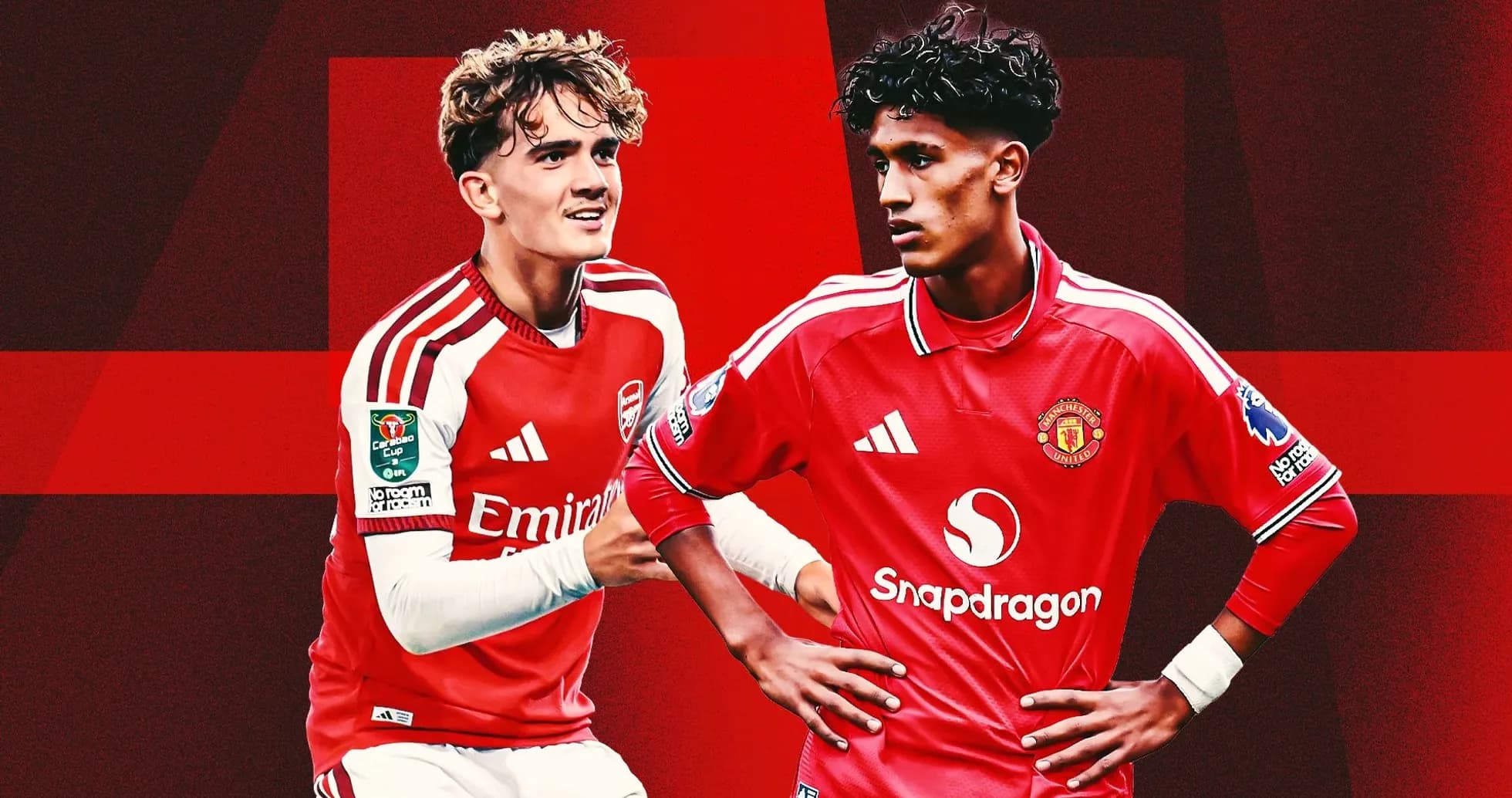
The noise around Manchester United this season was supposed to be about Michael Carrick, about a reset, about a club clawing its way back to relevance. Instead, a 15-year-old who has not kicked a ball for the first team is threatening to become the defining story.
Gabriel, the dazzling academy forward widely viewed as United’s brightest talent since Marcus Rashford, is at the centre of a tug-of-war that stretches from Old Trafford to the powerhouses of Europe. Real Madrid, Barcelona, Paris Saint-Germain and Bayern Munich are all trying to prise him away. United, for now, are refusing to blink.
Inside the club, the stance is clear: they have no intention of sanctioning his exit. Senior figures are scrambling to convince him to stay, aware of the optics as much as the footballing cost. INEOS chairman Sir Jim Ratcliffe has already felt the sting of supporter anger in his short spell as the public face of United’s football operations. Letting a once-in-a-generation academy prospect walk out the door would turn discontent into fury.
The problem? Gabriel can walk.
A loophole that could cost United dear
He is under contract until next summer, but he is not a full-time scholar or part of United’s full-time model. That technicality becomes crucial when he turns 16 on October 16. Under current rules, if he holds a European passport, he would be free to leave England and sign for a club in the European Union before turning 18.
United are urgently exploring that detail. His father, Joe O’Cearuill, is a former professional who represented Ireland twice at senior level, while his mother is of Greek Cypriot heritage. That background could make Gabriel a dual national and open a door United are desperate to keep shut.
They already won one battle for him, keeping him out of Manchester City’s grasp last year. This feels different. The stakes are higher, the suitors more glamorous, the player older and more aware of his own value. It may already be too late.
The signs are not encouraging. Gabriel was due to join first-team training on Saturday. He never arrived. He has not been seen at Carrington all week.
Carrick had planned to name him in the squad for Wednesday night’s Carabao Cup third-round tie against Brighton at Old Trafford. Had he stepped onto the pitch, Gabriel would have become the youngest player ever to represent United’s senior side. That chapter has been torn out, at least for now.
A beacon in a fading production line
This is why the club is so rattled. United’s academy has not produced a true global superstar since Rashford burst through. In Gabriel, they saw a new standard-bearer: a two-footed forward with extraordinary agility, capable of spinning out of the tightest spaces and finishing ruthlessly when the goal opens up.
The comparisons came quickly. Lionel Messi’s name has been whispered, though that does him no favours. Neymar is a more realistic reference point – in style, not status. Gabriel’s low centre of gravity, his slaloming dribbles, his flair in one-on-one situations all evoke the Brazilian. He even wears the same model of Nike boots, having penned a lucrative extension with the sportswear giant in March 2025.
The numbers back up the hype. Last season, aged just 14, he broke into United’s Under-18 side – another club record – and tore the league apart: 20 goals in 21 games. He walked away with the first-ever Premier League U18s Player of the Year award and became the youngest winner of United’s Jimmy Murphy Young Player of the Year prize.
This August he jumped again, into the U21s. His debut against Ipswich was a statement: two assists and a delicate chip in a 5-0 rout. A week later he scored again as United hammered Leicester City 4-1. Each step has looked too easy.
This is the profile that has Europe’s elite on alert. A teenager operating ahead of schedule, gliding through levels that usually slow even the best down. For many fans, it is obvious: play him. United are crying out for spark in the final third, and they see Arsenal handing the keys to Max Dowman and wonder why their own prodigy is still on the fringes.
The Dowman effect – and the danger of shortcuts
Dowman has become the poster boy for the modern English prodigy. Arsenal threw him into the Premier League against Leeds United in August 2025, making him the second-youngest player in the competition’s history. By March, he had broken James Vaughan’s record as the league’s youngest goalscorer with a brilliant solo strike against Everton at 16 years and 139 days.
He did not stop there. He became the youngest title-winner in Premier League history in May, then this week matched Wayne Rooney as only the second 16-year-old to score a brace for a Premier League club in a major competition, driving Arsenal to a 4-2 Carabao Cup win over Ipswich.
Fourteen senior appearances already, all laced with a mix of flair and surprising physical strength. Mikel Arteta has even mentioned him in the same breath as Messi, while carefully rationing his minutes, choosing his moments, shielding him when needed.
Arteta explained the balancing act after that Ipswich game, stressing that a 16-year-old in the Premier League is a rarity and that Arsenal must ensure every outing comes in the right context, with the right preparation. He knows the league’s physical and mental demands can break young bodies and minds.
Gabriel is not Dowman physically. He is slight, often the smallest player on the pitch. His bravery and determination go a long way, but they do not change the fact that throwing him into the Premier League too soon could go badly wrong – especially if he shines immediately.
That is the paradox. If Gabriel explodes on debut, the clamour to play him every week would be deafening. United do not have Arsenal’s depth. Arteta can rotate Dowman in and out of a winning side stacked with quality. Carrick is juggling a squad whose performance levels swing wildly from week to week.
If Gabriel starts, dazzles, then disappears from the team sheet, Carrick will be branded too cautious, accused of stifling talent while the team struggles. If Gabriel starts and struggles, the narrative flips: overrated, overhyped, not ready.
So Carrick has waited. And some inside the game think he has been right to do so.
“Very different to Max Dowman”
Danny Simpson, a United academy graduate who broke through late in the Sir Alex Ferguson era, understands the landscape better than most. Speaking to GOAL courtesy of Free Bets, he drew a sharp contrast between Dowman’s situation at Arsenal and Gabriel’s at United.
He pointed out that when he emerged at Old Trafford, United were dominant. Youngsters could come on for ten minutes with the team already 2-0 or 3-0 up, often surrounded by a “second XI” strong enough to win the league. Dowman, Simpson argued, is stepping into a similarly luxurious environment: a side brimming with confidence, packed with elite players, winning consistently.
That cushion does not exist at United now. Every minute feels loaded with consequence. Every dropped point deepens the crisis. It is not the ideal stage for a slight 15-year-old to learn his craft.
Simpson urged patience, referencing another gifted youngster, Shea Lacey, who has been eased in carefully. His message was simple: let Gabriel train with the group, let him feel the environment, and trust that his moment will come.
Yet patience is a hard sell to a teenager watching his peers accelerate past him.
Yamal, La Liga and the lure of fast-tracked stardom
If Dowman is one reference point, Lamine Yamal is another. The Barcelona winger made his senior debut at 15 years, nine months and 16 days, as skinny and vulnerable-looking as Gabriel is now. He survived – and then thrived – not because he was built for the fight, but because his speed of thought and movement allowed him to evade it.
La Liga helps. The Spanish top flight is less physically relentless than the Premier League, more focused on structure, possession and positional play. Technicians have more time to breathe, more space to show their craft. In England’s high-octane chaos, where time on the ball evaporates and contact is constant, Yamal’s rise might have been slower.
Gabriel will know this. Barcelona and Real Madrid offer not just prestige, but a pathway he can see and touch. He may feel they can fast-track him to global stardom in a way United cannot.
That belief would be understandable. It would also be naïve.
When Yamal broke through at Barca, they were marching towards the La Liga title under Xavi but licking their wounds from a Champions League group-stage exit. Raphinha, Ousmane Dembele and Ferran Torres were not at their current levels. There was space for disruption, for a teenager to elbow his way into the hierarchy.
Now, the picture is different. Barcelona boast Yamal, a peak Raphinha, Anthony Gordon, Karim Adeyemi and Gabriel Jesus in their attacking stable. Over in Madrid, Jose Mourinho can call on Kylian Mbappe, Vinicius Junior, Jude Bellingham and Yan Diomande. At PSG and Bayern, the competition is no less brutal.
Wherever Gabriel goes, he will have to wait. The irony is that his clearest route to regular senior football may still lie at United, the club he is currently holding at arm’s length.
United’s line in the sand
That is the crux of it. United cannot allow themselves to be held hostage by a 15-year-old, however gifted, who is still 18 months away from sitting his GCSEs.
They believe they have treated Gabriel properly. Carrick and the academy staff have managed his progression step by step, protecting him from the worst of the chaos swirling around the first team. They will keep doing so – if he stays and buys back into the project.
If he does not, there is a growing feeling that the club should step aside rather than be dragged into a long-running saga that overshadows their attempts to repair a dismal start to the season. The suspicion lingers that Gabriel, whether guided by family, agents or his own instincts, is acting with a sense of entitlement that does not sit comfortably at a club built on graft.
United’s history is defined by homegrown legends who earned everything. George Best, Sir Bobby Charlton, Ryan Giggs, David Beckham, Paul Scholes, Gary Neville – none of them were handed status. They climbed, they fought, they stayed.
Ruben Amorim, the much-maligned former United manager sacked in January, spoke pointedly about that culture shift before his exit. He warned of a creeping entitlement, of young players too quick to speak out, too ready to push back when things get hard. His message was stark: stay, fight, overcome.
He got plenty wrong. On this, he struck a nerve.
Right now, with his current mindset, Gabriel does not look like a player ready to carry the weight of United’s shirt. Talent alone is not enough at Old Trafford. The first and most important lesson every youngster must absorb is simple: no individual is bigger than the club.
If that truth does not land, United may decide that losing a prodigy is a price worth paying – and let Gabriel chase his personal brand under someone else’s badge.