.svg&w=384&q=75 "logo")
Manchester United's Defensive Issues Worsen in Draw Against Everton
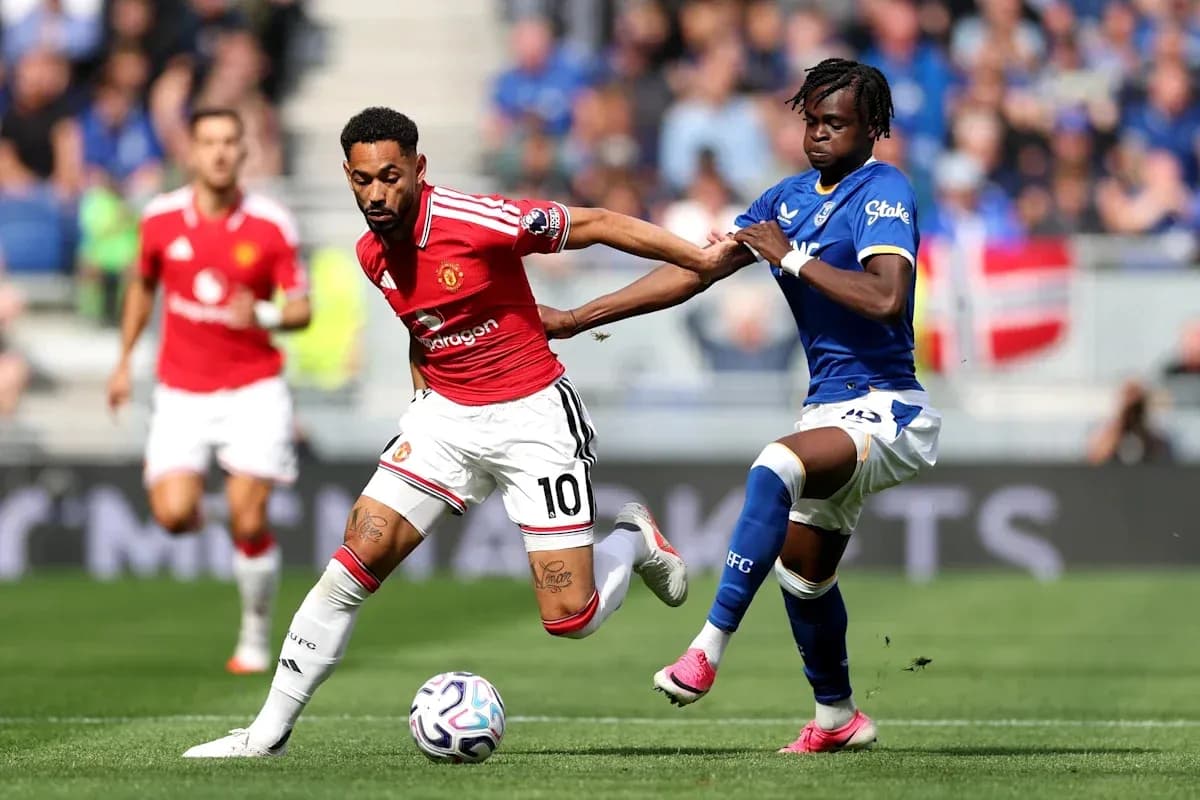
Manchester United walked out of Goodison Park with a 2-2 draw and the unmistakable feeling of a defeat. They led twice, scored twice from well-worked restarts, played some sharp football in patches – and still couldn’t finish the job at either end of the pitch.
They created enough. They competed. They even looked in control for long stretches.
They just didn’t kill the game. And they couldn’t keep the door shut.
All the Craft, None of the Cut-Throat Edge
United’s attacking play carried promise. Three inventive forwards stitched together moves, dropped into pockets, and pulled Everton’s back line around. The approach play was often slick. The final act rarely was.
Too often, promising moves fizzled out before the ball reached a truly dangerous area. Runs into the box came a fraction too late or not at all. Crosses flashed across the face of goal with no one gambling. United’s structure got them into good zones; their lack of penalty-box presence stopped them from turning those zones into a winning margin.
They twice found a way through from restarts, a reminder that this side has rehearsed patterns and enough technical quality to break teams open. But in open play, the absence of a true penalty-area predator showed. The attack felt one body short in the spots that matter most.
Benjamin Sesko’s return to fitness offers one possible remedy. Bryan Mbeumo stepping back into a central striker role is another. Amad’s absence on the right has also left a gap that neither a still-developing Shea Lacey nor the idea of Matheus Cunha as a right winger seem ready to fill.
Up front, United look like a team one piece away from being ruthless. At the back, they look like a team several steps away from being reliable.
A Back Four That Never Settles
The more damning pattern isn’t in front of goal, though. It’s behind it. United have now conceded two goals in each of their first three matches of the season. Hull City, Ipswich Town, Everton: none of them heavyweights, all of them able to score twice.
At Goodison, against an Everton side that has struggled in attack, the same issues resurfaced. The back four never truly settled, and when the game tilted, they bent with it.
Luke Shaw actually produced his best performance of the campaign so far. He overlapped Marcus Rashford with purpose, delivered several good crosses and, crucially, supplied the ball that Sesko headed in what looked like an 88th-minute winner. He threw himself in front of shots, made blocks, and for long spells looked more like his old self.
Yet his defensive concentration wavered at a critical moment. For Tyrique George’s first equaliser in the 83rd minute, Shaw drifted too far inside, leaving George the angle he wanted to lash a fierce strike into the near-post top corner. Arne Lammens got a hand to it and might feel he should have done better, but the chance should never have been that clean.
That theme ran through the entire back line. Individually, Harry Maguire, Lisandro Martinez and Diogo Dalot were below par. Collectively, they allowed Everton too many sights of goal.
Maguire’s positioning almost cost United in the 42nd minute, when Thierno Barry rose unmarked and really should have scored with his header. Dalot’s attempted clearance in first-half stoppage time went straight to Jarrad Branthwaite, who let United off by firing directly at Lammens. Later, a badly miscued Dalot cross in midfield left Shaw and Martinez scrambling to recover and only a desperate block prevented Brennan Johnson from punishing them.
Those moments weren’t isolated. They were warnings. United didn’t heed them.
Sitting Back, Paying the Price
The most troubling spell came with United 1-0 up for most of the second half. Rather than press home their advantage, they retreated.
Everton took control of the ball and, with it, the tempo. United sank deeper, stopped winning first contacts, and struggled to keep possession long enough to relieve the pressure. It looked less like a team managing a lead and more like one clinging to it.
That caution invited exactly the sort of long-range, high-risk efforts that can flip a game. Everton obliged with two rockets into the top corner. United’s defending, passive and reactive, gave those shots room to happen.
Michael Carrick tried to change the picture after the first equaliser. Mazraoui came on at left back, Leny Yoro at right. The reshuffle did not steady things. In the 90th minute, Mazraoui lost track of George again, allowing another near-post attempt that Lammens saved – the flag went up for offside, but the warning was loud.
United didn’t act on it. Deep into stoppage time, with Everton chasing one last chance, Hayden Hackney drifted past Yoro far too easily and fed Kiernan Dewsbury-Hall. Mazraoui’s clearance from the ensuing scramble went straight to Ainsley Maitland-Niles, who unleashed a stunning, Puskas-level strike to salvage a point for the hosts.
Carrick’s full-back changes didn’t work, but the uncomfortable question hangs in the air: would leaving Dalot and Shaw on have made any real difference? Right now, whichever combination he picks, United still look like conceding.
Structural Flaws, Not Just Bad Days
This isn’t just about one afternoon on Merseyside. The pattern is starting to harden.
The full-back positions remain the glaring weakness. Shaw can still contribute with his delivery and intelligence, but he no longer has the recovery speed to repeatedly bail himself out when caught high. Dalot faces similar problems on the opposite flank. When both push forward, the centre-backs are left covering huge spaces, ripe to be attacked by pace on the counter.
Opponents don’t need long to spot it. Hit United wide. Turn the full-backs. Drag the centre-backs out. Exploit the gaps behind. The script is becoming familiar.
There are caveats. Personnel will change. Matthijs de Ligt is edging back towards his first appearance since November 2025 and should strengthen the heart of the defence. Youngster Ayden Heaven is pushing for more minutes and offers a different profile. But the issues go beyond individual names.
United spent the summer rebalancing their midfield and sharpening their attack. The ball progression looks cleaner, the front line more inventive. The squad, though, still feels tilted. Too much attention went on fixing one department while another frayed.
Unless Carrick finds a tactical solution – a different line height, more protection for his full-backs, or a braver approach to rotating his defenders – United could score freely this season and still bleed points in games they ought to control.
With the first Champions League match looming, that’s not an abstract concern. It’s a fault line running straight through their season.