Kapil Pokhariya: From Cotton Mattresses to Asian Games Bronze
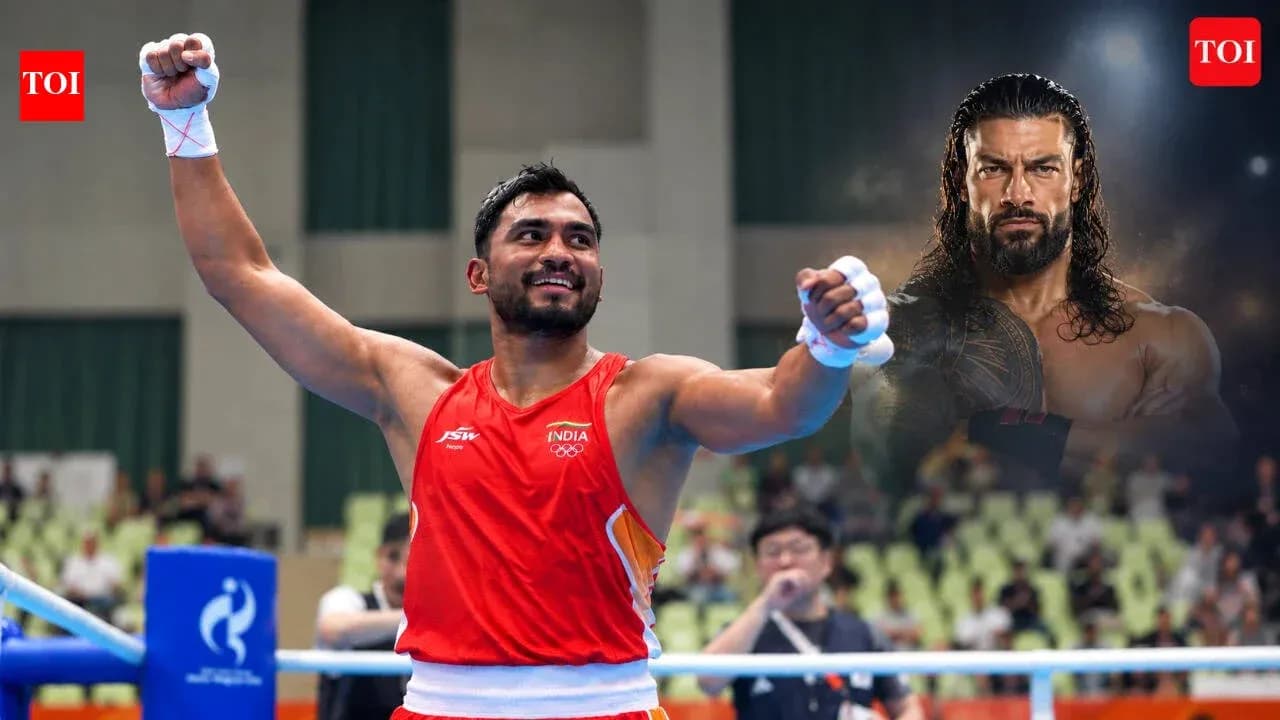
The boys in Chakarpur village always knew where to find him. Not on the cricket field. Not at the corner shop.
Inside his house, Kapil Pokhariya would be flying off cotton-filled mattresses, punching pillows, hurling them at walls, and smashing a homemade punching bag stuffed with mountain soil. On television, Roman Reigns ruled the WWE ring. In Khatima, a young Kapil tried to copy every punch, every swaggering walk to the ropes.
He skipped meals, skipped playtime, skipped outings. WrestleMania and Money in the Bank were non‑negotiable. Once the shows ended, the real performance began in his living room.
He had no idea those make-believe punches would one day carry him to a real podium, under a real flag.
Today, that same boy is Havaldar Kapil Pokhariya of the Indian Army — and an Asian Games medallist. In Aichi-Nagoya, Japan, he fought his way to bronze in the men’s 90kg boxing event at the 2026 Asian Games, the biggest moment of his career so far.
“I never knew that copying Roman Reigns and practising those punches would bring me this far,” he told TimesofIndia.com. He still keeps the recordings of those WWE shows. The dream has changed; the obsession has not.
A Soldier’s Son Who Wasn’t Meant to Box
Chakarpur, in Khatima, Uttarakhand, sits far from India’s established boxing hubs. No big academies, no conveyor belt of champions, no tradition of producing national stars.
His father, Narendra Singh Pokhariya, served in the Indian Army. His plan for Kapil was simple: study hard, clear the exams, wear the officer’s stars. Boxing had no place in that blueprint.
What he did see, though, was a boy wrecking the house in the name of WWE. Pillows torn, mattresses battered, walls taking a beating. The father’s first reaction was predictable — scoldings, even beatings, to stop the chaos.
Then one day, Narendra watched his son drag a thick sack home, fill it with sand after school, hang it up and hammer it with everything he had. This was no casual mimicry anymore. It was intent.
A nearby school had a teacher who coached boxing. Kapil had seen students pounding a proper bag there and decided to improvise his own. The homemade sack changed more than his training routine; it changed his father’s mind.
The same man who once pulled him away from the “fake fights” took him by the hand to a training centre and got him admitted. That was Kapil’s real debut — not on a TV screen, but on a dusty ground in Khatima.
Learning the Trade the Hard Way
There was no grand facility waiting for him. No high-performance centre. Just a small training ground, a handful of boys, and a coach who could only spare a few hours on selected days.
“Pooran Bohra sir was there,” Kapil recalled. Bohra worked with a small group, but the sessions mattered. Kapil listened, absorbed, then went home and repeated every drill, every correction, every movement until it became his own.
The ring, when it finally arrived, did not welcome him gently.
In 2015, he entered his first state-level competition, buzzing with excitement. The crowd was bigger than anything he had seen. The lights felt harsh. The nerves hit early.
His first competitive bout ended quickly — defeat in the opening round.
The loss stung. It could have ended the experiment right there. Instead, it did the opposite. The disappointment hardened his resolve. That early exit, in front of a large crowd, became the turning point. His interest in boxing didn’t fade; it deepened.
He came back at the national level with a different mindset. The boy who had been overawed at state level now walked in with purpose. This time he didn’t just win bouts; he won the gold medal.
The medal brought prize money. The prize money brought something even bigger — a job in the Indian Army.
Wearing the Uniform, Climbing the Ranks
In April 2017, Kapil joined the Army as a havaldar. For his father, who had enlisted as a sepoy and retired as a havaldar, the moment carried a quiet symmetry — and a louder pride.
Narendra had always wanted his son to climb higher than he did, to become a commissioned officer if he joined the Army at all. Boxing had rewritten that script, but not the ambition.
The Army, in turn, opened doors that Chakarpur never could. Better training, stronger sparring partners, a proper competition calendar. Kapil stepped into Services events, began winning medals, and started to look like a serious contender on the national circuit.
The day he won his first national medal, his father’s reaction told him everything. No long speech. Just a hug that said the gamble on boxing had paid off. Kapil understood in that embrace that his life had shifted to another level.
Now, with an Asian Games bronze, another shift is coming. He is set to be promoted to naib subedar. The son will outrank the father in the same force.
“Papa said, ‘Ab tu mera senior ho gaya hai’,” Kapil recalled, smiling. For a family built on Army discipline and quiet sacrifice, that line might be worth as much as the medal itself.
‘Khatima ka Russell’
Boxing wasn’t his only outlet as a kid. Like millions of Indian boys, Kapil grew up on gully cricket and inter-village tournaments. The bat felt as natural in his hands as the gloves.
Tall, muscular, and fearless, he became a menace for local bowlers. He didn’t just clear boundaries; he cleared them by a distance. Those towering sixes earned him a nickname that stuck — “Khatima ka Russell”, a nod to West Indies powerhouse Andre Russell.
“I loved Andre Russell. I also liked Hardik Pandya,” Kapil said, laughing. Teams wanted him in their XI for one simple reason: if he connected, the ball disappeared.
That raw power, that willingness to hit hard and hit often, now lives in his right hand inside a boxing ring. The stage changed. The intent didn’t.
Bronze in Japan, Eyes on Los Angeles
The bronze in Aichi-Nagoya is not the destination. For Kapil, it’s the first proper marker on a much longer road.
Under the Boxing Federation of India’s selection criteria, Asian Games medallists are set to be the main entries in their weight categories for the 2027 World Boxing Championships in Astana, Kazakhstan. Scheduled for April, that tournament will be the first qualifying event for the Los Angeles 2028 Olympic Games.
The stakes could not be clearer. Astana is not just another championship; it is the gateway.
Kapil knows it. He speaks like a man who has already drawn a line through the past and circled the future.
“Rukna nahi hai ab, bas aage dekhna hai,” he said. No stopping now, only forward.
The dream is stripped down to a single target: the Olympics. Not just to march in the opening ceremony, not just to say he made it, but to win a medal for India on the biggest stage in sport.
“I am preparing for the World Championships in April,” he added. The focus is already there — on Astana, on qualification, on Los Angeles 2028.
From a boy copying Roman Reigns on cotton mattresses to an Asian Games medallist and future naib subedar, Kapil Pokhariya has punched his way out of a small Uttarakhand village into the continental spotlight.
The next question is no longer whether he belongs there. It’s whether that homemade punching bag was the first swing in a journey that ends with an Olympic medal around his neck in Los Angeles.