.svg&w=384&q=75 "logo")
Javagal Srinath: From Cricket Star to Everyday Commuter
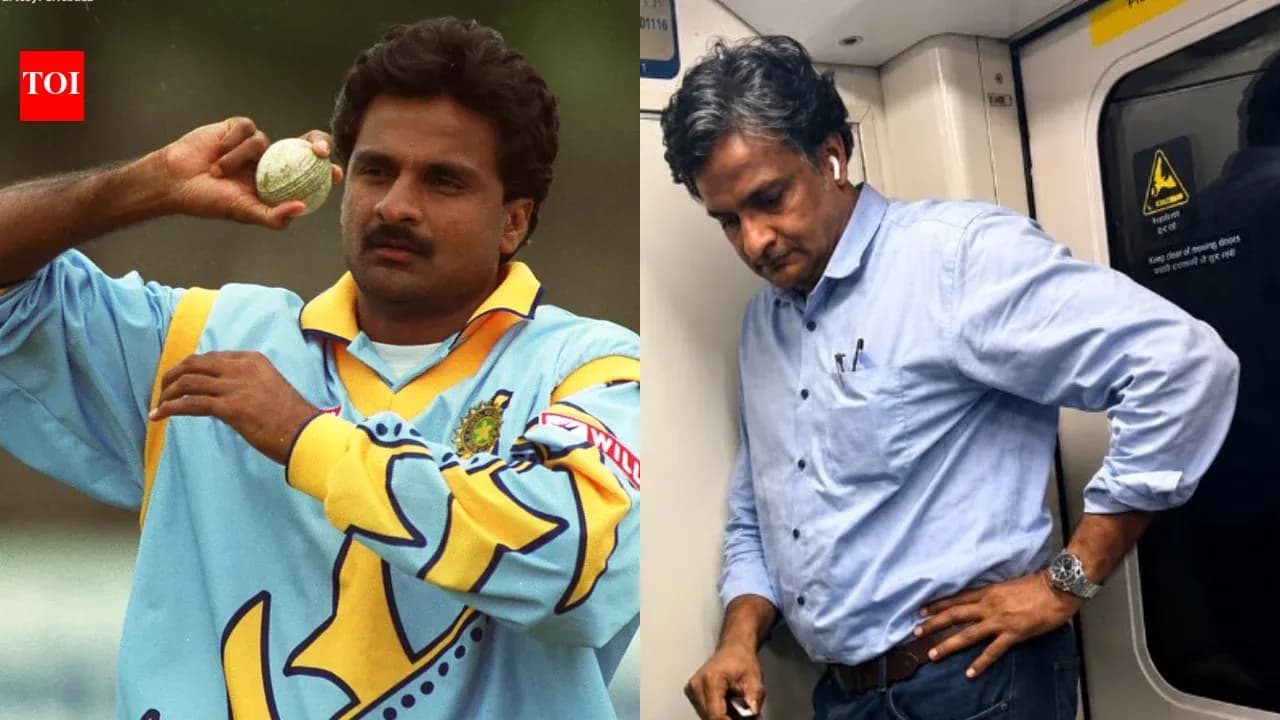
On a Bengaluru morning that could have belonged to anyone, a familiar face stood by the Metro door with a trolley bag and a light-blue shirt. No India blazer. No TV crew. No autograph hunters closing in.
Just Javagal Srinath, once the spearhead of India’s pace attack, now another commuter on Namma Metro.
The picture, snapped quietly and then sent spiralling across social media, shows nothing dramatic. No raised arm, no bails flying, no white ball in hand. That is exactly why it has stopped fans in their tracks. The man who once thundered in as the ‘Mysore Express’ now waits for his stop like every other passenger, luggage by his side, gaze turned away from the camera.
For a generation that grew up watching him carry India’s fast-bowling burden through the 1990s, the contrast is striking.
From ‘Mysore Express’ to Metro regular
Srinath was never just another name on a team sheet. At a time when India still searched desperately for a reliable pace battery, he became the constant. Sixty-seven Test caps. Two hundred and twenty-nine ODIs. Spells that began with a brisk walk, gathered into a powerful run, and ended with the ball thudding into the keeper’s gloves or smashing into the stumps.
He led India’s seam attack through years when conditions, expectations and workloads rarely cut him any slack. Yet the image that has gone viral now has nothing to do with outswingers or reverse swing. It captures something quieter.
Jeans. Shirt. A trolley bag. A carriage full of people who, at least in that frozen moment, seem largely unaware that the man in their midst once opened the bowling for India at World Cups.
That ordinariness is what has resonated. The idea that a bowler who once shouldered the pressure of a billion now shoulders his own luggage on public transport.
‘This is Srinath’
The responses online have poured in with a familiar theme: this is exactly who fans believed Srinath to be.
Users recalled spotting him in Bengaluru before, walking through the city without security, without fanfare, without the bubble that often builds around former internationals. Some spoke of seeing him at stations, on streets, in everyday settings where the only hint of his past was the double-take of someone who recognised him.
Others widened the lens to Karnataka’s understated cricketing lineage. Names like Rahul Dravid, Venkatesh Prasad and Anil Kumble surfaced in the conversation, held up as part of a generation that married elite performance with quiet dignity. One fan summed it up, calling that group proof that “immense sporting success can coexist with absolute humility and grace.”
The Metro photograph simply adds another frame to that narrative. No luxury car. No private escort. Just a former India fast bowler blending into the crowd, not towering above it.
For many, the image has become a small but powerful reminder: sporting fame does not have to morph into a celebrity lifestyle.
A familiar scene, a recurring theme
This is not the first time Srinath’s everyday travels have found their way online. An earlier photograph, shared by a fan, showed him waiting at Mysuru railway station, a bag slung over his back, looking for all the world like any other passenger checking the platform.
That picture, too, drew admiration. Not because he looked like a star, but because he didn’t.
The Metro shot has triggered the same reaction. It surfaced on social media, spread rapidly, and sparked a fresh wave of appreciation. The exact date of the photograph remains unclear, but the timing hardly matters. What people are responding to is not when it was taken, but what it represents.
A cricketer who once lived under the relentless glare of international scrutiny now moves through his city with the anonymity of someone content to let the game, and the limelight, move on.
Still in the game, just in a different role
Srinath’s life after retirement never really strayed far from cricket. He may have stepped away from the new ball, yet he stayed close to the centre of the sport as an ICC match referee, trading the bowler’s run-up for the match official’s clipboard.
From the middle of the pitch to the match referee’s room, he has remained part of the international circuit, only now as the man in charge of upholding the laws rather than exploiting them. The roar of the crowd has been replaced by the quiet authority of the referee’s report.
For many Indian fans, though, that is a secondary chapter. In their minds he is still the fast bowler who shouldered India’s pace responsibilities when options were thin and expectations heavy.
Perhaps that is why a simple Metro journey has cut through the noise of highlight reels and nostalgia clips. The photograph does not show Srinath celebrating a wicket, shaking hands with captains or standing for the anthem. It shows something far more ordinary: a man with a bag, on a train, heading somewhere in his city.
In an era obsessed with curated images and manufactured glamour, that unvarnished moment has become its own kind of highlight.