.svg&w=384&q=75 "logo")
Ireland Football Team Faces Ethical Dilemma Against Israel
The naming of an Ireland squad has rarely carried this kind of weight.
On Thursday, when Heimir Hallgrímsson reads out his list for the upcoming fixtures against Israel, the usual debates about form, shape and selection will feel secondary. The real scrutiny will fall on who is missing for reasons other than injury, and on the moral load that has been shifted from boardroom to dressing room.
Players still talk about the call-up as the pinnacle, the moment a career feels validated. This time, that honour comes tangled with a question that should never have been left at their door: do you play football against a nation accused of carrying out genocide?
That is where the Football Association of Ireland has left them. By choosing to proceed with the games, the FAI board has pushed a decision of deep ethical consequence onto individuals whose job is to play, not to adjudicate the gravest of international crimes. It is an abdication of responsibility dressed up as business as usual.
The old line that “politics has no place in sport” collapses on even light inspection. Politics runs through stadium funding, international fixtures, sponsorship deals, national anthems. It sits in every flag, every handshake, every decision about who is allowed to compete and who is not. Sport has never been separate from the world; it has always been one of its loudest stages.
This, though, is different in scale. The charge of genocide is not a throwaway slogan. It is the most serious accusation in international law. Some argue that the legal process is still ongoing and that judgment must wait. But the law moves slowly by design. Moral judgment cannot afford the same luxury of time. Those who look at the scale and nature of Israel’s assault on Palestine see a deliberate campaign of terror that, they argue, meets the threshold of genocide. They insist the response cannot be to carry on as if nothing has changed.
When institutions face decisions of this magnitude, the expectation is clear: those in charge do the work, absorb the facts, and act in line with the principles they claim to hold. Faced with a state widely viewed as guilty of systematic barbarism, the obvious stance for a sporting body that speaks of values would be to refuse to play. Not to pause. Not to hesitate. To say no.
Once, the FAI did exactly that.
Last November, the board formally asked UEFA to ban Israel. That move was understood as a line in the sand, a declaration that no national team, no group of players, should be placed in the position Ireland now occupies. The association was applauded for it. Here, at last, was Irish football putting principle ahead of fixtures and fees.
That was then. The moment Ireland were drawn to face Israel, that principle was quietly boxed up and put away.
The FAI’s reversal does not exist in a vacuum. It sits within a wider pattern of Irish institutions stepping back from the edge when confronted with the full cost of their stated values. The Government’s stalling on the Occupied Territories Bill has already sent a message that economic and diplomatic caution can trump moral clarity. Other sports have followed that lead. The GAA has refused to sever its commercial ties with Allianz, a stance that has drawn fierce criticism and accusations of complicity.
Yet it is Irish football that now offers Israel something it desperately needs: normalisation. Two fixtures. Two nights under the lights. A handshake at kick-off. The global language of sport telling the world that this is just another game.
The matches will go ahead. The dates are set: September 27th and October 4th. The scorelines will be recorded, the minutes logged, the appearance fees paid. On paper, they will look like any other entries in the record books. In reality, once the whistle blows, there is only one winner, and it is not Ireland.
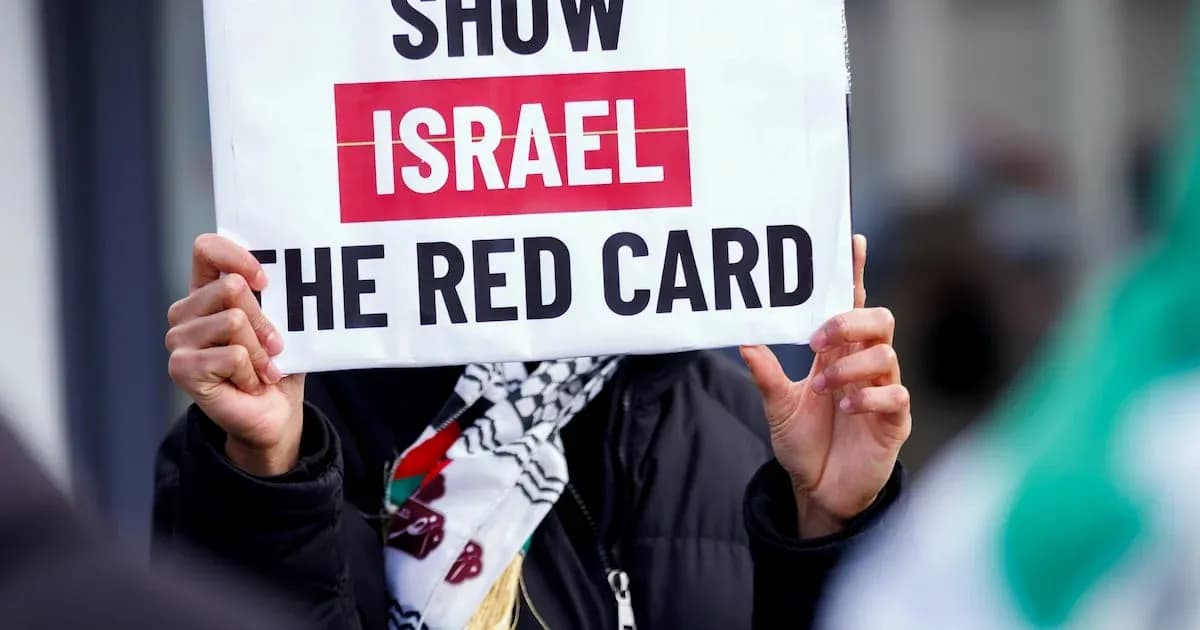
Protesters have marched, written, petitioned, and argued. They have pressed the case that human rights must sit above rankings and revenue. They have not shifted the board. The FAI has held its line. The argument, in procedural terms, is over. The games remain on the calendar.
Government carries its own share of the blame. From the outset of this crisis, it has fallen short of the standard it claims to set on human rights. That failure does not stay in Leinster House. It trickles outward, offering cover to organisations looking for a reason not to take the hardest road. The FAI did not have to search long to find justification.
When Taoiseach Micheál Martin publicly backed the games proceeding, he wrapped his comments in the language of football optimism. He spoke of “rejuvenation,” of a “journey ahead for the Irish team,” and wished them well. It was the kind of easy, upbeat rhetoric usually reserved for tournament qualifiers or a new manager bounce. In this context, it jarred badly, sounding wildly out of step with the gravity of the situation.
Because this is what the choice boils down to. Ireland is now days away from placing points, prize money and competitive momentum above the lives of tens of thousands of civilians, among them more than 25,000 children. That is the trade. That is the ledger.
The players will walk out carrying not only the weight of a shirt, but the burden of a decision that should have been made long before they ever laced a boot. The boardroom has stepped back. The Government has looked away. And principle, in this story, has turned out to be a cheap commodity.