.svg&w=384&q=75 "logo")
Iraola's Message: Liverpool Must Prioritize Team Structure
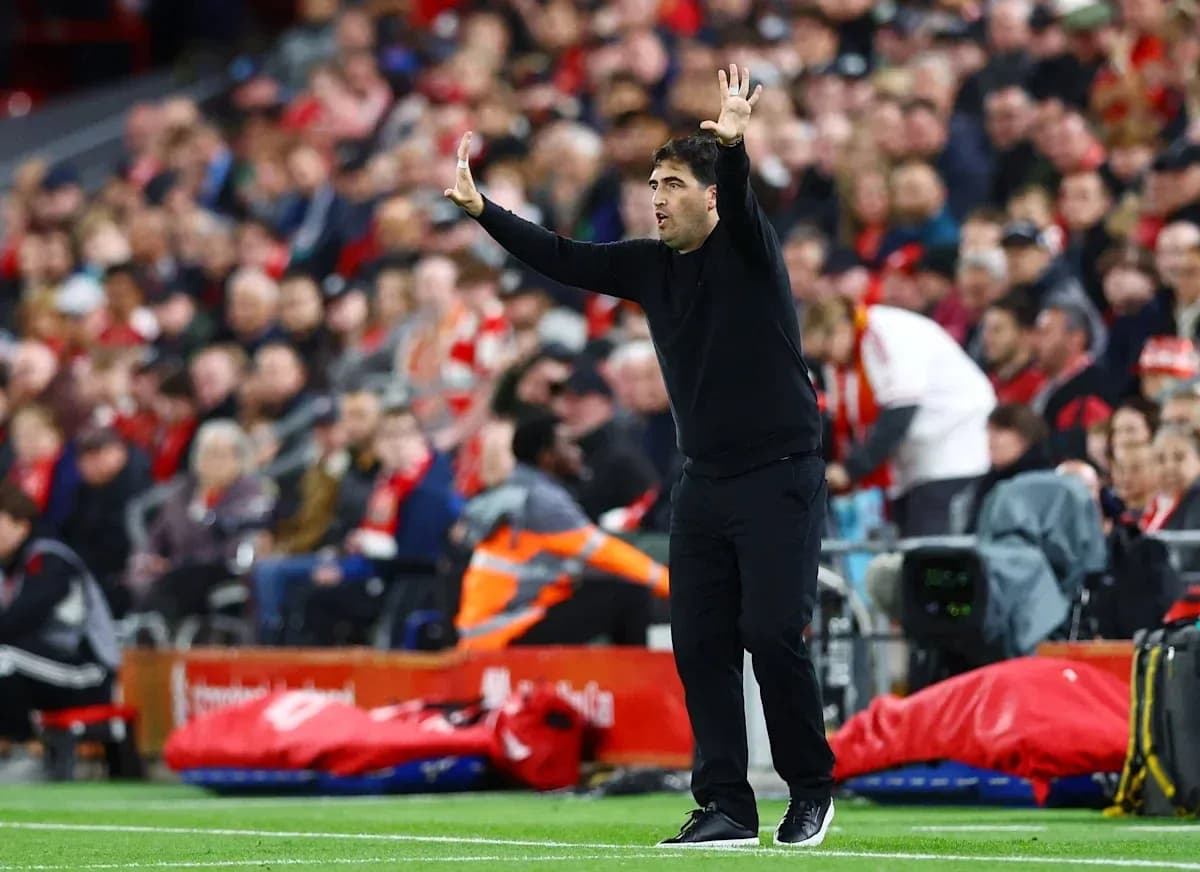
Andoni Iraola has delivered the kind of message that cuts through the noise at Liverpool. No shopping lists. No early January wish-casting. His demand is blunt: make this squad work first.
“I think now is not a moment to look backwards to the market. When the January market opens, we will see where we are,” he said, setting the tone. “We have very good players and a very good squad. We need to find the balance and the right combinations so everyone can look even better than the player he is. If we are not well drilled, the timings are not there, then everyone looks worse. Everyone has to add a little bit.”
That is not a manager flirting with excuses. It is a manager putting the mirror up to his own dressing room.
Structure Before Spending
In an era when the first answer to any dip in form is “sign someone,” Iraola is going the other way. He is shutting the door, at least for now, on the easy narrative that Liverpool’s problems can be solved by a fast-track winter deal.
There is no ambiguity in his stance. If the team looks disjointed, the solution is not a new face; it is a new level of organisation. Managers reach for the market when the structure collapses. Iraola is adamant: structure comes first.
That matters at Liverpool, where the issues that surface in September are rarely fixed by reflex spending. Team shape, spacing between the lines, pressing triggers, combinations in possession – these are the details that decide whether a squad looks elite or ordinary. Get those wrong, and even top players look exposed. Get them right, and the same group suddenly appears transformed.
Balance at the Heart of the Project
The word Iraola keeps circling back to is “balance.” Not just in the abstract, but in the very real sense of how Liverpool’s pieces fit together on the pitch.
He is not questioning the quality in the building. He is questioning how that quality functions as a unit. If the timings are off in the press, if the distances are wrong, if the rotations don’t click, individuals suffer. Players look a yard slower, a touch sloppier, a fraction late.
When the system works, it flatters the individual. When it doesn’t, it exposes him.
This is the hard-line view of a coach who refuses to hide behind recruitment. No talk of “needing help” before he has extracted every last drop from what he already has. No attempt to move the spotlight onto the board or the scouting department. He wants more from the squad, and he wants more within the collective.
Everyone, as he put it, “has to add a little bit.”
January Can Wait
None of this means Liverpool will ignore the winter window. No serious club does. When January opens, they will assess the market, measure their needs, and decide if there is a gap that cannot be bridged on the training pitch.
But Iraola is drawing a clear line in time. The here and now is not about agents and shortlists; it is about drills, repetition, and relationships on the pitch. Fix the patterns. Tighten the distances. Sharpen the understanding. Then, and only then, judge what is missing.
Until that work is done, transfer speculation remains exactly what he wants it to be: background noise.
For Liverpool under Iraola, the next decisive step will not come from a fax machine or a presentation in a boardroom. It will come from the training ground – or it will not come at all.