.svg&w=384&q=75 "logo")
Iraola Faces Early Challenges at Liverpool: Balancing Act with Tottenham Ahead
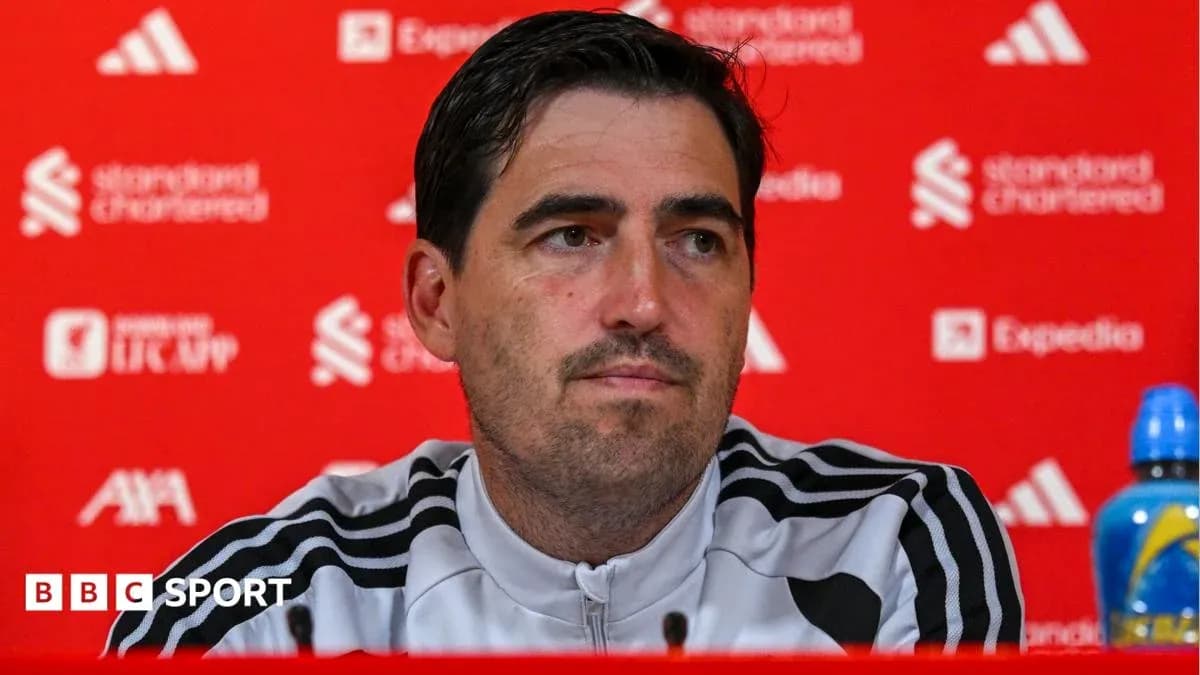
Andoni Iraola is barely a month into his first season at Anfield and already knee‑deep in one of the hardest lessons a Liverpool manager can learn: this club never plays just one game at a time.
The calendar is already biting. Champions League midweek, Premier League at the weekend, Carabao Cup squeezed in between. And the new man on the touchline is discovering, in real time, which of his players can live with that rhythm and which start to creak.
Iraola’s balancing act
Asked whether he can simply go full strength in the Carabao Cup, Iraola didn’t pretend.
“No. You can decide and put the same players in every game. The problem is there'll be a moment when they're really tired. And there is more risk of injury.”
That’s the reality he’s working with. Liverpool host Tottenham in the EFL Cup, not a lower‑league side you can quietly rotate against and hope nobody notices. This is a Premier League opponent, wounded, awkward, and dangerous enough that any gamble on freshness over firepower comes with a price.
Some in the squad, Iraola admits, are “very robust”, capable of playing every three days with barely a dip in level. Others are not. Performances fluctuate, risk spikes, and the manager is still mapping those fault lines.
“I have to learn who is ready to play games every three days and who needs a rest so their performance level isn't affected,” he said. “I thought I had it quite clear in my mind with some, but with others, it's new, even for them, because they haven't played as many games. We are learning.”
That learning curve suddenly feels steeper after a flat, goalless draw with Fulham that left Anfield restless.
Anfield stalls again
Two home league games. Two draws. For only the third time in 63 years, Liverpool have failed to win either of their opening league fixtures at Anfield.
It’s not a meltdown. It is, however, a jolt.
The contrast with midweek was stark. Against Atletico Madrid in the Champions League, Liverpool were sharp, relentless, everything Iraola wants them to be. Against Fulham, a side short on confidence and leaking goals, they looked like strangers to that intensity.
“The Reds looked physically and mentally tired,” came the verdict from the press box, and it felt accurate. The same players who had out‑run and out‑fought a Diego Simeone team that reached last season’s semi‑finals suddenly looked heavy-legged and short of ideas.
Six points from four league games is not catastrophic, but by Liverpool standards it is underwhelming. Four points dropped at home to Nottingham Forest and Fulham, another draw at Newcastle, with the only win coming away at Ipswich. For a team that expects to live in the title conversation, that’s a start that nags.
Big‑money front line, small returns
Against Fulham, Iraola unleashed his £364m attacking trio from the start in a league game for the first time. Alexander Isak, Bradley Barcola and Florian Wirtz – the front line built to terrify defences and define an era.
They never really caught fire.
Liverpool had moments, half‑openings, the odd surge of threat. But nowhere near enough. Isak’s 16 touches in 90 minutes tell their own story: the second fewest ever recorded for a Liverpool outfield player, and the only man below him on that list is Isak himself, with 14 touches against Forest a fortnight earlier.
Wirtz, outstanding against Atletico, looked a shadow of that player. Barcola and Isak flickered, but this is a partnership that clearly needs time, patterns, and perhaps a slightly fresher platform behind it.
The wider issue was energy. With the schedule tightening and at least seven more Champions League games guaranteed, Liverpool cannot afford to look this blunt every time they play twice in a week.
Fulham dig in, Liverpool fade
Alvaro Arbeloa arrived back at Anfield under pressure, three defeats from three in the league and questions already circling. He left with his first Premier League point as Fulham manager and a performance that, with a little more ruthlessness, might have brought more.
Fulham unsettled Liverpool early. A mix‑up between Alisson and Ryan Gravenberch almost handed them the lead, Jeremy Jacquet forced to hack Gonzalo Garcia’s effort off the line after chaos entirely of Liverpool’s own making.
The visitors were the better side in the first half. Josh King tested Alisson from inside the box, Antonee Robinson headed wide, and Liverpool’s response was sporadic: a Victor Munoz header beaten away by Bernd Leno, a Bradley Barcola volley deflected behind by Timothy Castagne.
Kostas Tsimikas, who struggled, made way at half-time for Milos Kerkez. By the hour, Gravenberch and Munoz had also gone, replaced by Alexis Mac Allister and Cody Gakpo as Iraola tried to crank up the tempo and pin Fulham back.
Isak finally wriggled free for a sight of goal but shot too close to Leno. Dominik Szoboszlai thumped in a powerful drive, again beaten away by the Fulham goalkeeper. Changes kept coming – Rio Ngumoha and Jeremie Frimpong introduced with 18 minutes left – but the breakthrough never arrived.
Deep into stoppage time, Isak glanced a header wide from a corner. Fulham, who still carved out late chances through King and Kevin, held on for a point that felt earned rather than stolen.
For Liverpool, it felt like a warning.
Cup pedigree meets present tension
All of this feeds into the Tottenham tie. Under normal circumstances, the League Cup at this stage is a chance to breathe, to blood academy prospects and fringe players under the lights, safe in the knowledge that history at least is on Liverpool’s side.
No club has a richer relationship with this competition. Ten trophies, stretching from the early 1980s to Jurgen Klopp’s farewell season.
The first came in 1980‑81, the start of four consecutive triumphs that underlined Liverpool’s domestic dominance. The fifth arrived in 1995, Steve McManaman scoring twice against Bolton at Wembley. The new millennium brought another surge: the trophy returned in 2001 under Gerard Houllier, then again in 2003 when Liverpool beat Manchester United in the final.
Kenny Dalglish added the next in 2012, edging past Cardiff City on penalties. Then came the long wait until 2022, when Klopp’s Liverpool beat Chelsea in an extraordinary 11‑10 shootout. Two years later, Klopp delivered number 10, again against Chelsea, before walking away with the cabinet full.
That is the weight of expectation Iraola inherits. This club doesn’t treat the League Cup as an afterthought. It treats it as silverware there to be won.
Which brings him back to the dilemma he faces now. Rotate heavily and risk another flat performance, this time against a Premier League opponent in Tottenham? Or lean on his big guns again, asking tired legs to go once more and hoping their “robust” side holds?
Liverpool must find the balance quickly. Because if Iraola really wants to chase honours on all fronts, the question will not be whether he can survive this schedule.
It will be whether he can add League Cup number 11 while living with it.