.svg&w=384&q=75 "logo")
India’s Asian Games Journey: Highlights and Heartbreaks
India’s long day at the Asian Games unfolded like a full tournament in itself – early hope, sharp peaks, and more than a few gut punches.
Lakshya lights up the badminton hall
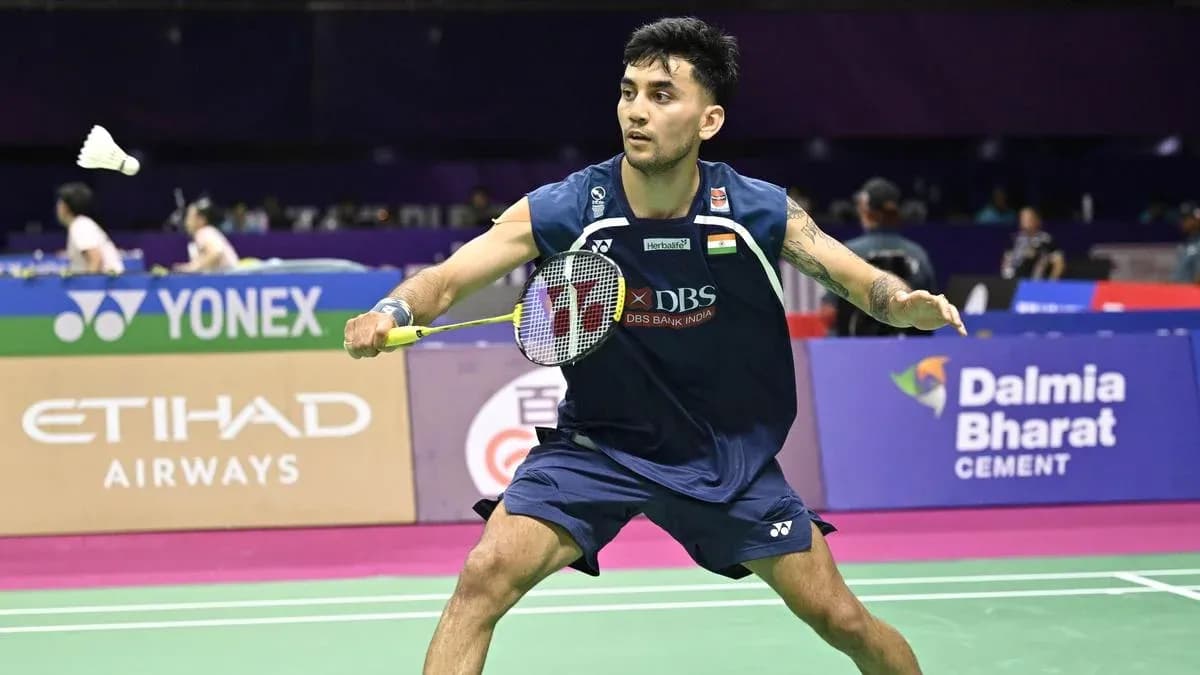
In the men’s team quarterfinal against Japan, Lakshya Sen walked into a pressure cooker and walked out with a statement win.
Up against World No. 7 Kodai Naraoka, he started badly. Very badly. The first game slipped 11-21, the Japanese star dictating tempo and length, Lakshya stuck in defense and searching for rhythm.
Then the switch flipped.
He tore through the second game 21-5, turning rallies into sprints and leaving Naraoka scrambling. The decider became a street fight. Lakshya trailed by five at one stage, the tie seemingly tilting Japan’s way. He refused to let go. Point by point, he clawed back, and at 19-19, the arena tightened. Sen held his nerve, closing it out 21-19 to take the match 2-1 (11-21, 21-5, 21-19) and hand India a 1-0 lead in the tie.
That comeback gives Satwiksairaj Rankireddy and Chirag Shetty a platform in the second rubber against Takuro Hoki and Yugo Kobayashi. India leads. The pressure now sits squarely on the hosts.
Women’s team bow out to ruthless Japan
The women’s team, though, ran into a Japanese wall.
The tie began with a heavyweight clash: P. V. Sindhu vs Akane Yamaguchi. It was gripping, then draining. Sindhu staged a stirring recovery in the opener, rallying from 13-17 down to steal it 23-21, saving game point and then pouncing on her second chance.
Yamaguchi responded like a world-class operator. She edged the second game 21-18 despite another late Sindhu surge from 12-17, then ran away with the decider 21-11. After 72 minutes of high-intensity badminton, Japan led 1-0.
The second singles was a test of nerve for youngster Unnati Hooda. She lost the first game 16-21 to Tomoka Miyazaki but roared to an 11-4 lead in the second, threatening to drag the match into a decider. The momentum slipped. Miyazaki reeled her in, closing it 21-18 to put Japan 2-0 up and India on the brink.
Treesa Jolly and Gayatri Gopichand, World Championships bronze medallists, refused to let the tie die quietly. In a must-win doubles, they overpowered Yuki Fukushima and Mayu Matsumoto 21-17, 21-16, dragging India back to 1-2 and briefly igniting hope of a famous comeback.
Nozomi Okuhara extinguished it.
In the third singles, the former World Champion was all control and precision, beating Tanvi Sharma 21-12, 21-10. Japan sealed the tie 3-1, India’s dream of a first women’s team medal since 2014 ending in the quarterfinals.
Mandhana headlines India’s charge in cricket final
Over at the women’s cricket final, India’s top order produced a statement total against Sri Lanka.
After winning the toss and choosing to bat, the openers set the tone early. By the end of the PowerPlay, India was cruising at 67/0, with Smriti Mandhana on 38* and Shafali Verma on 29*, both taking the attack to the Sri Lankan bowlers.
The aggression never really dipped. Mandhana carved the field apart, top-scoring with 79 off 45 balls. Verma’s 48 off 29 kept the tempo high, and Richa Ghosh’s late burst – 49 off just 22 – turned a strong platform into a formidable total.
India finished on 216/3, its third-highest WT20I score, and a daunting chase now stares at Chamari Athapaththu and her side in this gold-medal clash.
Close calls and heartbreak in shooting
In 10m air rifle mixed team, Parth Mane and Elavenil Valarivan promised a lot early, then ran into the razor-thin margins of elite shooting.
They qualified for the final in style with a total of 634.6, finishing second behind China, which set a Qualification World Record of 638.9. Japan and Vietnam initially rounded out the top four, only for Vietnam to be later disqualified, bringing Japan into the medal round.
The final, though, never quite tilted India’s way. After the first 10-shot series, India sat fourth on 103.6, behind China (107.2), Korea (104.9) and Japan (103.9). The pattern held. At the end of the second series, India remained fourth with 207.9, and even after three series, the gap stayed: India on 312.3, trailing Korea (314.3), Japan (314.9) and China (315.7).
The contest ended with India stuck in that same position. Their total of 376.3 meant a fourth-place finish, just outside the medals. China took gold with a stunning World Record of 507.1, Korea claimed silver with 502.9, and Japan secured bronze on 439.7.
Promise, but no podium.
Kabaddi: champions flex their muscle
In men’s kabaddi, India’s title defence remains firmly on track.
Facing Korea in Group A, the defending champion tore through the contest, winning 63-31 to register a second straight victory. The scoreline underlined the gulf in class and depth, and it keeps India’s campaign moving with the kind of authority expected from a side used to standing on the top step.
Table tennis: women fight through, men bow out
The women’s team produced one of the day’s most dramatic turnarounds.
Against Thailand in the round of 16, India trailed 0-1 after Sreeja Akula lost a five-game thriller to Orawan Paranang. Akula had led 2-0 in games and even held match point at 10-9 in the decider, but Paranang clawed back to win 3-2 (7-11, 1-11, 11-9, 11-6, 12-10).
Yashaswini Ghorpade steadied the ship with a gritty 3-2 win over Suthasini Sawettabut, rallying to take it 11-8, 5-11, 7-11, 11-9, 11-9 and level the tie at 1-1.
Diya Chitale then fell 2-3 (7-11, 11-5, 11-7, 7-11, 11-13) to Jinnipa Sawettabut, pushing India back to 1-2. Again, Ghorpade answered the call. In the fourth singles, she dominated Orawan Paranang 3-0 (11-5, 11-8, 11-9) to drag the tie into a decider.
It came down to Akula once more. This time, she finished the job. A fierce forehand down the line sealed a 3-1 (9-11, 11-6, 12-10, 11-8) victory over Suthasini Sawettabut and a 3-2 win for India. The women marched into the quarterfinals, where North Korea awaits.
The men’s team could not match that escape act. Facing the Republic of Korea in the round of 16, India went down 0-3. Harmeet Desai lost the opener to Jang Woojin 1-3 (11-8, 7-11, 8-11, 9-11). Manush Shah battled into a decider against Oh Junsung but could not close it out. The tie ended when An Jaehyun beat Manav Thakkar 3-1 (12-10, 11-6, 7-11, 12-10), drawing the curtain on a disappointing campaign for the two-time bronze medallist.
Mixed fortunes in fencing
In women’s epee, Taniksha Khatri delivered India’s first knockout win of the day, beating Thailand’s Natpapat Sangngio 15-10 in the round of 32. That set up a daunting round of 16 clash with reigning World Champion Sera Song of Korea. There, her run ended with a 9-15 defeat, closing India’s challenge in that category.
Earlier, Taniksha had finished third in Pool 4, while Mitva Chaudhari’s campaign ended in the round of 32 against China’s Yang Jingwen.
In men’s foil, both Hemash Singh Sanasam and Sachin navigated the pool stage into the round of 32. Hemash had a mixed set of results, including a 5-1 win over Oman’s Saeed Al Shuaibi and a 5-2 victory against Sammuel Tranquilan of the Philippines, but fell 9-15 to Kazakhstan’s Galim Nurumov after leading 6-5 following the first period. Sachin, who opened with a 5-0 win over Pakistan’s Baryal Khan and beat Galim Nurumov 5-3 in the pools, also exited with a 9-15 loss to Kazakhstan’s Timofey Semyonov.
Promise in patches, but no deep run.
Gymnastics and wushu: battling on the fringes
In artistic gymnastics, India’s Pranati Nayak kept herself in the mix on women’s vault. She sits fourth with a total of 12.916, built on a 13.000 first vault and 12.433 on her second. It leaves her just outside the medals, but in touching distance.
In wushu, Hanjabam Langlentombi Devi took on the demanding Nanquan & Nandao all-around. She finished ninth overall with 18.839, placing ninth in Nanquan with 9.403 and then eighth in the Nandao final with 9.436. Solid numbers in a high-quality field, yet shy of the podium.
Equestrian eventing: India adrift after dressage
Eventing opened with the dressage phase, and India’s riders found themselves playing catch-up.
Fouaad Mirza, a double Asian Games silver medallist, posted 38.70 on Camouflage 38, earning a 61.33 percentile and 26th place. Arjan Singh Nagra, on Cooley Goodwood, edged him with 38.20 and a 61.80 percentile, finishing 23rd.
India’s best mark came from Ashish Limaye, astride Willy be Dun, the same gelding he rode at the Hangzhou Games. Limaye’s 35.50 translated to a 64.47 percentile and 14th place in the 32-rider field. Only three riders breached the 70-percentile mark, with China’s Tian Hua and his Irish Sport Horse Manjushri leading the standings, followed by Thailand’s Korntawat Samran and Japan’s Toshiyuki.
On the team front, India’s cumulative score of 112.40 left it seventh out of eight nations, well off Japan’s leading 91.60. With cross-country and show jumping still to come, the mountain is steep.
Swimming: relay team books a lane in the final
In the pool, the men’s 4x100m medley relay team did what was required.
Rishabh Das, Danush Suresh, Benedicton Rohit and Akash Mani clocked 3:40.41 in the heats, finishing seventh among 16 teams and securing a spot in the final. No fireworks yet, but a chance now to race for something bigger.
Soft tennis: bright starts, brutal exits
Soft tennis offered both lift and letdown.
In the men’s singles Group C, Aryan Thakur began with a dominant 4-0 win over Mongolia’s Bold-erdene Altangerel. That put him in a strong position, but his second outing against Chinese Taipei’s Chen Po-Yi turned the group on its head. Thakur lost 0-4 (1-4, 2-4, 2-4, 1-4), a result that ensured India would finish second in the group and miss out on the final-eight stage.
In the women’s draw, Aadhya Tiwari’s Group D campaign started with a 1-4 loss to Thailand’s Alisha Ziegler despite taking the opening game. She responded well later, beating Pakistan’s Kainaat Shallwani 4-0 (4-2, 5-3, 4-1, 5-3) to register her first win of the event.
Jay Meena, cousin of national pole vault record holder Dev Meena, cruised through his sole men’s group-stage match, beating Pakistan’s Hussain Arain 4-0 (4-2, 4-0, 4-2, 4-0) to reach the knockouts.
Combat sports: karate so close, yet so far
Karate brought India to the edge of history, then pushed it away.
In men’s kumite -84kg, Chetan Bhatt started directly in the semifinals, knowing a win would guarantee India’s first-ever karate medal at the Asian Games. He ran into Jordan’s Mohammad Alja’Fari and lost 0-8, dropping into the bronze medal bout.
There, against Chung Meng-yu of Chinese Taipei, Bhatt fought to a 1-1 draw, both scoring one yuko. The medal went to Chung on the first-point rule, a brutal way to lose a bronze.
In women’s kumite -55kg, Alisha Choudhary fell 1-6 to Indonesia’s Cok Istri Agung Sanistyarani in the round of 16. Her only hope of a repechage route to bronze depended on the Indonesian reaching the final. When Sanistyarani lost in the semifinals, that door shut too. No second chance, no medal bout.
Esports and sepaktakraw: learning curves
On the virtual pitch in eFootball, India’s Chinmay Sahoo and Danial Patel opened their Group D campaign with a 0-0 draw against Uzbekistan’s Abubakir Iminjonov and Farrukh Mirkhamitov. A solid, if unspectacular, start.
In sepaktakraw, the men’s regu team endured a rough day against Malaysia, one of the favourites. India lost the first of three matches 1-2 (13-15, 15-11, 6-15), then saw Malaysia clinch the second 2-0 (15-9, 15-12) and the third 2-0 (15-11, 15-5) to complete a 3-0 sweep. India now turns to its final Group B match against the Philippines.
A day of thin margins and stubborn belief
From Lakshya Sen’s fearless comeback to the women’s table tennis team’s nerve in a fifth rubber, India showed plenty of fight. From the shooting range to the karate mat, it also felt the sting of finishing just outside the medals.
The schedule doesn’t slow down. Finals loom, knockouts await, and some campaigns are already hanging by a thread. The question now is simple: who turns these near-misses into podium finishes before the Games are done?