.svg&w=384&q=75 "logo")
Harpreet Brar: The Spinner's Journey with Punjab Kings
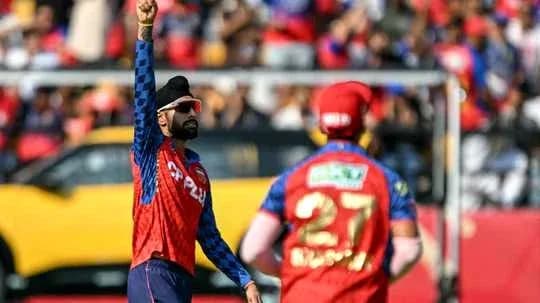
Harpreet Brar has lived through just about every version of Punjab Kings.
He has seen a name change, seven captains, tactical U‑turns every season, and the same old hunt for a first IPL title. Through all of that noise, one thing has barely moved: a tall left-arm spinner from Moga who keeps turning up, keeps landing it on a length, and keeps taking wickets whenever he’s actually allowed on the park.
Seven seasons on the books. Only two of them as a regular in the XI. And still, since his debut in 2019, no Punjab Kings spinner has taken more IPL wickets than Harpreet Brar.
The night that changed everything
For most fans, his career has a single, blazing snapshot.
RCB. A young, unfussy left-armer. Virat Kohli, then Glenn Maxwell, then AB de Villiers. Three giants, gone in a blur. Two in two balls, three in four deliveries. It was the kind of spell that usually launches careers into a different stratosphere.
Even now, the memory follows him everywhere. He laughs that it came up “ten minutes ago” in another interview. Maxwell has fallen to him three more times in the IPL, Kohli once again. The victims’ list is a roll call of the league’s elite – Rohit Sharma, Yashasvi Jaiswal, a long tail of established and emerging names.
Yet for Brar, one name still sits apart.
“After Virat paaji, there’s no batsman whose aura is such that their wicket can be remembered,” he tells Cricbuzz. Then comes the itch. He still hasn’t dismissed Shubman Gill in the IPL. Abhishek Sharma, Vaibhav Sooryavanshi, Jaiswal – he’s ticked off most of his generation. Gill remains the missing line on the CV.
“I would definitely like to take Gill’s wicket in my career,” he says. “But for the last 3-4 years, whenever there’s a match against him, I am not playing.”
That last sentence explains his story better than any highlight reel.
A constant benched in a league of flux
In the last two seasons, Brar has spent more time in a bib than in a match jersey. In IPL 2026, he appeared just twice – once in April, once in May.
The numbers hardly screamed bench material. Against Rajasthan Royals, on a batting strip where 222 played 228, he went 0 for 25 in four overs. In another high-scoring game against RCB, he took 2 for 35, removing Jacob Bethell and Devdutt Padikkal in a chase where only four wickets fell.
In a season dominated by batters and flat pitches, those are the kind of spells that usually buy a bowler a longer run. For Brar, they bought nothing.
The reason sits in the fine print of modern T20: the Impact Player rule.
In the old template, Brar was exactly what coaches craved – a frontline spinner who could bat at No. 7, offer stability, and stretch the batting. Once the Impact Player came in, that value shrank. His batting role all but vanished, and his place in the XI turned into a matchup call. On flat decks, teams leaned towards another batter or a quick. The all-rounder became, in effect, a specialist bowler who might or might not play.
Ask him what he’s been working on with the bat and he cuts in quickly.
“Sir, main na sirf kaam hi kar sakta hu (I can only work on things),” he says. Cricket, as he sees it, has moved in a direction that pushes him down the order. If he plays, only Arshdeep Singh and Yuzvendra Chahal follow him, with Marco Jansen and, when picked, Azmatullah Omarzai batting ahead.
The arithmetic is brutal.
“If our batting comes first, I will not be in the team,” he explains. “If bowling comes, I will be in the team. If the total is more, the pacer plays. This is how it is.”
At odds with the Impact era
His wish is simple: scrap the Impact Player rule.
The debate has already reached boardrooms. Before the 2026 season, captains discussed it in a formal meeting. Several senior players have spoken publicly against it. Franchises will be asked for feedback, but for now the indications are clear – the rule is likely to stay for at least one more year.
“Personally, Impact Player is not good for me because I want to play all games,” Brar says. “Every player wants to play more. So yeah, I have been working on my batting – I have been doing that for eight years. But I am not getting enough chances.”
His frustration is not just personal. Punjab’s use of spin this season bordered on neglect. They bowled the lowest percentage of spin overs in the league – just 18.7% – and took the fewest wickets with spin, 14. It matched their joint-lowest tally for a season.
The irony bites harder when you rewind to their best years. In 2014 and 2025, the two seasons they reached the final, spin delivered their highest share of wickets: 33% and 32%. When Punjab have gone deep, their spinners have gone with them.
This time, beyond Chahal, the spin cupboard barely opened.
A bowler without a game
Brar’s reputation doesn’t end with the IPL. Since 2023, no spinner has taken more wickets than him in the Syed Mushtaq Ali Trophy. He has also stepped out of the white-ball-only box, playing his first Ranji Trophy season last year.
Yet the lack of IPL time has had a ripple effect. He has not played any professional cricket since May.
Last month, Punjab Kings pulled him into an off-season camp with five other players. It was a rare luxury: one-on-one time with strength and conditioning staff, long sessions with assistant coaches, a chance to drill into the details of his craft.
“I worked on plenty of things in detail,” he says. “How can I get better… how can I bowl better?”
The emotional side is harder to train. Doing well, then suddenly finding your name missing from the next XI, leaves a mark.
“Dukh lagta hai (it hurts),” he admits. The line is followed by the cricketer’s code. The team comes first. That is the motto. The demands of the side dictate selection, and you fall in line.
“But it doesn't mean that if I am not playing, I’ll just sit and feel low.”
Conversations with the bosses
In a franchise that has churned through leaders, Brar has learned to lean on the constants he does have: Shreyas Iyer and Ricky Ponting.
“They are very similar kinds of people. And they are very practical people,” he says. If a question nags him, he walks up and asks. They answer. Clearly, directly.
He likes catching them alone, away from the noise. Those are the moments when stories come out – how they dealt with being dropped, with form, with selection puzzles. He is comfortable enough now to ask the hard question: why am I not playing, and what must I do to change that?
The answers don’t guarantee selection. They do give him a roadmap.
Chasing cricket across continents
The hunger for game time has pushed Brar beyond domestic schedules and IPL calendars.
His wife works as a doctor in the United Kingdom, so the couple often head there once the IPL ends. For most players, that period is a break. For Brar, it is also a scouting trip.
This year, he turned those weeks into a mini-season, playing club cricket across weekends. The logic is simple: if there’s a ball to be bowled and a bat to be faced, he wants to be involved.
“Even when you go for some free time after the IPL, say for a vacation,” he says, the default instinct is the same. Find a game. Stay in touch with the ball. Keep the body and mind in cricket mode.
“Even if matches are on the weekend, I want to play and stay associated with the game whenever I have free time.”
Last year, that mindset took him closer to the India Test team than he has ever been.
During England’s tour, Brar was in Birmingham when the national side trained there. He spotted an opening and messaged Shubman Gill, now India’s captain, asking if he could join the session.
“He said, ‘Yes, you can come,’” Brar recalls. It turned out to be an optional practice. Gill himself didn’t turn up, but Brar did, bowling and training with the rest of the squad.
He loved it. The environment, the standards, the familiar faces in a foreign city. “It’s always great to meet your own people on foreign soil,” he says.
A red-ball pivot
For now, the road runs back through home.
Brar is in Punjab’s state T20 league, back with the white ball, applying the tricks that made him such a handful in the shortest format. The bigger test, though, waits later in the year: his second Ranji Trophy season.
In an era where the Impact Player rule can marginalise a specialist T20 spinner, red-ball cricket offers something he badly needs – control over his own narrative.
His first Ranji campaign, in 2025-26, was a statement. Twenty-three wickets at 21.26, the most for Punjab. He added more big names to his personal scrapbook. KL Rahul, in particular, will remember the delivery that tore past his defence and crashed into middle stump – a classic left-armer’s ball, angled in and straightening just enough.
Performances like that have shifted Brar’s ambitions.
“Personally, I feel I can play Test cricket for India,” he says. “And for that, I am willing to put in all the hard work needed and will even exceed that in the future.”
So the spinner who can’t get a full IPL season now chases something far bigger and far rarer. In a league shaped by substitutions and short-term tactics, Harpreet Brar is betting on the oldest format in the game to give his career the permanence the IPL has never quite allowed.