.svg&w=384&q=75 "logo")
FAI's John Martin: Criticism Should Be Aimed at Board, Not Players
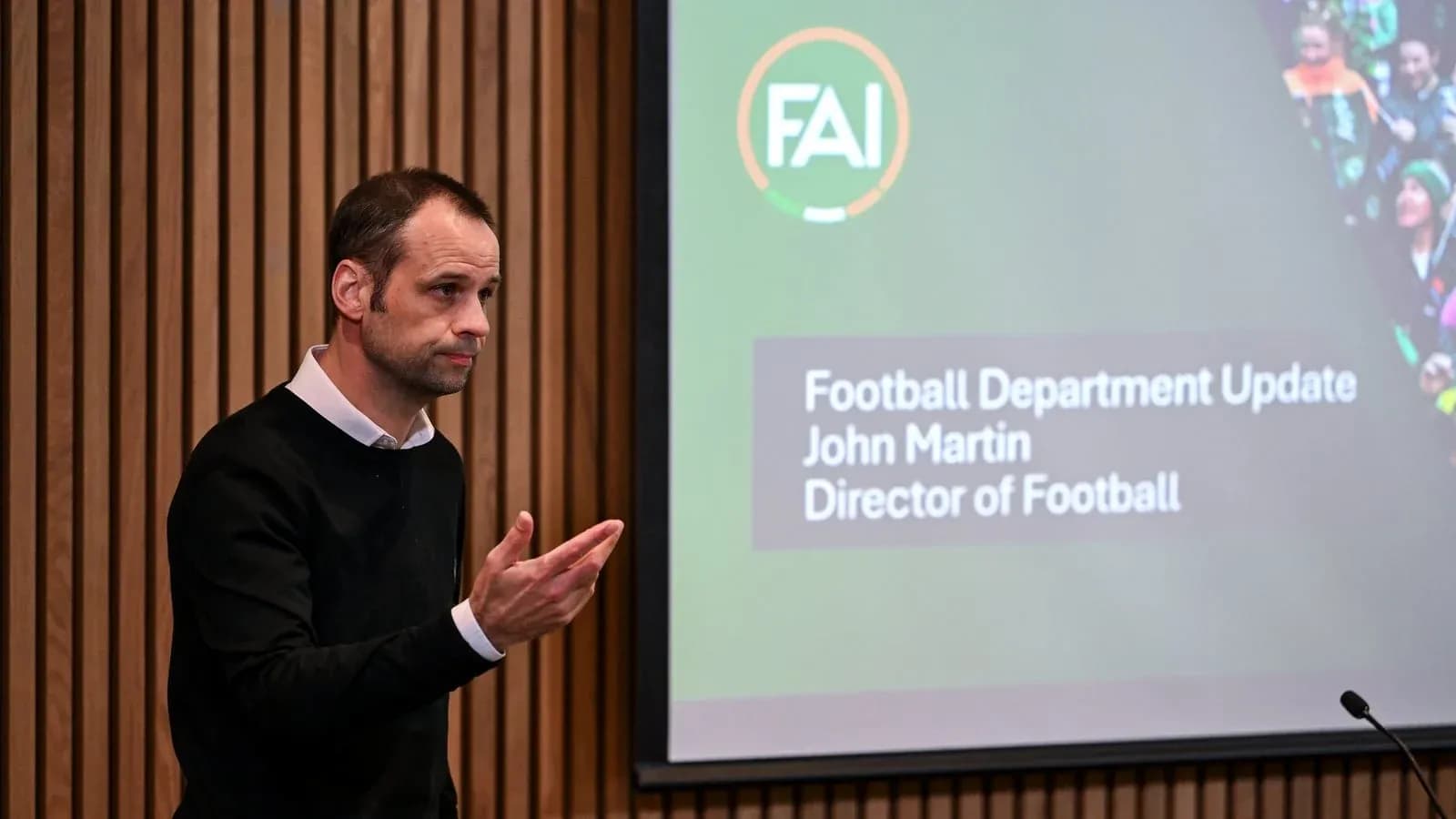
The Republic of Ireland’s autumn dates with Israel are still on the calendar. John Martin sounds like a man who wishes they weren’t.
The FAI Director of Football has again made it clear he would rather the Nations League double header did not go ahead, but insists Irish football cannot afford the cost of defiance. And he is adamant about one thing: the players must not be turned into the lightning rod.
Games nobody wants, but games that will be played
Heimir Hallgrimsson’s side are due to face Israel in Debrecen, Hungary, on 27 September, with the ‘home’ leg set for Backa Topola in Serbia on 4 October. Both games will be played away from Ireland. One will be behind closed doors from an Irish perspective, the other without any Irish supporters at all.
In July, FAI delegates were asked to back the board’s decision to fulfil the fixtures. They did so by 68% to 32% at an extraordinary general meeting, a clear majority but not an overwhelming one, and the debate has rumbled on since.
Last month, the association confirmed that no tickets would be sold to Ireland fans. The September match in Debrecen will have only Israeli supporters present; the October ‘home’ game will be played in an empty stadium, at least as far as Irish fans are concerned.
Against that backdrop, calls for a boycott have grown louder, targeting both the FAI and the players. Martin, speaking to RTÉ Sport, moved quickly to pull the squad out of the firing line.
“It’s really hard on the players because I think someone said, ‘oh, it’s falling on the players’. It always falls on the players in a performance environment,” he said.
“In this situation, the decision shouldn’t fall on the players because it’s not at the player’s decision. It was a decision made by the association, by the board and by the executive.
“People like me and David Courell made this decision, not the players.
“We need to protect the players and look after the players because we shouldn’t find a situation where they’re being criticised. People can criticise me and David, that’s fine, and people are getting heavily criticised over it. It’s a deeply uncomfortable situation for us to be.”
The discomfort is obvious. So is the calculation.
Playing on for Irish football
Martin did not pretend there is any enthusiasm within Abbottstown for these fixtures. But he believes the consequences of not playing could be severe, and not just for this campaign.
“We all agree, and the association has been on the record to say that we don’t want to be playing these games. That is the reality. I don’t want to play the games, but for that to impact Irish football, that’s where I would maybe disagree with some of the voices, say we shouldn’t play the game.
“I agree with a vast majority of what people are saying about the situation. The aspect of not playing the game is where we have a difference of opinion.
“I think it’s for Irish football we will play the game.”
The fear is clear: UEFA sanctions, potential financial penalties, maybe even sporting repercussions that could damage the national team and the wider game for years.
A personal choice for players
Inside the dressing room, another layer of complexity. Players will be allowed to decide for themselves whether they wish to be involved in the two fixtures, and Martin stressed that the FAI will back them whatever they choose.
“It’s a personal choice for the player,” he said. “We have a fantastic manager in person in Heimir who will manage that. But at all stages, we need to mind the player, but you always need to mind the player.
“You should never forget the player. We’re always mindful of the environment the player is in and we need to protect them as best as possible.
“It’s going to be really difficult because it does fall on them naturally because they’re on the pitch.
“But I would hope people can see that they’re following the lead of the association and following the decision that the association took, as opposed to putting them at the centre.”
The message is blunt: if there is anger, direct it at the boardroom, not the dressing room.
Separate storm: Shamrock Rovers investigation
While the Nations League row swirls around the national side, Martin’s past life at club level has also come under scrutiny.
The Sunday Times reported that the FAI is investigating alleged third‑party ownership breaches involving Shamrock Rovers players Michael Noonan and Alex Noonan. The agreements in question date back to Martin’s time as Rovers CEO.
Now, as an FAI executive, he finds himself working for the body that is examining those deals. He is not part of the investigative team and says there has been no move to ask him to step aside while the process runs its course.
The investigation will determine whether any FIFA rules were broken.
Earlier this year it emerged that Michael Noonan’s mother had lodged a complaint with the English FA concerning agent agreements. Shamrock Rovers then announced they were working with FIFA to review two agreements and stressed that the club itself was not the focus of the probe.
The case has since been referred back to the FAI, which is seeking documentation to establish the facts.
Martin has consistently defended his record at Tallaght Stadium and did so again.
“I’m very comfortable about my time from Shamrock Rovers, exceptionally comfortable,” he said. “I can’t comment. I’ll leave that to other people to figure that out. It’s not something I’m worried about.”
On whether he had been asked to stand down temporarily, his answer was unequivocal.
“Absolutely not. It is frustrating because there’s things that I’d like to be able to go into more detail on.
“I’ve been incredibly dignified, professional and respectful of the club. I intend to continue being dignified, professional and respectful towards the law because I think someone in my role needs that.
“I don’t think Irish football needs people to be talking public negatively about each other because that damages the perception of the game. I’m a naturally positive person. I’ve only good things to say about the club. It’s a situation I can’t talk about. But I’m in no way worried about it.”
So Martin stands in the middle of two separate flashpoints: a politically charged international fixture list and a regulatory probe tied to his old job. He insists he is comfortable with his past and resigned to the present.
The next move, though, will belong to the players who must decide whether to step onto the pitch in Debrecen and Backa Topola — and to a football public that must decide how, and whom, to hold to account.