.svg&w=384&q=75 "logo")
England's Record Chase in ODI Series Opener
England’s new era did not creep into life. It kicked the door down.
At the Uptonsteel County Ground, with three senior batters missing and a new top order under scrutiny, England made a record chase of 282 look almost routine, hammering Ireland by six wickets with 11.5 overs to spare to go 1-0 up in the ODI series.
Bouchier seizes her moment
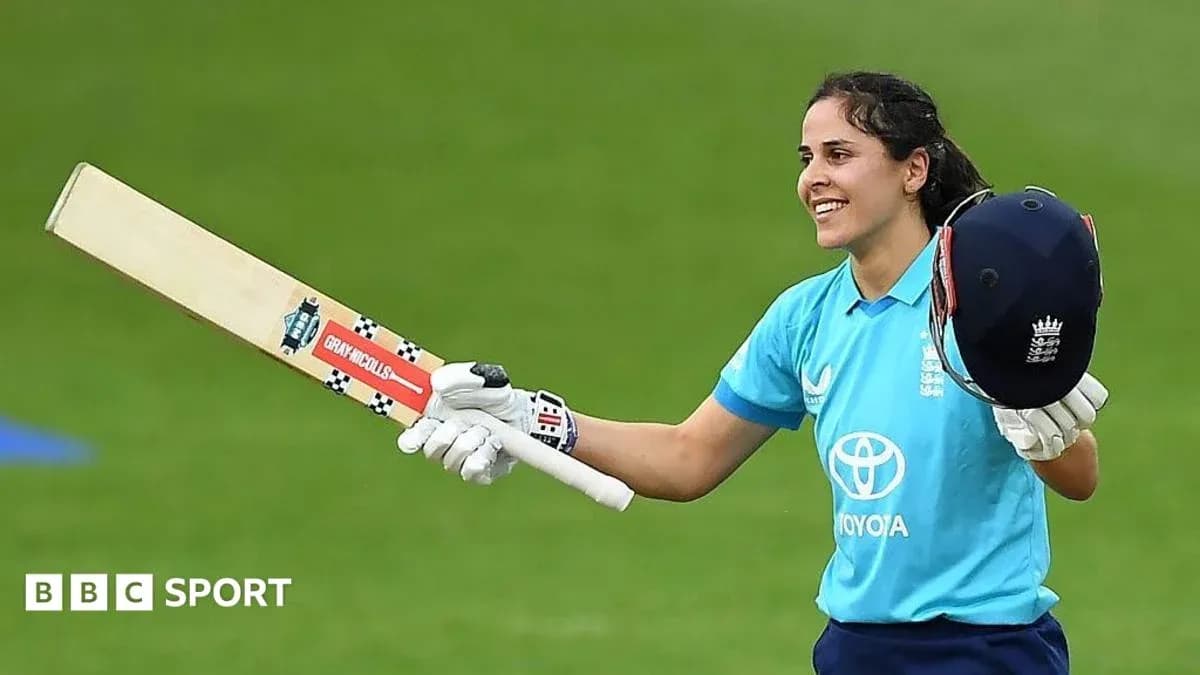
Maia Bouchier has waited a long time for a day like this in 50-over cricket. Often on the fringes, often the one rotated out, she walked out in Leicester knowing there were vacancies at the top of the order and that this was the kind of surface where reputations are made, not protected.
She began quietly. Eight from 19 balls, feeling her way, content to let Sophia Dunkley take the lead. Then came the sixth over from Jane Maguire and with it the switch. A cluster of crisp boundaries, timing suddenly in sync, and England’s chase was moving.
From there, Bouchier never really loosened her grip on the innings. Her 104 from 95 balls was a statement, not a cameo: 11 fours, control from the front, and a calm authority that has not always been visible in her stop-start international career. When she finally holed out to long-on with just 59 needed, she walked off looking annoyed rather than satisfied. That in itself said plenty about the standards she was chasing.
Dunkley turns the screw
At the other end, Dunkley played like someone fully aware that top-order spots are being contested and she has no intention of giving hers away.
She was brutal on anything loose, particularly in the powerplay, where Ireland’s bowlers repeatedly missed their lengths on a flat pitch offering no help. Her fifty came from just 47 balls, the fastest of her ODI career, and by the time she miscued a caught-and-bowled chance back to Cara Murray for 73 from 61, England were 143 without loss and the game was already tilting decisively one way.
The pair’s opening stand of 143 dismantled any notion that Ireland’s 281-5 would stretch this reshaped England side. On a day when the hosts were missing Heather Knight and Tammy Beaumont to retirement and Nat Sciver-Brunt to injury, the message from the new-look top order was clear: the safety net has gone, but the ambition has not.
Ireland’s promise with the bat, problems in the field
For all the one-sided feel of the chase, Ireland’s batters had done plenty right earlier.
Gaby Lewis and Amy Hunter were excellent in a second-wicket stand of 136, Lewis crafting 69 from 89 balls and Hunter 62 from 90. They were measured, patient when they needed to be, and quick to punish anything short or wide. On a surface this true, 281-5 looked, at the break, like a total that would ask serious questions of an England side in transition.
Rebecca Stokell then injected late urgency, her unbeaten 54 from 48 balls a sharp, counter-attacking innings that dragged Ireland beyond par on many grounds. England’s attack, missing Lauren Bell and Sophie Ecclestone, struggled for incision in the middle overs. The lack of threat was obvious as Ireland’s innings drifted into a position of strength.
But the tone changed completely once the fielding innings began. Misfields crept in, catches went down, and the lines with the ball wavered. On a flat pitch, against batters this aggressive, that combination proved fatal. Only Orla Prendergast consistently offered the kind of pace and skill that resembles the world’s top operators; around her, Ireland’s attack frayed under pressure.
New faces, same intent
Once Dunkley departed and Jodi Grewcock’s nervy nine came and went, the chase entered its final phase. If Ireland hoped that Bouchier’s dismissal on 104 might open a door, Alice Capsey and Freya Kemp slammed it shut.
Capsey, all angles and intent, finished 41 not out, punching gaps and driving England towards the line. Kemp, just 19 and already hitting the ball as hard as anyone in the side, hammered 36 from 22 balls. Their 54-run stand from 38 deliveries underlined the depth Charlotte Edwards is quietly assembling.
This was not England leaning on old hands to bail them out. Five batters from last year’s World Cup semi-final XI were missing, and yet the tempo never dropped. The winning boundary from Capsey felt less like a scramble over the line and more like the closing note of a performance that had been under control for most of the evening.
Edwards’ blueprint takes shape
For Edwards, this series is about more than a 1-0 lead. It is about building an order that can survive the loss of Knight and Beaumont, absorb the temporary absence of Sciver-Brunt, and still threaten to overwhelm opponents on flat decks and tricky ones alike ahead of next summer’s Ashes.
Dunkley and Bouchier have both had chances before. Neither has truly nailed down an ODI spot. On this evidence, both intend to. They will face sterner bowling than this, and they know it. But in a game where the pressure of opportunity can weigh as heavily as the opposition, they responded with clarity and aggression.
Ireland, for their part, showed with the bat that they can construct competitive totals against a major nation. They also saw, in stark terms, the gulf that still exists when it comes to depth, discipline and composure under a hard chase.
The series moves to Derby on Thursday. England’s new order has set its standard. The real question now is who can keep pace with it.