.svg&w=384&q=75 "logo")
Dan Lawrence's Crucial Moment in England's Middle Order
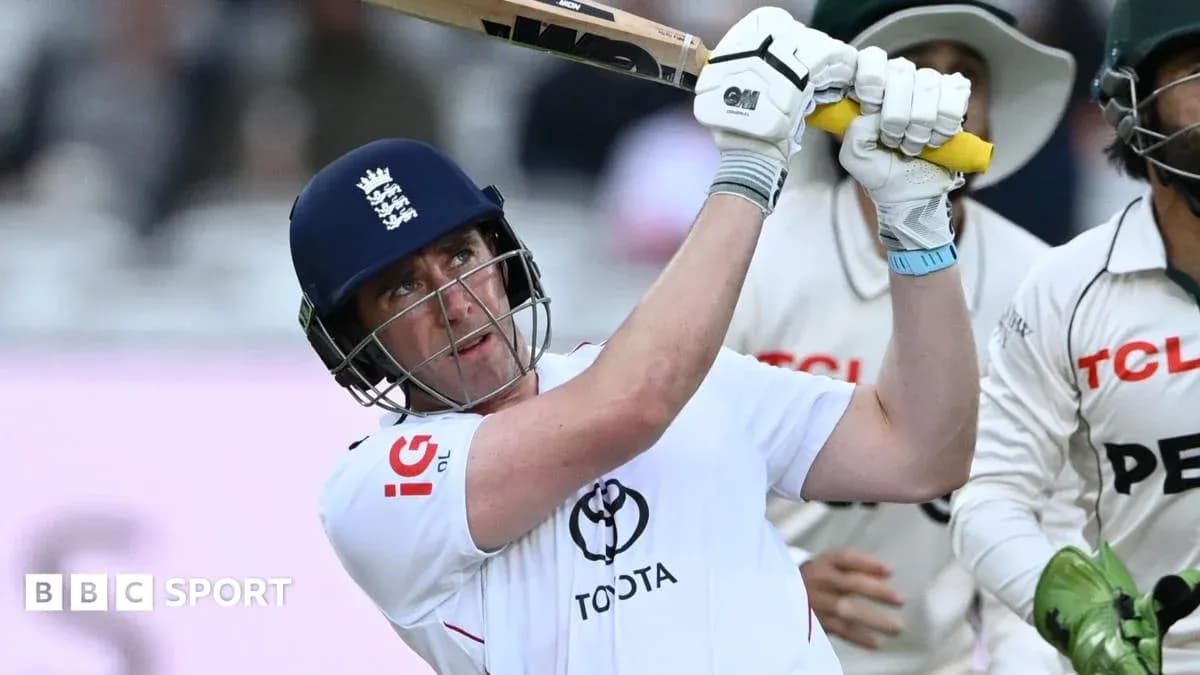
Dan Lawrence has waited a long time for a moment like this. Two years out of the England side, a career average under 27, a reputation as a talented nearly-man. Then, with Ben Stokes retired from Test cricket and a hole yawning in the middle order, England took a gamble.
Right now, it looks a smart one.
Lawrence seizes his chance
Thrown into the Stokes-shaped vacancy as a batting all-rounder who only occasionally turns his arm over, Lawrence was hardly the obvious choice. He arrived in this series with scars: 14 caps, a stint as an emergency opener, and no hundred to his name, his best still the 91 that has lingered like an unfinished sentence.
At Headingley he began to change the story with a measured 51 in the first Test. On day three of the second Test against Pakistan, he gave it real substance.
Walking in at 83-4 in England’s second innings, with the ball jagging, the pitch misbehaving and the game teetering, Lawrence did not bunker down. He counter-punched. He carved 50 not out from 66 balls, six fours and two sixes in an innings that felt less like survival and more like a statement. By the time rain dragged the players off at 177-7, it was his knock that had dragged England there.
Michael Vaughan, watching on for BBC Test Match Special, did not need persuading.
“I think it is a really good selection,” the former captain said. “He will have a period in the England side that we will enjoy watching him bat. I think in time his off-spin will come in very handy indeed.”
A quirky technique, a clearer mind
Lawrence, 29 now, looks a different player from the one England shuffled up and down the order earlier in his career. The technique is still idiosyncratic – that slightly restless set-up, the busy hands – but the decision-making has sharpened. He attacked when others might have frozen, yet never lost control of the situation.
“He seems to read the game,” Vaughan said. “It was the right way to play at that moment. He has a quirky technique that has worked for him and is very confident. He knows his scoring areas. He is clearly a better player than when he played for England last time.”
England’s selectors have backed that evolution. By choosing Lawrence over a frontline spinner, they loaded the side with four quicks and trusted him to offer part-time off-spin if required. So far in this series, with seamers dominating, he has bowled just one over. The message is clear: his primary job is runs.
Lawrence understands the stakes. He has been here before and drifted out of the picture.
“It's pointless looking to the future because it hasn't happened yet,” he said. “I'm just trying to contribute every Test I can and give a good showing of myself. Thankfully, so far, I think I have done.”
The honesty runs deeper.
“Obviously thoughts creep into your head and I'm desperate, along with all the other boys, to establish myself in an England shirt, which is something I haven't quite done in my career so far. It's just about trying to take every opportunity you get and really enjoy the occasion instead of feeling nervous about the occasion. Just have fun, play the cricket that's got me here this summer.”
Selection squeeze on the horizon
For now, England’s balance feels made for home conditions. Ollie Robinson, Jofra Archer, Gus Atkinson and Josh Tongue have formed a pace quartet strong enough to make a specialist spinner feel like a luxury, not a necessity. The same template could carry into South Africa and Australia this winter, where seam is king and a part-time spinner is often enough.
The equation changes in Bangladesh in the new year, where the ball grips, pitches tire quickly and genuine spin options become non-negotiable. That tour will almost certainly test the durability of this experiment.
Even before then, decisions loom.
Jacob Bethell, sidelined from this series by a knee injury, hovers over the selection debate. Like Lawrence, he is a batter who can bowl spin. When he returns, he could go straight back into Lawrence’s slot, or reclaim his position from Jordan Cox, who has quietly built a compelling case of his own with two fifties at number three.
There are other permutations. Cox, who opened earlier in his county career, or Bethell, England’s current 50-over opener, could be pushed to the top in place of Emilio Gay. That would free up a middle-order berth and trigger another call: does Cox stay as a specialist batter, or drop down to take the gloves from Jamie Smith?
Smith has not gone quietly. His 61 in the first innings of this Test was composed and timely, and his work behind the stumps has tightened after a difficult Ashes. He has forced his name into the long-term conversation rather than slipped through it.
All of which makes Lawrence’s response under pressure even more significant. When a dressing room is this competitive, innings like his 50* on a treacherous third day do more than prop up a scorecard. They change how selectors think.
A place worth fighting for
Lawrence knows that no one is clearing the path for him. Bethell is coming back. Cox is scoring runs. Smith is improving. The pace bowlers are making life easy for a team without a frontline spinner.
Yet on a grim, rain-affected day at a vulnerable 83-4, it was Lawrence who walked out and batted like a man determined not to be the expendable one this time.
If this is the start of the “period in the England side” Vaughan predicts, it will not be remembered for the elegance of the numbers, but for the way Lawrence chose to fight for them.