.svg&w=384&q=75 "logo")
Celtic's Tactical Dilemma After Derby Defeat
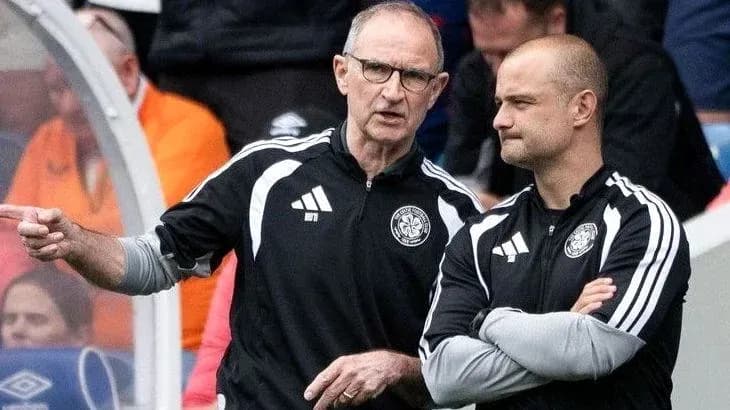
Martin O'Neill will walk into Celtic Park on Thursday night knowing the questions are already waiting for him.
A 3-0 derby defeat to Rangers in a League Cup quarter-final would always sting. Losing it with a team selection that raised eyebrows inside and outside the dressing room guarantees the scrutiny will be sharper still.
For former Celtic striker Cillian Sheridan, too many players simply vanished at Ibrox.
Speaking on the BBC's Scottish Football Podcast, Sheridan did not dance around it. "I can imagine personnel changing [on Thursday] because I think there were too many players that didn't show up against Rangers," he said. In a fixture where careers are often defined, Celtic had passengers.
One decision in particular jarred with him. Sebastian Tounekti from the start, Haissem Hassan on the bench.
Sheridan admitted he was stunned to see the winger preferred to the summer signing, who only appeared as a half-time substitute with Celtic already chasing the game and the tie slipping away. The ex-forward felt the occasion, the stakes, even the tactical picture, all pointed in one direction.
"I was surprised that Tounekti started," he said. "I thought the game was built for Hassan and to see the front three of Hassan, Kasper Hogh and Camilo Duran."
That imagined front three never materialised. Instead, Celtic laboured through a first half that allowed Rangers to seize control, and the change Sheridan expected arrived right on cue.
"If there were worries over Hassan's fitness, you start him and give him 60 minutes," Sheridan argued. "I just knew as soon as the team was announced that that half-time change was coming."
The pressure finally told on O'Neill’s selection sheet. Tounekti off, Hassan on, but by then the damage felt close to irreparable in a cup tie of this magnitude, in that stadium, against that opponent.
Now the Celtic manager must absorb the blow and reset with little time to breathe. Ferencvaros visit Glasgow on Thursday in the Europa League opener, a game that suddenly carries more edge than a routine group-stage curtain-raiser usually would. Three days later comes the rematch with Rangers in the Scottish Premiership, a chance for revenge or a risk of the narrative darkening further.
Sheridan is convinced change is coming.
He expects O'Neill to react, not just tactically but in terms of who he trusts when the pressure tightens. That may mean Hassan from the start, a reshaped forward line, and a different tone from the first whistle.
"O'Neill will maybe take a little bit of criticism, probably for his selections and one or two subs he made," Sheridan said. At Celtic, "a little bit of criticism" can feel like a storm.
The former striker knows the landscape in Glasgow. One bad result rarely stays as just one bad result in the conversation around Celtic and Rangers. It snowballs, it fills phone-ins and back pages, it becomes a story about something bigger.
"At clubs like Celtic and Rangers," Sheridan added, "as soon as one bad result comes, it's magnified and the season's in crisis."
O'Neill now has two games in four days to decide whether that narrative hardens, or whether the derby defeat becomes a jolt that forces Celtic into a sharper, more ruthless version of themselves.