.svg&w=384&q=75 "logo")
Bournemouth's Dominant Display Against Real Sociedad
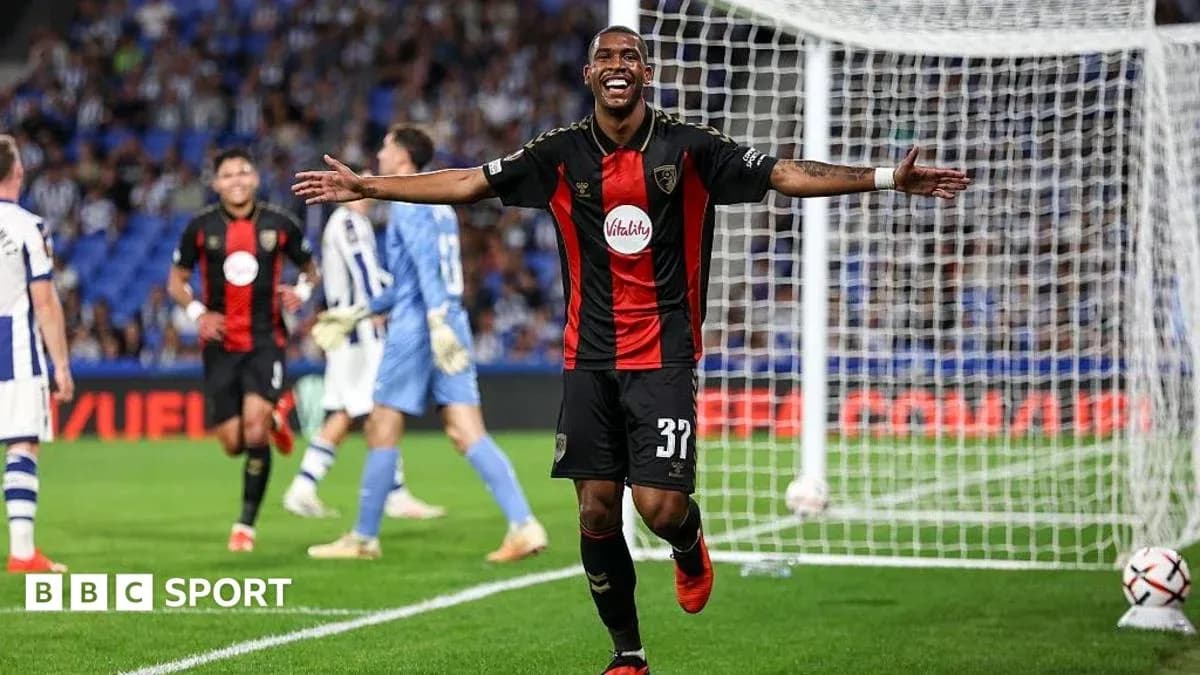
For 45 minutes in San Sebastian, Bournemouth made European football look easy.
They walked into a notoriously awkward arena and played as if they owned the place, zipping the ball around with a swagger that silenced the home crowd and rattled Real Sociedad. Passes were sharp, angles were clever, and every red-and-black shirt seemed to know exactly where the next one would be.
On the ball, they were slick. Off it, they were nasty in all the right ways. Bournemouth hunted in packs, snapping into tackles, shutting down passing lanes, and refusing to let their hosts breathe. Sociedad tried to build from the back; Bournemouth simply tore up the script.
The breakthrough felt inevitable. When the opener came, it released a sense of “here we go” rather than surprise. Bournemouth had control, territory, and rhythm. And when Rayan rose to nod in the second, the mood shifted from optimism to something bordering on disbelief. At that point, the only realistic question was how many they might score.
Scott dictated everything from midfield, a metronome with bite, always offering, always available, always choosing the right pass. In front of him, Evanilson dragged the Sociedad defence into uncomfortable places, never allowing the centre-backs to settle, constantly forcing them to turn and chase. Kluivert drifted into pockets of space with ease, ghosting between the lines, always a half-turn away from doing damage.
Bournemouth were not just competing in Europe. For a spell, they were dominating it.
Second Half
Then the game changed.
Sociedad, wounded but not broken, refused to let the night become a procession. They stayed in the contest, held their nerve, and slowly began to wrestle back control. Bournemouth’s fluency with the ball gave way to something more rugged, more desperate. The second half stopped being about expression and started being about endurance.
The flowing patterns of the opening period faded. In their place came blocks, clearances, and last-ditch interventions. Bournemouth’s back line suddenly had work to do. A lot of it.
The defence creaked at times. They were not always convincing, and there were moments when the structure bent alarmingly under the weight of Sociedad’s pressure. Crosses flashed through the box, runners broke the line, and the noise inside the stadium grew with every half-chance.
Yet Bournemouth held. Not perfectly, not serenely, but stubbornly.
When that resistance was finally pierced, Petrovic stood tall. Twice he denied Oskarsson with saves that carried more than just technical quality; they carried a sense of defiance. One low stop, one strong hand when the angle seemed to favour the forward – both interventions arrived when Bournemouth most needed a calm head and a strong wrist.
Those were the moments that separated a statement away performance from a cautionary tale.
By the final whistle, the tone of the night had shifted from “how many?” to “how hard?” Bournemouth had shown both faces required for European football: the confident, front-foot side that can slice through a good team, and the gritty, backs-to-the-wall version that survives when the tide turns.
If this is what their learning curve looks like, the rest of the continent will be paying attention.