.svg&w=384&q=75 "logo")
Battle for 2030 World Cup Final Venue: Morocco vs Spain
The battle for the 2030 World Cup final has moved from boardrooms to the political stage, and Morocco’s prime minister has just tried to slow the tempo.
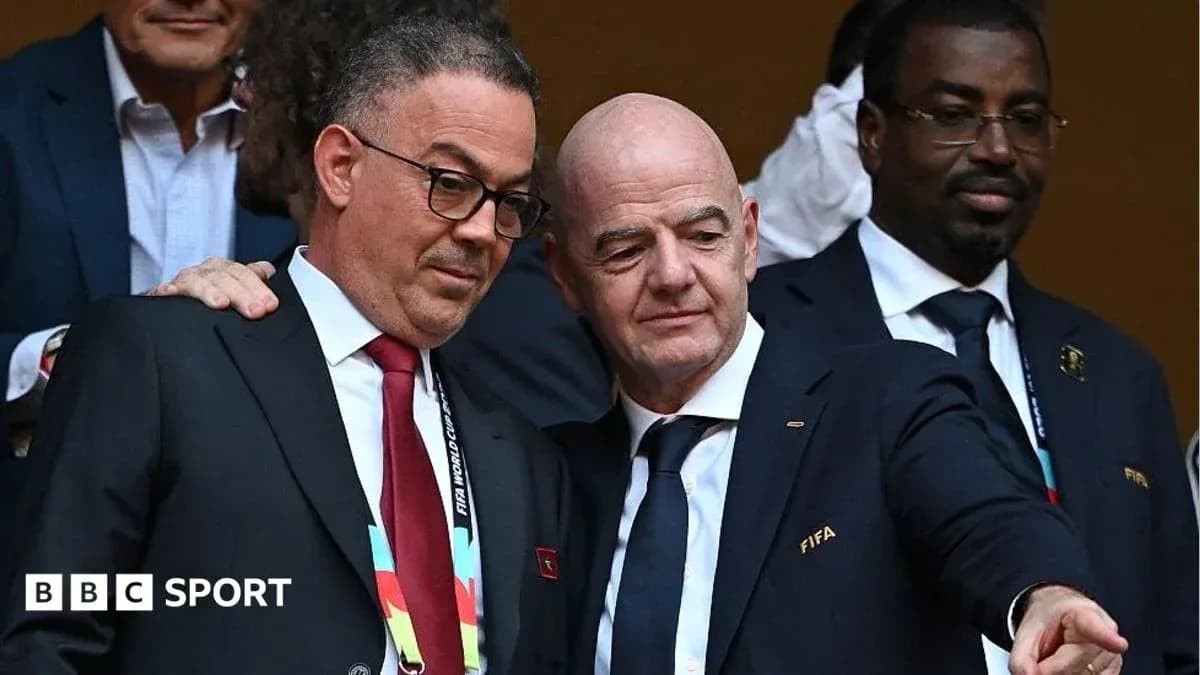
Aziz Akhannouch has publicly rebuked Fouzi Lekjaa, the powerful president of the Moroccan football federation (RMFF), telling him to stop promising that Casablanca will host the showpiece match of the tournament Morocco is due to co-host with Spain and Portugal.
The message was blunt. The timing, pointed.
Political warning in Casablanca
Lekjaa, one of the key architects of Morocco’s successful joint bid, had told a political party event that Casablanca would have the “honour” of staging the final. It played well locally: a rising football nation, a new super-stadium on the way, and the prestige of the biggest game in world football.
Akhannouch, speaking at a rally, cut through the euphoria.
“Do not offer to host the big final game in Morocco while we still have not discussed the matter with our allies, Spain and Portugal,” he said, turning a football question into a diplomatic one.
“There should be some respect, brothers. Stop using electoral promises to pull the rug out from under us. These are huge matters. Deciding where the final will be held is a major issue.”
It was a rare public dressing-down for Lekjaa, and a reminder that, even in football, coalition politics matter.
Spain pushes its claim
While Morocco wrestles with its own messaging, Spain has been far less shy.
Rafael Louzan, president of the Spanish football federation (RFEF), has already laid out his country’s stance: the final belongs in Spain. He believes that position has only grown stronger after Spain’s men won the World Cup for the second time this summer.
“Even though no decision has been taken, I believe Spain is the place because it cannot be any other way,” he told Cadena SER. “As you know, we are currently world champions.
“I believe Spain’s organisational capacity for major events is beyond question and that is why reality dictates that the grand final cannot and must not be held anywhere other than in Spain.”
That is not subtle lobbying. It is a clear pitch to Fifa and a signal to Morocco and Portugal that Spain sees itself as the natural centre of the 2030 project.
Fifa keeps its distance
For now, Fifa is staying above the fray.
World football’s governing body has confirmed that a list of host stadiums has been proposed, but nothing has been finalised – including the venue for the final. Its line is simple: “a decision will be made in due course”.
The structure of the 2030 World Cup only adds to the complexity. Morocco, Spain and Portugal will serve as the main hosts, but the opening three matches will be staged in Uruguay, Argentina and Paraguay to mark the centenary of the tournament.
With six nations involved and three primary hosts, the choice of final venue carries more political weight than usual. It is not just about capacity and infrastructure; it is about symbolism.
Stadiums and statements
On the ground, both Morocco and Spain are building their cases in concrete and steel.
Morocco is constructing a proposed 115,000-seat stadium, which would become the largest football arena in the world. That scale alone sends a message: the country is not content to be a supporting act.
Spain, though, can point to proven giants already in place. Real Madrid’s revamped Bernabeu now holds 83,000 and has been transformed into a multi-event venue in the heart of Madrid. Barcelona’s Spotify Camp Nou, once its renovation is complete, will host 105,000.
These are not just numbers. They are arguments. Capacity, location, history, transport links, commercial pull – all will feed into Fifa’s final call.
Spain can lean on decades of hosting major events and a fresh world title. Morocco can counter with ambition, regional pride and a stadium that would dwarf every other in the game.
A decision that will define the bid
The 2030 World Cup already stands apart: three main hosts, three symbolic openers in South America, and a political map unlike any previous tournament.
Inside that complex puzzle, one question now dominates: Madrid, Barcelona or Casablanca?
Fifa will decide, not prime ministers or federation presidents. But as the public manoeuvring intensifies and national leaders start to intervene, the choice of one stadium over another is beginning to look like more than a logistical call. It is starting to feel like a verdict on which vision of this World Cup truly leads the way.