.svg&w=384&q=75 "logo")
Ancelotti vs. Silva: A Clash Over Brazil's Football Future
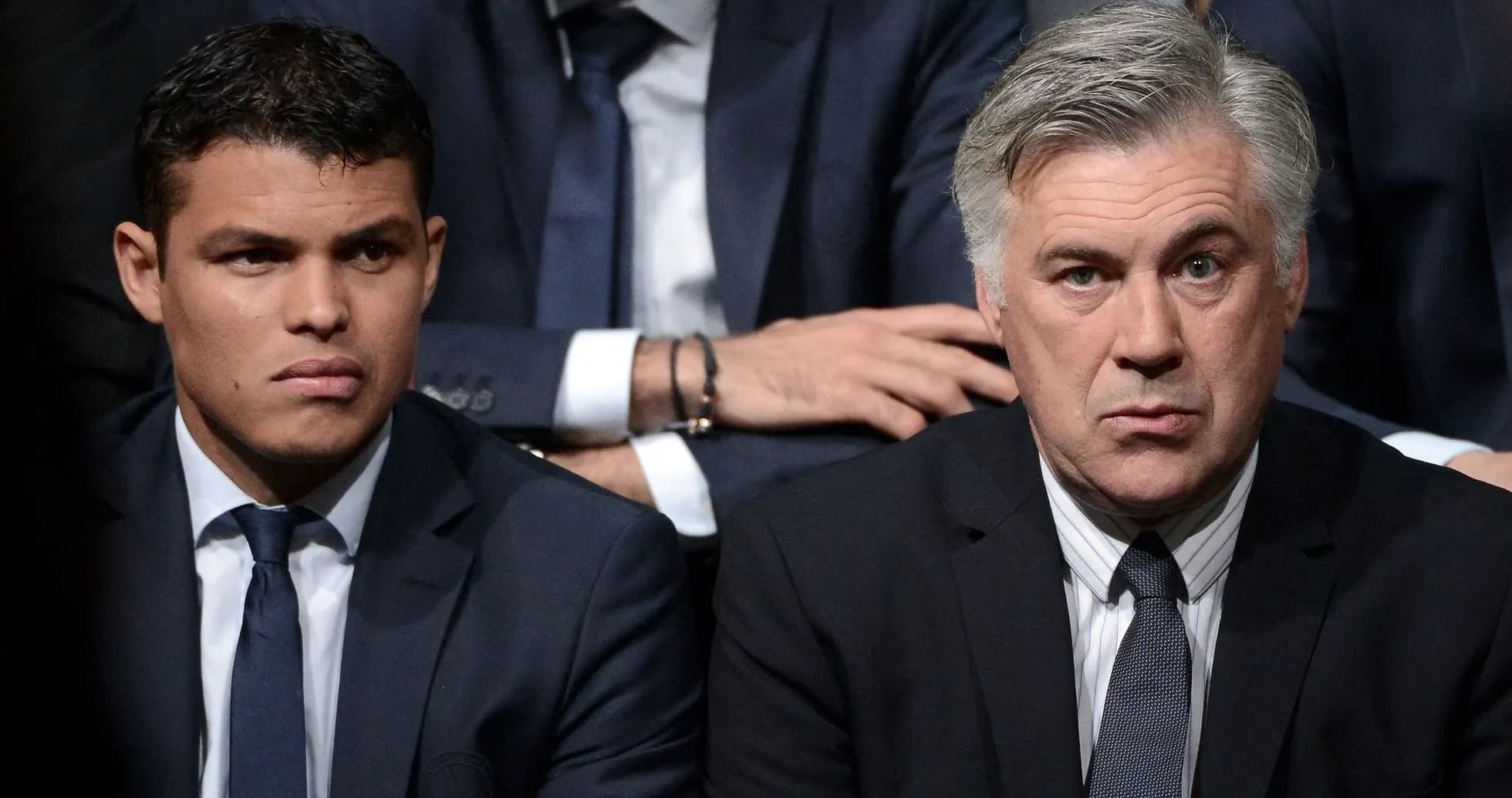
Carlo Ancelotti and Thiago Silva are no strangers to each other. A decade ago in Paris, they were the backbone of a rising Paris Saint-Germain, and Ancelotti did not hesitate to call the Brazilian centre-back “the best defender in the world.”
Now they stand on opposite sides of a fault line running straight through the heart of Brazilian football: how to rebuild a fallen giant.
From admiration to open disagreement
The spark came as Ancelotti unveiled a bold 26-man Brazil squad, heavy on domestic talent and light on established veterans, for upcoming friendlies against Australia and India. Ten home-based players. Ten uncapped names under 30. A clear statement that the reset is real, not cosmetic.
Thiago Silva, watching from the outside, did not like what he saw.
Fresh from Fluminense’s Copa Libertadores win over Platense, the 113-cap defender spoke to Radio Tupi and tore into the pace and scale of the overhaul. For a player once trusted to marshal Brazil’s back line at multiple World Cups, the message was blunt.
“You can't rule out players who are 31, 32 or 33,” he said. For him, international football is evolution, not revolution. “In the Brazilian national team, things have to be done step by step. You can't just get rid of everyone and bring in new players.”
Silva, left out of the most recent World Cup squad despite a strong loan spell at FC Porto, framed the debate as a clash of footballing cultures. “He comes from European football, where it's easier to make changes,” he argued. “It doesn't work like that here. I don't agree with it, but he's the one in charge.”
That last line carried the weight of resignation, but not acceptance.
Ancelotti stands his ground
The response from Ancelotti came swiftly and in public. Sitting at CBF headquarters in Rio, the Brazil coach was asked directly about Silva’s criticism.
“I don't look,” he said, brushing away the noise with the kind of dismissive shrug that has followed him through some of Europe’s biggest dugouts. Then he laid out his plan.
For this international window, the friendlies are a laboratory. The emphasis is on tomorrow, not yesterday. “For the objectives we have in these friendlies, it's a balanced list,” Ancelotti explained. “I don't generally look at players' age. Right now, the priority is young players. But if a 34 or 35-year-old is prepared to play in an important competition, he will be in the national team.”
The message was clear: this is not an age purge, it is an audition. Experience is not banned, but it will no longer be a shield.
A new wave wears the shirt
The names on the list underline that shift.
Ten players without a senior cap, all under 30, have been thrown into the frame. In goal, Hugo Souza, Pedro Morisco and Otavio headline the new generation, tasked with proving they can handle the scrutiny that comes with the Brazil shirt.
Across the back line, Arthur Dias, Jair, Mauro Junior, Matheuzinho and Manchester City’s Vitor Reis form a defensive unit that looks more like a scouting report than a traditional Seleção roster. Raw, hungry, and untested at this level.
In midfield, Breno Bidon and Gabriel Bontempo receive their first call-ups, dropped straight into a squad that still carries star power in attack. Vinicius Junior, Endrick, Estevao and Raphinha provide the familiar sparkle, the bridge between the Brazil that has already lit up Europe and the one that Ancelotti hopes will define the next cycle.
It is not a gentle transition. It is a reset button slammed down.
Brazil at a crossroads
This is the tension at the core of the argument. Thiago Silva speaks for a generation that believes the national team should be handed over, not taken away. That scars, caps and late-career form should still count for something. That Brazil’s dressing room needs elders as much as it needs energy.
Ancelotti, charged with dragging Brazil out of another World Cup disappointment, is betting on something different: that the only way to escape the weight of history is to put it on the bench.
The calendar will not wait for either man. Brazil face Australia on September 25 and 29, then travel to Kolkata to meet India on October 3. Three friendlies, thousands of miles, and a first glimpse of what this “new era” actually looks like when the anthem stops and the ball starts moving.
By then, one question will hang over every team sheet and every performance: is this the brave renewal Brazil needs, or a brutal cut that risks leaving too much experience outside the door?