.svg&w=384&q=75 "logo")
Patrick Vieira's New Chapter as Senegal Head Coach
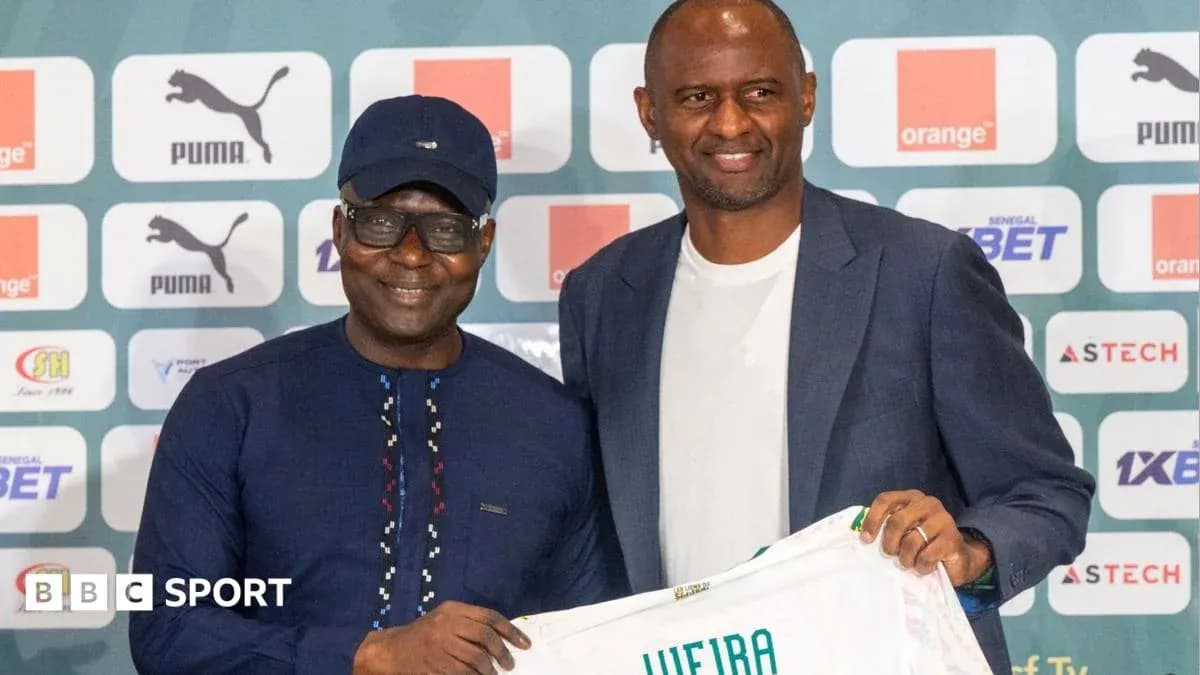
Patrick Vieira stood in Dakar and called it what it was: “an honour” and “an absolute dream”. Not another job. Not just the next line on a glittering CV. This one, he said, was “from the heart”.
The new head coach of Senegal is 50 now, a World Cup and European Championship winner with France, a legend at Arsenal, and a man who has spent most of his adult life far from the streets where he was born. On Friday, in front of the cameras and the federation officials, he framed this return as something deeper than a career move.
“I was born here, my parents were born here, and it really is a homecoming,” he said in Dakar, speaking of “immense pride” as he took his first international job.
A giant with something to prove
Vieira walks into a dressing room that no longer sees itself as an underdog. Senegal are African champions on the pitch, even if the trophy is currently the subject of a legal battle. They are World Cup regulars. They are, as he put it, “among the major nations in world football”.
The expectations reflect that. All 20 million of them.
He inherits a side still smarting from a brutal exit at the 2026 World Cup: 2-0 up against Belgium with five minutes of normal time left in the last 32, only to collapse and lose 3-2 after extra time. Before that, they had climbed to the summit of African football again, beating Morocco 1-0 after extra time in January to win the 2025 Africa Cup of Nations.
Yet even that triumph is in limbo. A walk-off by some Senegal players and staff in protest at a penalty decision in the final led to the trophy being handed to hosts Morocco in March. The Court of Arbitration for Sport will decide where the title ultimately rests.
So Vieira starts with a paradox: a team that has both won and lost, celebrated and seethed, often within the same night.
“Senegal’s objectives aren’t what they were 10 or 15 years ago,” he said. “On the back of its recent results, Senegal has moved forward, has reached new levels. The demand for results has also stepped up. We need to lay solid foundations.”
Not a revolution, a continuation
This is not a coach promising to rip everything up. Quite the opposite. Vieira talked repeatedly about respect – for what has been built, for the identity of a group that has already scaled the mountain.
“What matters to me isn’t starting again from scratch,” he said. “It’s about respecting what the federation has put in place over the last few years and building the next stage, opening a new chapter.
“A new chapter meaning my job isn’t to tear everything down, it isn’t to throw everything out of the window. It’s about keeping this team’s strength: its identity, its unity, its ability to suffer together.”
The tweaks will come in the details. He spoke of “a very precise structure”, of a team that plays with “intensity and aggression”. The football he wants is clear. The culture he inherits is non-negotiable.
“To make this project work, I’ll need the whole nation united,” he said. “I’ll work heart and soul to restore the team’s pride.”
Thrown straight into the fire
There will be no gentle warm-up. No long training camps or extended friendlies to find his feet.
Vieira is immediately into competitive football with qualifiers for the 2027 Afcon. Two games in this international window, two more in November, and the final rounds in March 2027. The calendar is already racing.
His reign was supposed to begin with a home match against Mozambique in Dakar on Friday, 25 September. Instead, preparations for the 2026 Youth Olympic Games have forced a change of plan. The game has been reversed. Senegal will travel.
“Of course, I’d have preferred to play the first match here in Dakar,” Vieira admitted. “But unfortunately, with the federation, we all felt the best decision was to postpone the match and go and play in Mozambique. Those are difficulties we’re going to accept and deal with.”
From there, the road stays long: another away fixture, this time in Ethiopia on 29 September. Two matches, two trips, and a new coach still learning names and habits in real time.
Big names missing, big calls to make
He will do it without some of the most familiar faces of Senegal’s golden era.
Edouard Mendy, 34, the long-time number one, has retired from international duty. Sadio Mane, also 34 and still the heartbeat of the attack, will miss this window with what Vieira described as “a bit of a physical issue”.
Talk of Mane following Mendy into retirement has lingered, but Vieira moved to steady the narrative. The former Liverpool and Bayern Munich forward will “surely” be part of his next squad, he said, if his fitness allows.
Elsewhere, right-back Krepin Diatta is out because he is currently without a club. Ismaila Sarr is missing too, yet to play for Crystal Palace this season amid transfer speculation and a groin injury.
So the new coach must blend a reshaped squad on the move, while the old guard either steps aside or watches from afar.
A decorated player, a tested coach
On the touchline, Vieira arrives with a reputation forged as a player and tested as a manager.
His time with New York City, Nice, Crystal Palace, Strasbourg and Genoa has brought flashes of promise and hard lessons. At Palace, he left in March 2023 with 22 wins from 74 games in all competitions. At Genoa, he first guided the club to safety in Serie A in the 2024-25 season, only to be sacked the following November after six defeats in nine league games, with the team bottom of the table.
He has been out of work since. The scars are there, but so is the conviction.
“I’ve always been someone who stays positive,” he said. “That means you learn, and there are always positive things to take from it. I’m a better coach today than I was in my last spell at Genoa, because that experience helped me grow and made me realise certain things.
“Given the experience I have as a manager, I’ve got no doubt about my ability to meet the expectations of fans.”
A nation’s embrace
If he needed a reminder of those expectations, he got it on Thursday night.
As he arrived in Dakar, videos on social media showed Vieira holding a Senegal flag aloft, swallowed by a crowd at the airport, shaking hands, smiling, almost pushed along by the surge of bodies. This was not a quiet return. It was a welcome reserved for someone the country has claimed as its own again.
“I couldn’t have been given a warmer welcome,” he said. “I saw the supporters’ enthusiasm and I thank them for it. Taking charge of this national team isn’t just a new stage in my career – it’s coming back home.”
Home, now, comes with pressure. With Afcon qualifiers looming, a disputed continental title hanging over them, and the memory of that World Cup collapse still raw, Senegal have turned to one of their own.
Vieira asked for unity. The crowd at the airport answered. The real response, though, will come on distant pitches in Mozambique and Ethiopia, where the new era starts without fanfare, but with the weight of a nation on his shoulders.