.svg&w=384&q=75 "logo")
New Zealand Breakers: A Fresh Start Under Matt Mitchell
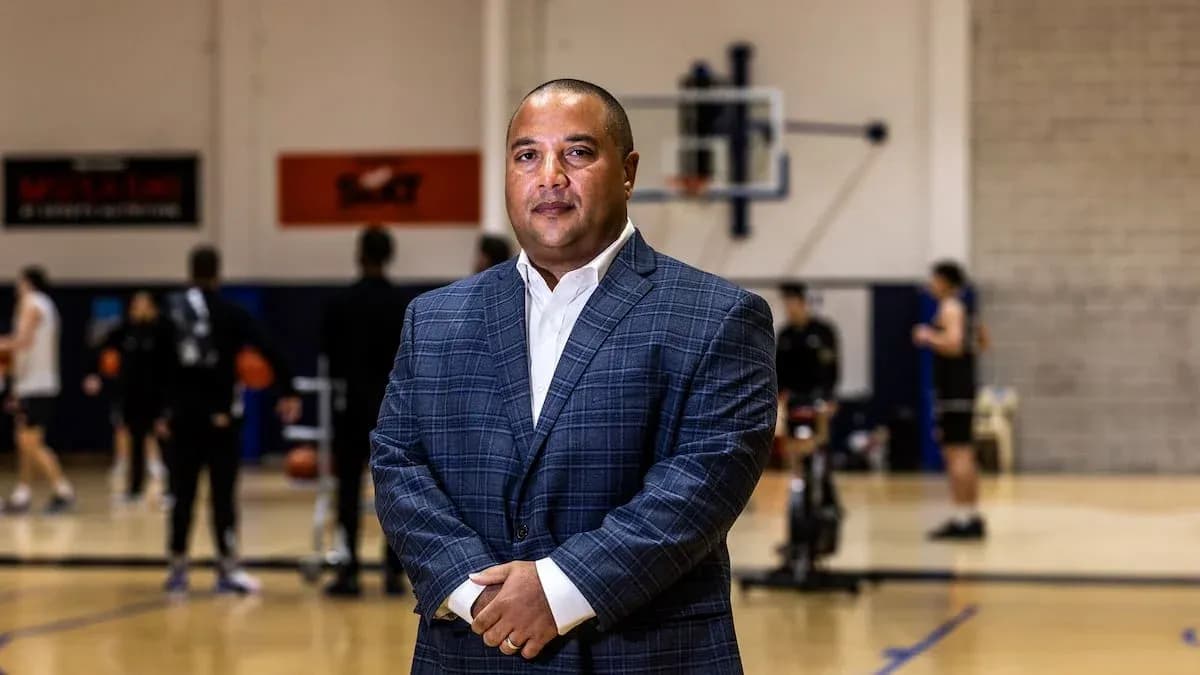
At Atlas Place, the New Zealand Breakers don’t just look different. They feel different.
The logo is new. The uniforms are new. The coaching staff and roster have been turned over. The academy is back. Even the floor beneath their feet has changed, with a gleaming new court donated by Steven Adams anchoring a refurbished headquarters.
All of it flows from one place: Matt Walsh-era survivor and now sole owner, American businessman Matt Mitchell, and his insistence that the Breakers must be unmistakably Kiwi while thinking globally.
“This is a restart,” he told the Herald. And he has treated it like one.
Rebuilding the foundation
For the first season under his watch, Mitchell largely left things alone. Then he started pulling levers.
Atlas Place has been modernised. Facilities upgraded. The club’s off-court operation reshaped. The rebrand — crest, colours, identity — is designed, he says, to reflect New Zealand’s heritage, its people and its land.
When he bought the team, Mitchell believed the Breakers needed to be stripped back and built again. The first move was symbolic and practical: hiring club great Dillon Boucher to restore the championship ethos that once defined the franchise.
From there, the pieces came steadily. New staff across the front office. A revamped basketball department. A deliberate attempt to reconnect with the community that once packed out arenas and turned the Breakers into the NBL’s model club.
“Step by step, we brought in a wonderful staff,” Mitchell said. “That’s contributing to making the Breakers what we want it to be. So that’s great on the court and in the community.”
He always saw it as a two-year plan. Get the right people in the right seats, build the infrastructure, and then let the basketball breathe.
“I think we’ve done that,” he said. “We’ve got a great set of people who are working every day to make this a great experience.”
Now comes the part that really counts.
A new look on court, same old ambition
On Sunday, Spark Arena hosts the home opener against the Illawarra Hawks. The banners in the rafters — four titles from the 2010s — still hang as a reminder of what the club once was. The fifth is the obsession.
The Breakers have kept a solid core, with Parker Jackson-Cartwright and Sam Mennenga returning to lead the group. They have added proven NBL winners in Kouat Noi and Dejan Vasiljevic, and gone international again with the recruitment of 7-foot rim protector Charles Bediako and versatile wing Josiah-Jordan James.
James, a defensive presence who can stretch the floor, will miss the start of the season with a hamstring injury, but the intent behind his signing is clear. The Breakers want length, versatility and defensive edge.
The biggest statement, though, stands on the sideline.
World champion on the Breakers bench
Gordon Herbert is not the kind of coach you expect to find in the NBL. Yet here he is.
The Canadian arrives with a résumé that dwarfs most of his peers: years at the sharp end of European basketball, a stint as an assistant with the Toronto Raptors, and, most notably, the 2023 Fiba World Cup title with Germany.
“No one thought we could bring him to New Zealand, but we were able to do it,” Mitchell said. “He’s excited to be here.”
Herbert leads a staff that blends local knowledge and international experience. New Zealanders Matt Lacey, Quinn Clinton and Josiah Maama join him, along with lead assistant Sebastian Gleim, who previously coached the Franklin Bulls in the New Zealand NBL.
The coaching group is a snapshot of what Mitchell wants the Breakers to be: Kiwi at the core, plugged into the wider basketball world.
He believes the club now sells itself to players who once might have brushed past an offer from New Zealand.
“We brought in a lot of players who I think in years past might not have taken a hard look at coming to the Breakers,” Mitchell said. “The Breakers brand is something that people now know and we’re going to be competitive in our league.”
Written off across the Tasman
Not everyone is convinced.
Across the Tasman, pundits have the Breakers pegged near the bottom of the table. One statistic keeps getting thrown at them: they are the only team in the NBL without NBA playing experience on the roster.
Mitchell shrugs that off as a curiosity, not a weakness.
“All of our guys are NBA level, played in the G League, played at high levels around the world, so it’s not necessarily a prerequisite,” he said.
In most seasons, Breakers rosters have included players with NBA time. This year, they don’t. Mitchell insists that doesn’t change the core question: can they play, and do they fit?
“We’ve found the right guys for this year and the guys who fit well together with the locals that we brought in before,” he said.
What he doesn’t brush off is the responsibility of being the country’s lone representative in the Australian-based NBL.
“The league’s in a great place,” he said. “For us to be the one team in New Zealand that represents our country in the league is really an honour.”
Expansion, Asia and a bigger Breakers footprint
The NBL’s next big move may not be in New Zealand at all.
Talk of expansion has focused on the Gold Coast, Canberra and a possible return to Asia. League requirements for new arenas — between 8000 and 12,000 seats — make a second New Zealand team unlikely without significant upgrades.
Mitchell won’t rule anything out, but he is realistic about where the league’s eyes are pointed.
“Right now what the league is looking to do is more about expansion of the footprint around the world,” he said.
Asia looms large in that conversation. Pre-season games there, more visibility, more reach. Mitchell wants the Breakers right in the middle of that push.
“We want to continue to expand the Breakers’ presence around the world,” he said.
The academy returns — and so does the pathway
For all the talk of titles, Mitchell keeps circling back to one theme: pathways.
After six years in limbo, the Breakers academy is back. The first intake: 20 male athletes from school years 11-13, drawn from six Auckland high schools.
History says that matters. The academy has already produced players such as Mennenga, Reuben Te Rangi and Anzac Rissetto, all now part of the senior set-up.
Mitchell wants young New Zealanders to see basketball as a vehicle — to college scholarships, to professional careers, to life experiences.
“The academy is really important because it is for the entire country to highlight the best young players,” he said.
“One day we want them to be Breakers, but they’re not all going to be Breakers. But it allows them a pathway to continue to play at a high level, potentially to go to college and to use the sport for all the positive things that it can bring.”
That philosophy runs through almost everything he says. Win now, yes. But build something that lasts.
From Showtime to Spark Arena
Mitchell’s vision for the Breakers traces back to a very different basketball world.
He grew up in Los Angeles during the Lakers’ Showtime era, when Magic Johnson and Kareem Abdul-Jabbar turned the Forum into a global stage and owner Jerry Buss turned basketball into a community event.
Mitchell still holds Lakers season tickets. He saw up close how a winning team can lift an entire city. That’s the template he carries into New Zealand.
His ties to the country run deeper than business. His wife Jessica is a Kiwi. The couple and their three children have lived here, including an 18-month stretch during Covid when the borders were closed. He has been visiting for more than two decades.
“I’ve really enjoyed all parts of the country,” he said.
Mitchell knows some fans remain wary because of his involvement in the previous ownership group, but he points to the people he has brought back into the fold — Boucher, and long-time club figures Paul and Liz Blackwell — as proof of his intent.
“We’ve moved on from that era,” he said. “As long as I’m part of this, they will be a part of this. It’s about the history, and it’s about doing things the right way.”
He now splits his time between Los Angeles and New Zealand, but plans to be in the stands for most home games this season.
Swansea, Snoop and the wider sporting play
Basketball is not Mitchell’s only sporting investment.
In 2023, he backed a bid to launch an Auckland-based A-League football team, but lost out to a rival group fronted by Bill Foley, Ali Williams and Anna Mowbray.
He has since joined the ownership group of EFL Championship club Swansea City, a consortium that includes Martha Stewart, Luka Modric and Calvin Cordozar Broadus jnr — better known as Snoop Dogg.
Swansea’s squad features All Whites World Cup players Elijah Just and Marko Stamenic, giving Mitchell another New Zealand thread to pull on.
“Sports in general to me is a passion,” he said. “They approached me to be involved, and I was happy to join the team.”
He has met Snoop Dogg before, but not yet in the context of Swansea. That introduction, he says, is coming.
Mitchell visited the Welsh club with his family in July, meeting coaches, front office staff and players, and getting a feel for the project. As of Friday morning, Swansea sat second in the Championship table.
Closer to home, he hinted at further moves into New Zealand sport, without revealing details. One idea already locked in is the Breakers’ first Celebrity Golf Invitational, set for January.
The response, he says, has been strong. The event is designed to showcase New Zealand’s golf courses, bring international names to the country and funnel support back into basketball development.
Chasing banner number five
Strip away the rebrand, the academy, the global ambitions and the celebrity golf, and the Breakers’ target is familiar: win it all.
They were the first New Zealand side in an Australian competition to win a title. Four championships in the 2010s cemented their status as a powerhouse. The drought since then has only sharpened the hunger.
Last season teased something more. The Breakers won the pre-season tournament. They won the in-season tournament. Then they fell short when it mattered.
“Those are steps along the way,” Mitchell said. “The ultimate goal is to get to a championship, so we’re trying to do everything in our power to allow our guys to do that.”
He talks about importing best practice from around the world, then tailoring it to New Zealand.
“We’re trying to take best practices from around the world and put a little Kiwi dust on them and bring them to New Zealand,” he said.
The new court is down. The world champion coach is in place. The academy doors are open again. On Sunday, the lights go up at Spark Arena.
Now the Breakers have to prove that all this change leads to the only thing that ever really counts in sport: another banner in the rafters.