.svg&w=384&q=75 "logo")
Liverpool's Transformation Under Iraola: From Slot to New Beginnings
Only a year ago, Liverpool opened their Premier League title defence with five straight wins and a sense of inevitability under Arne Slot. The first of those came against Bournemouth, then coached by Andoni Iraola, on an opening night that felt like the start of another long Anfield reign.
Nobody in the ground that evening was sketching out this twist: Slot gone, Iraola in his place, and Liverpool arriving on the south coast with the Spaniard now in the away dugout.
Football turns quickly. Sometimes brutally.
From home dressing room to away
Twelve months on, Liverpool are six points worse off than at this stage last season. They are also unbeaten. Both statements are true, both shape the mood around Iraola’s early months.
On Sunday, he walks back into Bournemouth, the club he dragged clear of trouble and into Europe, only this time he’ll turn left, not right, down the tunnel. The away dressing room he’ll find has been upgraded to meet Europa League standards, a small irony for the coach who helped make those nights possible.
It will still feel strange. Three years of work condensed into a few seconds in a different corridor.
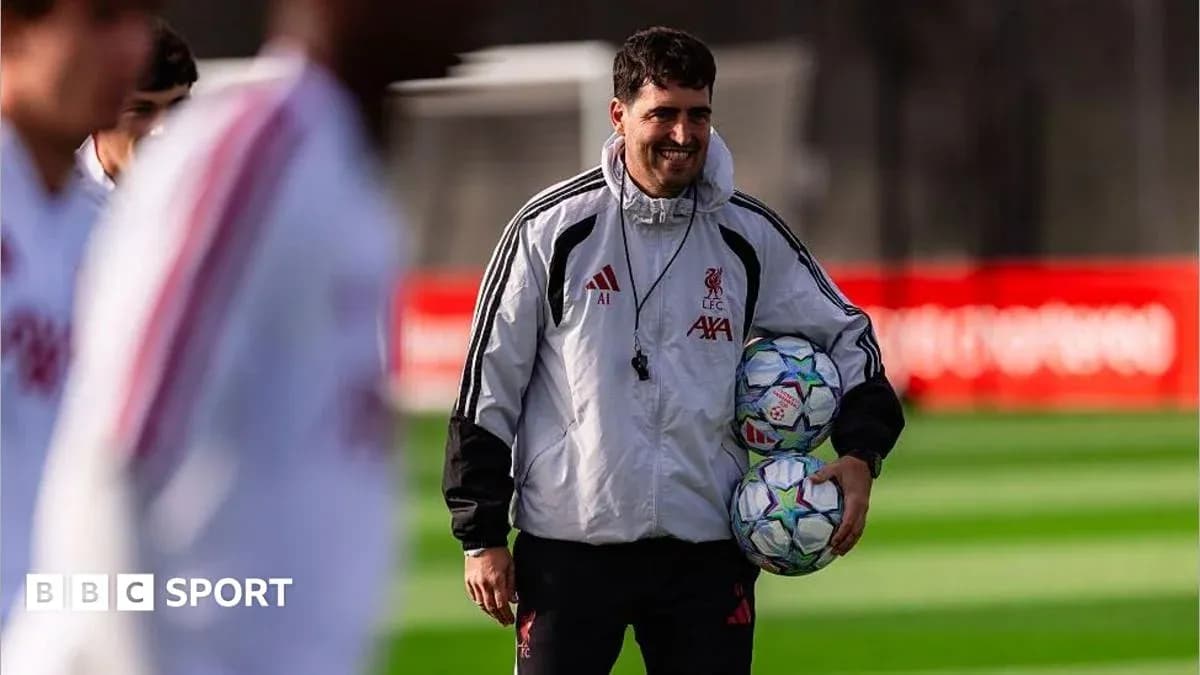
Iraola has traded the Dorset coast for Formby, the discreet beach town that once housed Jurgen Klopp and Brendan Rodgers. He is already part of the local scenery: occasional sightings in the city centre, a regular figure on his bike along the coastline. But his real habitat lies behind the walls of the AXA Training Centre in Kirkby.
There, he is the archetypal training-ground coach. Six days a week. First out on the pitch, cones in his hands, shaping the session before most players have tied their boots.
"It's really intense. There's a lot of hard work and no sort of light days. Everyone's putting in 100%," said forward Lewis Koumas. That line could serve as the mission statement for the new regime.
A quieter presence, same relentless demands
Inside Kirkby, the shift from Slot to Iraola has not meant a revolution in structure. Liverpool operate with a defined head coach model; the system outlives the individuals.
What has changed is the daily texture. Iraola rarely retreats to his own office. Instead, he works from the coaches’ room with Tommy Elphick, Shaun Cooper and long-time lieutenant Pablo de la Torre, the staff cluster that followed him from Rayo Vallecano to Bournemouth and now to Anfield.
De la Torre, in particular, has become central to the project, driving the physical standards required to sustain Iraola’s trademark intensity. The message is clear: if you cannot run, you cannot play.
Around the building, Iraola cuts a lower-key figure than some of his predecessors. Less show, more sweat. Those close to the club insist that everyone, from staff to players, simply wanted last season over, that the mood was always going to lift regardless of who took charge. But the new coach has leaned into that fresh-start energy without turning it into theatre.
He listens. To the medical department monitoring a squad that could easily pass 60 games if cup runs stretch deep. To the fitness staff trying to balance intensity with durability. To the academy, where Rob Page’s Under-21s are being drilled to mirror the first team’s pressing patterns.
"We have an understanding of how the first team play and key principles, like how we press, how he [Iraola] wants his number 10 to press, how he wants his number eight to press, how he wants his centre-backs to press - we mirror that absolutely," said Page.
The idea is clear: when a youngster steps up, he shouldn’t need a map.
Tacticians, not shoppers
The summer debate around Liverpool centred on a familiar theme: the absence of a classic defensive midfielder. The stands wanted a specialist number six. Iraola, like Slot before him, has doubled down on structure.
Dominik Szoboszlai recently laid out the blueprint: Liverpool play with a six, an eight and a 10, roles defined more by collective movement than by transfer-market labels. The burden falls on the unit, not the individual. If the system works, the gaps close themselves.
Iraola’s methods reflect that thinking. He tailors training times to kick-offs, shifting sessions into late afternoon and early evening to match the rhythm of upcoming fixtures. Under Slot, the schedule barely moved. Under Iraola, it flexes with the calendar.
Team selections arrive on the morning of matches. Post-mortems wait until the day after, when emotions have cooled and the video can do some of the talking. The process is intense but not frantic.
He learned an early lesson in the Liverpool spotlight during pre-season. After a friendly against Monaco, he told LFC TV his side had “run out of steam” after half an hour and lacked the energy to play at his desired intensity. It was meant as a fitness update, not a rebuke, but the quote ricocheted around social media as if it were a public dressing-down.
At Liverpool, every phrase is a headline. Iraola has adjusted. His press conferences now carry a measured calm, an openness that stops short of naivety.
Youth, running and the reality of the schedule
If there is one non-negotiable under Iraola, it is intensity. Liverpool lead the Premier League for sprints this season, a statistic that fits neatly with the club’s decision to appoint him in the first place.
His track record of developing young players was a major selling point, and the numbers back that up. The average age of Liverpool’s Premier League line-up this season is 25.3, with only five sides fielding younger teams.
The faces are changing. Rio Ngumoha, 18, Trey Nyoni, 19, and Koumas, 20, all started against Tottenham in the Carabao Cup. None of them are expected to fade back into the shadows. Their roles will grow, not shrink.
Still, there is only so much the legs can take. The goalless draw with Fulham last weekend told its own story. Less than 72 hours after a draining Champions League win over Atletico Madrid, Liverpool looked heavy, the usual spark dulled by the schedule.
Sunday’s trip to Bournemouth will be their fourth game in 12 days. After the international break, they face a run of four in 10. Between 11 October and 7 November, they are slated to play nine times.
Even for a coach obsessed with pressing, there will be nights when the game is decided by a corner routine or a flash of individual brilliance. Iraola knows it. The buzzword is intensity; the reality is compromise.
Back to where the rise began
From afar, he will have enjoyed Bournemouth’s Europa League debut win over Real Sociedad on Thursday, a landmark result in the Basque region where he grew up. A reminder of his own journey as much as theirs.
Perhaps on the flight down from Liverpool on Saturday, he will allow himself a glance back. From Rayo to Bournemouth to Anfield. From survival specialist to the man tasked with reshaping one of Europe’s giants.
Liverpool have not flown out of the blocks under him. They have, however, stopped losing. After 12 league defeats last season, becoming hard to beat is progress of a sort, even if it doesn’t fill the honours board.
Inside the dressing room, the standards remain unforgiving. Vice-captain Alisson spelled it out last week: at Liverpool, draws are not enough.
Iraola, unbeaten in the Premier League since January across Bournemouth and Liverpool, will not need reminding. On Sunday, in a stadium that still carries his fingerprints, he has the chance to turn resilience into something more tangible.
A first league defeat of the season would sting. A statement win, on familiar turf, would send Liverpool into the international break with something far more valuable than an unbeaten record: the feeling that this demanding, restless project is starting to move.