.svg&w=384&q=75 "logo")
Lionel Messi's Retirement: A Reflective Farewell
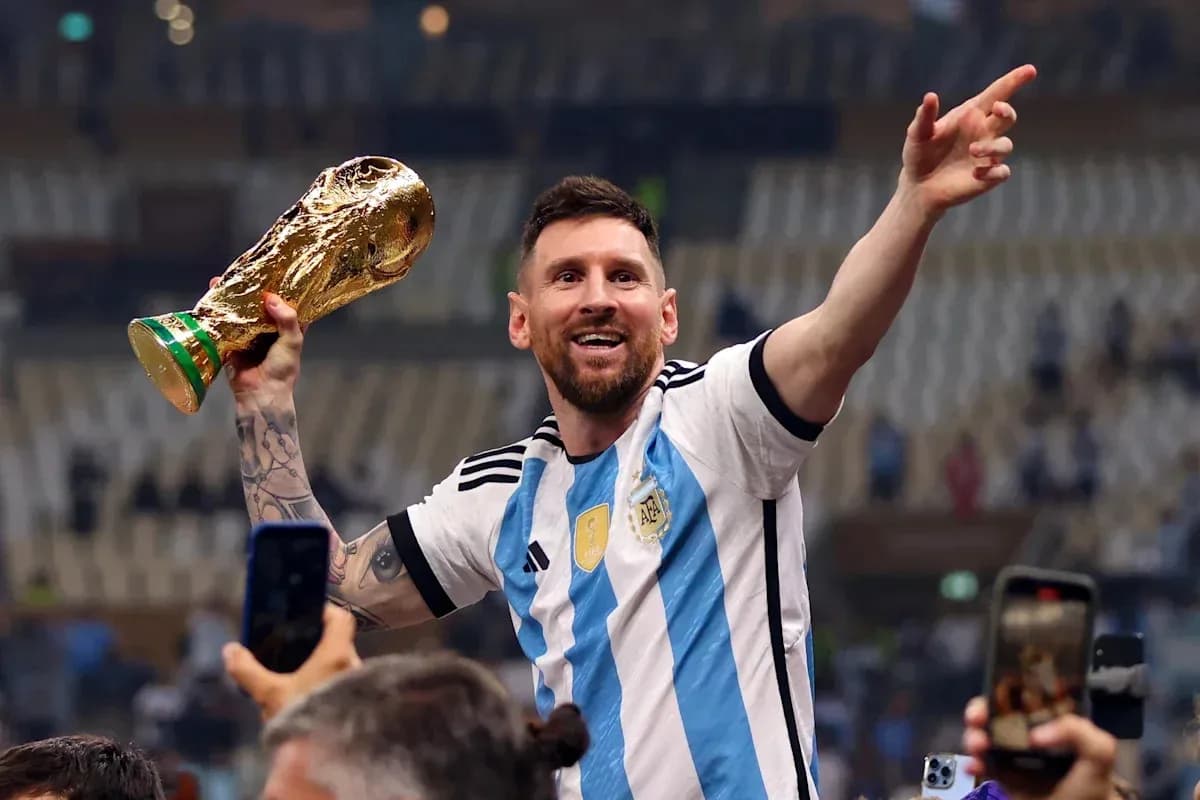
Lionel Messi walked alone.
After 120 minutes in suffocating heat, at 39 years of age, he stood on the touchline with a silver medal around his neck and tears in his eyes. No dramatic speech. No choreographed farewell. No grand reveal. Just silence, and the weight of a lifetime on his shoulders.
He looked out at the stands, then down at the grass. The same grass he had once left convinced that this stage would never truly belong to him. Then he sat, slowly, on that turf, untied his boots and slipped them off for the final time as an Argentina player.
No cameras in the dressing room. No “Last Dance” series. No farewell tour. That was never him. From the moment a four-year-old in Rosario was told he was too small to play with the older boys, Messi’s answers have always come with the ball at his feet, not a microphone in his hand.
Now, after more than two decades, the final answer has arrived.
The end of an era in sky blue and white
Messi has officially retired from the Argentina national team. The numbers alone are staggering: 207 matches, nine finals, four major trophies, crowned by the World Cup in 2022. His last act in Albiceleste colours ends with defeat to a superior Spain, but the result cannot rewrite the story.
Nor can it stain this tournament, in which a 39-year-old dragged his country back to the brink one more time.
It is easy to forget how long the dominant narrative around him was failure. “He does it for Barca, why not for Argentina?” was the taunt that followed him everywhere. It came from rival fans, from pundits, from within his own borders. The same voices that now call him a saint once accused him of betrayal.
Messi and his family absorbed abuse, ridicule, even hatred from sections of the Argentine public and media. Four straight lost finals deepened the scars. The Copa América defeats, the World Cup heartbreaks, the night in 2016 when he announced he was done with the national team after losing to Chile. The decision that was later reversed, but not forgotten.
The pressure could have broken him. Instead, it hardened him.
La Scaloneta and the flood that followed
With Lionel Scaloni on the bench and a core of loyal lieutenants around him – Rodrigo De Paul, Cristian Romero, Emiliano Martinez – the landscape changed. The old guard of Angel Di Maria and Nicolas Otamendi stayed on as pillars. A new culture formed, built around Messi but no longer dependent solely on him.
In 2021, at the Maracanã, against Brazil, the dam finally burst. Argentina won the Copa América on enemy soil. A 28-year drought snapped in the most cathartic way possible.
Once that barrier fell, everything else followed.
Enzo Fernandez and Julian Alvarez arrived to add fresh legs and fearless energy. Argentina became a machine, overwhelming almost everyone in their path – Saudi Arabia the lone outlier – on the way to three more trophies, including the 2022 World Cup. La Scaloneta evolved into the team nobody wanted to see in a knockout draw, led by a captain who had become both symbol and solution.
By the time he walked off for the last time, Messi had presided over Argentina’s greatest era. Generations of schoolchildren had grown up without ever seeing their country lose an elimination match with him on the pitch. The man once mocked as an international nearly-man left with so many medals that some now insist the sport bent itself to accommodate him.
More than records, but the records are absurd
The sport’s biggest stage is losing its defining figure. The records will outlive everyone reading this: 91 goals in a calendar year, eight Ballons d’Or – four of them before he turned 25 – 1,348 goal contributions, 44 trophies. And that is just the headline reel.
But to reduce Messi to numbers is to miss the point. Football is not an equation. It is a canvas. He painted it better than anyone.
Talent explains some of it, but not how a man closer to 40 than 30 hauled his country back to another World Cup final, outplaying stars young enough to be his kids’ teammates in school, all while his father lay on his deathbed. Talent does not fully explain why, after conquering the sport several times over, he still treated every game like a debt he had yet to repay.
You can chart his goals and assists. You cannot chart the feeling he gave people.
A career remembered in moments
Ask a hundred fans what they think of when they hear his name and you might get a hundred different answers.
Some will go straight to the solo runs – slicing through Real Madrid, Athletic Club, Getafe, defenders spinning in circles as if chasing a ghost. Others will think of the cutbacks from Jordi Alba, the telepathy of MSN, the way he orchestrated play behind the greatest midfield trio of their era.
There are the images of him lifting the Champions League, then La Liga again and again, and finally the World Cup, bathed in gold in Qatar.
La Pulga left behind thousands of snapshots like that. Yet his greatest gift was simpler: the sensation of watching someone who had completely mastered his craft. Every first touch into space, every disguised pass, every shoulder feint that sent a defender the wrong way felt like a reminder that he saw the game from a different altitude.
A routine layoff became a lesson in timing. A dummy at the near post became an optical illusion. Then there were the passes only he could imagine, the angles only he could calculate, the defenses only he could unlock. On top of all that, he just happened to be the most prolific scorer the sport has ever seen.
The childlike wonder he never let die
His retirement from international football triggers a reaction that unites generations. A crying child in the stands makes as much sense as the 60-year-old in tears in front of the television.
No degree explains it. No tactical breakdown does either.
Football is a children’s game dressed up in adult money and adult pressure. One man managed to perfect that game while keeping its soul intact. Strip away the sports science, the nutrition plans, the analytics, and what remains is the same thing that existed in a dusty park in Rosario: a ball, a kid, and a dream.
Messi never let that go. He reminded everyone else not to, either.
Very few athletes have both the talent to become an icon and the emotional intelligence to lead like one. Through his brilliance, his humility, his obsession with the ball and not the spotlight, Messi inspired an entire generation.
They sold belongings to cross continents just to see him live. They sprinted home from school to catch kickoff at the old Camp Nou. They copied his free-kick stance on playgrounds, argued about him in classrooms, and then some of them pulled on the Argentina shirt themselves.
Those kids grew up watching him fail, cry, and return. When their turn came, they ran until their legs gave out to help him finally lift the trophy they believed was his destiny.
People like to say football “owed” Messi a World Cup. The truth is harsher and more beautiful: nobody owed him anything. His teammates had to deliver. They did, because they understood they were playing for something bigger than their own careers. They had watched him move heaven and earth for the shirt, absorb heartbreak after heartbreak, then come back again.
The man behind the myth
Perhaps the most telling tribute is that, as the messages pour in from former teammates and coaches, most of them barely mention the goals. They talk about the person.
The captain who listened. The superstar who stayed behind to console a youngster. The icon who made the dressing room feel like a safe place. The friend who checked in, not for cameras, but because he cared.
His selflessness, as much as his left foot, made him impossible not to follow. It is one of the reasons he leaves the international stage not just as a champion, but as an undisputed one.
His club career continues. He will keep weaving patterns in Miami, scoring – as he did with four in a week not long ago – alongside friends in a gentler setting. But the World Cup final seems destined to stand as his last truly high-stakes occasion.
There is something cruel in that, because even at 39 he showed the world he could still be the best player on any pitch. Cruel, but also fitting. He has nothing left to chase. Nothing left to silence. Nothing left to prove.
The Argentina shirt will move on. New idols will emerge. New children will fall in love with different names.
But there will never be another career quite like his, because there will never again be a first time the world realised that football, at its peak, could look like this.
He walked off the international stage as he always played: quietly, decisively, on his own terms.
The question now is not what more he could have done for Argentina.
It is how long the sport will spend searching for someone who can make it feel that way again.