.svg&w=384&q=75 "logo")
Kristaps Porzingis: The Golden State Warriors' Key to Success
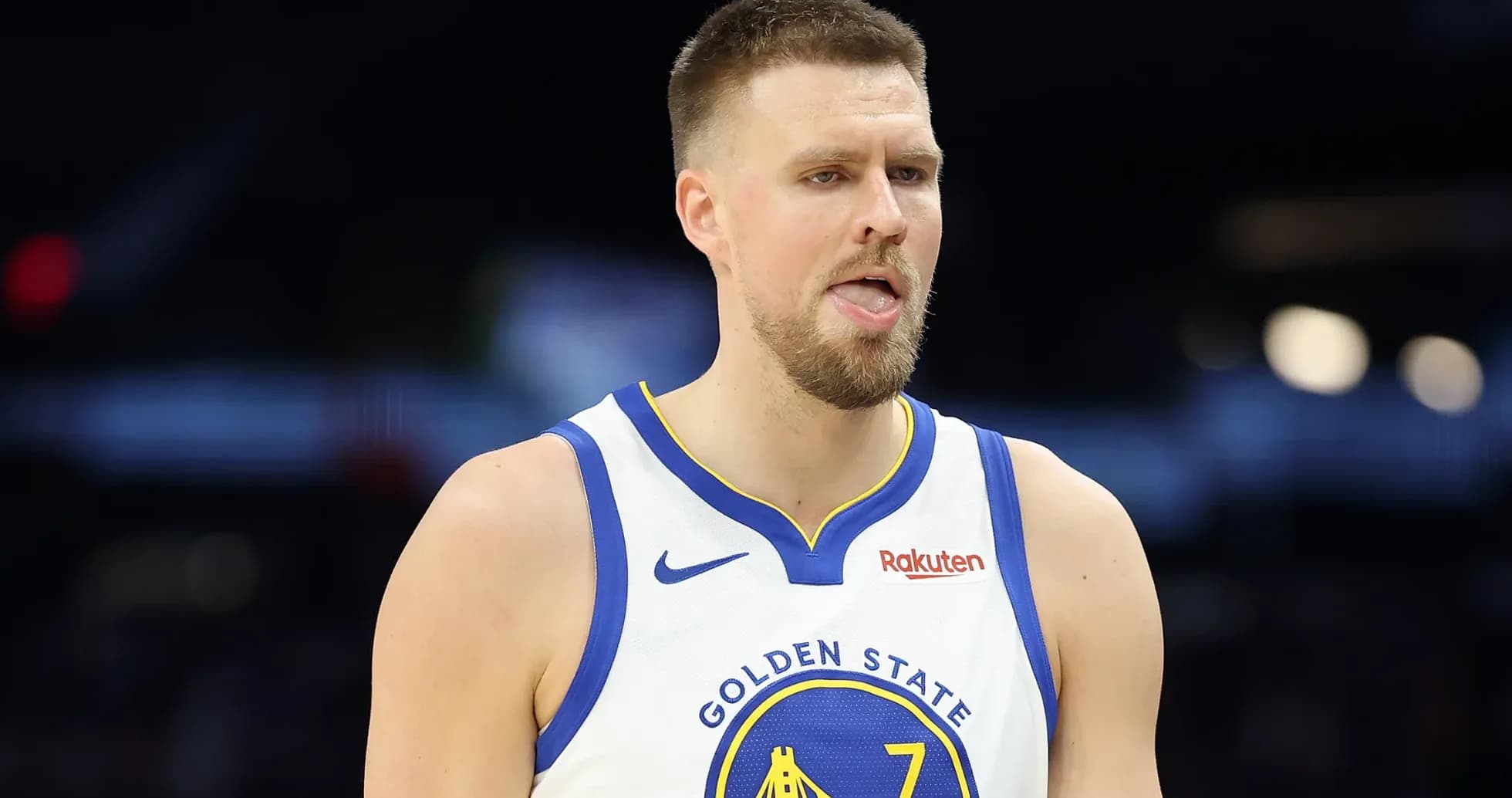
Kristaps Porzingis was supposed to be a luxury. Now, for the Golden State Warriors, he’s a necessity.
They doubled down on that belief this offseason, re-signing the 7-foot-3 Latvian to a two-year deal worth $40 million, a clear statement that they are willing to live with the risk if the reward is a fully engaged, fully healthy Porzingis anchoring both ends of the floor.
This is a franchise that paid a steep price to get him. At the trade deadline, Golden State sent Jonathan Kuminga and Buddy Hield to the Atlanta Hawks to bring Porzingis to the Bay. It was a bold swing for a team straddling two timelines and searching for one more meaningful run with its veteran core.
They barely got a glimpse.
Porzingis managed just 15 games in a Warriors uniform, derailed again by a recurring medical issue. But those 15 games were enough to tease the vision the front office and coaching staff keep coming back to: 16.1 points, 5.3 rebounds, 2.3 assists and 1.1 blocks per night, wrapped in the kind of floor spacing and rim protection that can still tilt playoff series.
The Warriors are betting that next season, that version of Porzingis becomes the norm, not the exception.
Vogel’s Blueprint for a 7-Foot-3 Anchor
One of the clearest signs of that bet sits on the bench.
Frank Vogel arrived in Golden State this offseason, stepping into the assistant role after Terry Stotts, Jerry Stackhouse and Chris DeMarco departed. Vogel’s reputation is carved in stone: he builds defenses around a shot-blocking big man. He did it with Roy Hibbert in Indiana. He did it with Anthony Davis in Los Angeles. He plans to do it again with Porzingis.
“We feel like Kristaps can fill that role,” Vogel told the San Francisco Chronicle. He didn’t dance around it. He sees Porzingis as the next in a line of rim protectors who have been the backbone of his schemes.
Vogel spoke openly about plugging Porzingis into his defensive system, a structure he believes can squeeze maximum value out of a long, mobile big. The details matter to him—angles, positioning, timing, how a center reads drives and closes space without fouling. He’s convinced those nuances can turn Porzingis from a good defender into a system-defining one.
For a Warriors team that slipped defensively and has grown older almost overnight, that kind of impact isn’t a luxury. It’s survival.
A Thin Frontcourt and a Heavy Burden
The pressure on Porzingis isn’t just tactical. It’s structural.
Golden State’s depth at center is paper-thin. Al Horford, still crafty and clever, is also the second-oldest player in the NBA. Charles Bassey, on the other hand, has never shouldered a major role. Between them sits a massive gap, and Porzingis is expected to fill it for 30-plus minutes a night.
That reality shaped his summer. Instead of suiting up for Latvia in FIBA World Cup qualifying windows, Porzingis stayed out, prioritizing his recovery and rehab. The Warriors didn’t just approve; they quietly needed it. They cannot afford to have $40 million tied up in a player who spends most of the year in street clothes.
The organization is banking on a simple equation: fewer national team minutes now, more NBA minutes when it counts.
The Shadow of His Injury History
The risk, of course, is not theoretical.
Porzingis has not played 70 games in a season since his rookie year with the New York Knicks back in 2015-16. Every stop since—New York, Dallas, Boston, now Golden State—has followed a familiar pattern: stretches of high-level production interrupted by injuries that halt momentum and raise the same old questions.
When he’s right, the numbers have always followed. Stretch fives who can protect the rim are rare. Stretch fives who can also put the ball on the floor, pass, and function as a hub in the half court are rarer still. That’s why the Warriors took the gamble in the first place. That’s why they’re doubling down now.
Inside the building, the tone around his health has shifted from cautious to quietly optimistic.
General manager Mike Dunleavy Jr. said the front office and medical staff dug deep into Porzingis’ situation, trying to understand the pattern of his injuries and what could be changed. “We looked at it extensively, what’s going on, how we can help him, how we can be better,” Dunleavy told the Chronicle last month. His conclusion was pointed: the work they’ve done “lean[s] in the direction of him having a healthier year.”
That’s not a guarantee. It’s a conviction. There’s a difference—but for a franchise in Golden State’s position, conviction is what drives decisions.
One More Roll of the Dice
The Warriors know what they are asking of Porzingis: to be the rim protector Vogel’s system demands, the floor spacer their offense craves, and the durable presence his résumé has rarely promised.
They also know the alternatives are limited. With an aging core, a shallow frontcourt, and a Western Conference that only gets more punishing by the year, this is a roll of the dice they almost have to make.
If Porzingis holds up, Vogel gets his anchor, the defense tightens, and Golden State suddenly looks a lot more like a team built to bother the league’s elite again.
If he doesn’t, the cost of this gamble won’t just be measured in cap space and draft capital. It will be measured in how many chances this era has left.