.svg&w=384&q=75 "logo")
Katie Taylor's Historic Send-Off in Croke Park
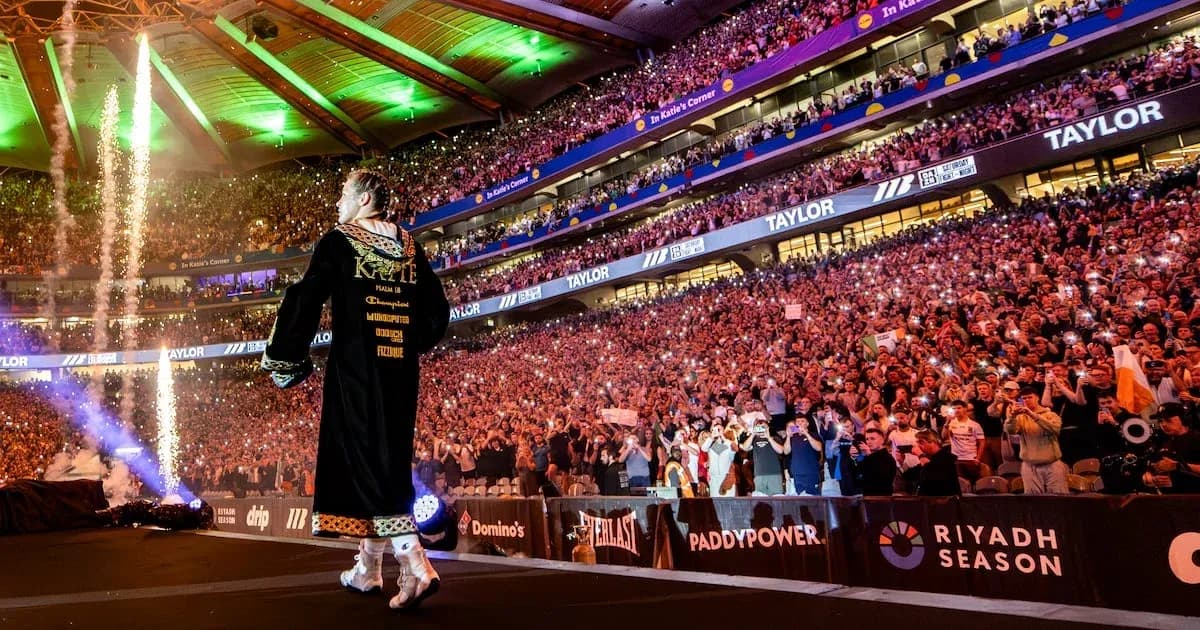
By the end, it felt less like a boxing match and more like a nation tucking one of its own into a well‑earned retirement. No gold watch. No lawnmower. Katie Taylor’s send‑off came in the form of 80,000 people in Croke Park, a soft September night, and a wall of sound that never really stopped.
Natasha Jonas, once across the ring from Taylor and now on RTÉ duty beside Bernard Dunne, watched it all with the knowing air of someone who has seen the cult up close. “It’s unreal,” she said, but she wasn’t shocked by the scale of it. She told the story of trying to qualify for the 2012 Olympics in “the middle of nowhere in China,” hearing an almighty roar from somewhere in the venue. She wandered over, baffled.
“When Katie was on, I heard a big massive roar. I went over to the crowd and said ‘youse can’t be Irish?’ But they were, they came from Beijing. People just follow her wherever she goes.”
They followed her again to Dublin, in numbers that felt historic. Some in the stands assumed this was the biggest crowd ever for a fight – though a few Mayo fans may simply have refused to leave – but the record books say otherwise. Tony Zale v Billy Pryor at Juneau Park, Milwaukee, drew a scarcely believable 135,132 back in 1941. No Jumbotrons then, so roughly 134,132 of them probably never saw a punch land, never mind who got their hand raised.
No such uncertainty here. Croke Park glowed. Whoever designed the lighting show deserved a bonus and a standing ovation of their own. The stadium pulsed with music, a ready‑made choir of 80,000 belting out Grace, The Fields of Athenry and Zombie with the kind of gusto usually reserved for last orders.
Visitors from abroad must have wondered what on earth they’d stumbled into. Taylor, a national icon, being serenaded with songs about a man executed just after his wedding, a man deported to Australia for stealing food during the Famine, and the killing of innocents during The Troubles. On the pitch: joy. On the playlist: trauma. This is how Ireland parties.
RTÉ leaned into the emotion and twisted the knife. Montage after montage rolled, Bernard Dunne clinging to composure. “This is more than just a boxing match,” he told host Jacqui Hurley. “It’s a celebration, a thanks for what Katie’s given us over the years.” Right on cue, My Way thundered over the PA and any remaining stoics in the ground were finished.
Then came the phones. A galaxy of tiny lights, swaying as three‑quarters of Westlife delivered You Raise Me Up. If that didn’t get you, Marty Morrissey dancing with Michael Flatley to Olé Olé Olé might have. It was part rave, part cup final, part farewell concert. Jacqui Hurley nailed it: “It’s like a rave that meets a football occasion.”
Ringside, Paul O’Flynn grabbed Shane Lowry for a chat, one Irish sporting heavyweight saluting another. On the big screens, tributes rolled in from Bono, Ed Sheeran, Niall Horan and Rory McIlroy – all apparently reduced to video messages like the rest of us. Just before the national anthem, Barry Keoghan’s voice took over.
“All stories begin at home. The rare ones end there, too. And so, Katie returns for every fan who walked the journey beside her ... for all Ireland. When they ask you about Katie, you can begin with four simple words. Once upon a time.”
Somewhere, Kleenex sales spiked.
Flora Pili, the woman tasked with sharing the ring and the spotlight, emerged to a scene that seemed to stop her in her tracks. Her expression screamed “mon Dieu,” but she didn’t bolt for Rosslare. She stood her ground, a visiting fighter staring down not just Taylor but an entire country’s affection.
Taylor’s entrance carried a very different tone. She walked in to All Hail King Jesus, a hymn that left the crowd largely mute, before the night exploded again in the mother of all firework displays. Taylor puffed out her cheeks, taking it in. For once, Madison Square Garden looked small. Croke Park turned Bray’s most famous boxing gym rat into something even bigger than a world champion.
“I’m feeling pretty emotional myself here and it hasn’t even started,” admitted commentator Hugh Cahill. Beside him, Eric Donovan could only gasp: “Oh my gosh, this is extraordinary.”
When the bell finally rang, the spectacle shrank to its purest form: two fighters, three judges, one outcome. Pili showed courage, but she rarely troubled Taylor. The Irishwoman controlled the ring, the tempo, the story. Any clean shot from the visitor would have felt like an act of vandalism against the mood of the place. The unanimous decision landed exactly where everyone expected, and the roar that greeted it was warm rather than wild – a thank you more than a celebration of dominance.
Then came the moment that will live longest. Taylor spoke to the crowd, then walked to the centre of the ring and laid her gloves down. A simple act, heavy with finality. They rested on the Lidl logo, an image marketing departments dream about. Somewhere in corporate Ireland, executives toasted a stroke of fortune that rivalled Nike’s famous Masters shot, when Tiger Woods’s ball paused on the lip with the swoosh facing the camera. Aldi, you suspect, were less amused.
“What now?” O’Flynn asked her.
“I’m just going to enjoy the fruits of my labour,” Taylor replied. “I’m going to eat chocolate.”
After everything she has given – the medals, the belts, the nights like this – a Time Out feels about right. And this time, she’s earned one that never ends.