.svg&w=384&q=75 "logo")
Katie Taylor’s Final Bell: Embracing Retirement and the Unknown
Retirement is the one opponent no fighter can outwork. No tape to study, no sparring rounds to sharpen the timing. Just a vast, unknowable space on the other side of the final bell, where the cheers fade and the lights go out.
Katie Taylor now stands on that edge.
Sport is littered with cautionary tales. Premier League and NFL stars who go from mansions to courtrooms, from back-page heroes to front-page tragedies. Bankruptcies. Sudden divorces. The emotional crash that athletes grimly call their “first death”.
Boxing has always understood that darkness. Eddie Arcaro, the American jockey who remains the only rider to win the US Triple Crown twice, put it brutally: “When a jockey retires he becomes just another little man.” Ray “Boom Boom” Mancini, once the WBA lightweight world champion, was just as stark. Since retiring, he said, he ate less, weighed less, trained less – and cared less.
They both built good second lives. That didn’t make the transition any less real.
Taylor now faces that same reckoning. What does the greatest Irish fighter of them all do when the gloves are finally folded away?
A Send-Off Like No Other
Money will not be the problem. Not for her.
A purse of roughly €3 million is expected to drop into her account for Croke Park alone. She took over €7 million from just the last of her three meetings with Amanda Serrano. And that’s only the visible tip of a decade at the summit. If boxers come back because they are broke or because they need the money, as former undisputed middleweight champion Alan Minter once joked, Taylor should be safe on both counts.
What she crafted instead was something far rarer in this sport: a near-perfect exit.
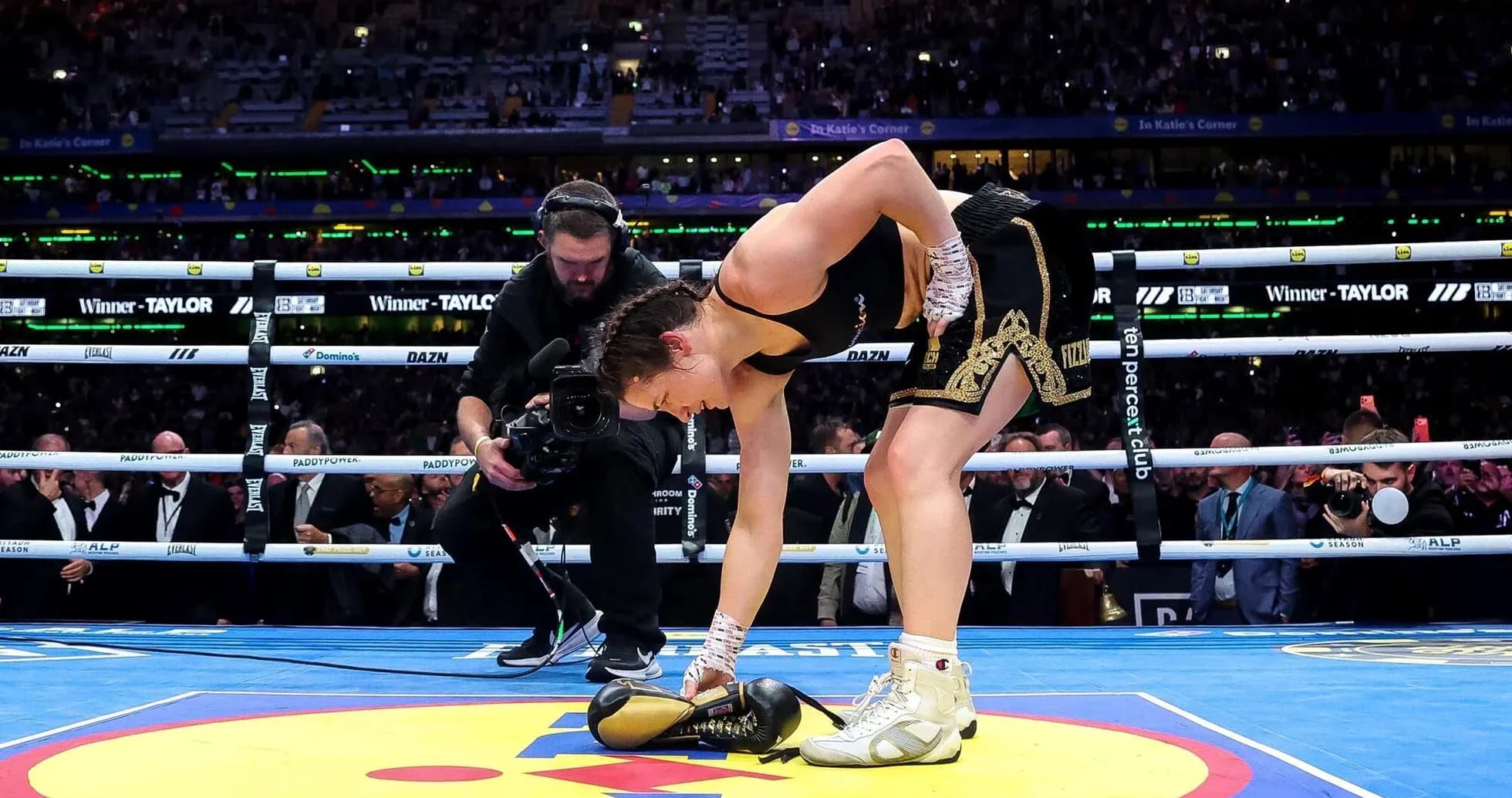
As Irish sporting farewells go, this one sits at the very top. Brian O’Driscoll’s 2014 long goodbye – crowned with a Six Nations title and a nation’s affection – now looks like a distant runner-up. Taylor’s final act at Croke Park was something else entirely, a night where the crowd’s love seemed to spill out of the stadium and into the September air.
Everything about it felt definitive. Complete. A career tied off with the kind of grace boxing almost never grants its champions.
The Second Act Nobody Can Script
And now? The unknown.
If promoter Brian Peters gets his wish, the next time the public sees Taylor won’t be under bright lights but beneath the low ceilings of parish halls. Inisbofin, and a necklace of unlikely venues scattered across Ireland, are pencilled in as stops on a nationwide stage play called “Her Story”, where she will sit alongside Steve Bunce and revisit the journey.
“It's going to be quite magical,” Peters said.
On paper, it sounds at odds with the Katie Taylor Ireland thought it knew. The fighter who spent a career avoiding the spotlight away from the ring, who recoiled from self-promotion, now touring the country to talk about herself? That doesn’t quite fit.
Then again, second acts rarely do.
Who would have predicted Roy Keane, once the snarling heartbeat of Manchester United, would become a media celebrity and darling of the advertising world? Or imagined the slow-motion car crash that Bill Belichick’s public image became once he stopped being the all-powerful Patriots coach?
Taylor has already started to shift. In the final week of her career she was more vocal than ever. Eddie Hearn even joked about how long she spoke in the ring after her polished win over Flora Pili. For once, she didn’t just let her gloves do the talking.
She has a voice. The only question is what she wants to say.
From Silence to Influence
Taylor explained it simply on Sunday morning. Very early in her career, she decided she would not sell herself with words. She would show people instead. Show them her boxing, her excellence, her talent. That was the language she trusted. And she stayed loyal to that idea right to the end.
Those skills do not have to disappear now. They can be passed on.
It feels almost certain she will remain tied to boxing in some form, but that certainty opens up more paths than it closes. Coaching is the obvious route. She has already shaped one generation of Irish fighters, men and women alike. Many of them have said it outright: she changed what they believed was possible.
Last week’s image of her sparring with ten-year-old Clodagh Keating captured that better than any speech. A national icon, gloves on, moving lightly around a child who looked at her the way a whole generation once did watching Olympic finals and Madison Square Garden nights. That hold on the next wave is already there.
When asked about a formal role in Irish boxing, Taylor half-joked that trying to persuade her husband to swap their home in Connecticut for a permanent move back to Ireland “might not have gone down very well”. They have six children between them. Any decision now is not just about her.
Faith, Family and a Different Kind of Arena
Boxing will not be the only constant. Family clearly anchors her. So does faith.
At Croke Park she walked to the ring to “All Hail King Jesus”, a choice that left nobody in any doubt about what underpins her. After the fight she spoke openly about how clinging to her beliefs, and to what she sees as the word of God, carried her through the darkest nights of her career – none darker than the heartbreak of Rio 2016.
“Look what God's done,” she said. “He's done the impossible in my lifetime and he's came through time and time again. And that's what I was saying in the ring afterwards and giving him all the glory and the honour for all that I've achieved.”
That kind of open declaration sits more comfortably in the American sporting landscape she now lives in than in an Ireland still wrestling with its relationship to religion. Yet it has never really jarred with the Irish public. Never cut against the affection they feel for her. The adoration at Croke Park was unconditional, rolling down from the horseshoe stands and out into the night.
Her status is unique. Not just as an Irish athlete, but as a figure in the national imagination. People struggle to explain it. So does she.
The Country in Her Corner
Asked why she thinks Ireland has taken her so completely to its heart, Taylor didn’t have a neat answer.
“I don't know, to be quite honest,” she admitted. Maybe, she suggested, it is because people have seen everything. The triumphs and the devastations. The medals and the tears. The heartbreak of Rio. The pain of personal loss. The quieter, private struggles that leaked into public view.
“I think people really resonate with your vulnerabilities as much as your successes,” she said. “They see me cope with the heartbreak of Rio. They see me cope with the heartbreak of the shadow of loss. They see me in the, just, personal difficulties as well. So yeah, I think my story is the story of everybody in the whole country.”
In that answer lies the core of it. Ireland watched her rise, then watched her fall, then watched her rise again. Not as a flawless champion, but as someone who absorbed blows outside the ropes and kept walking forward. The nation recognised itself in that stubbornness.
Now the fighting is over. The belts are banked, the purses secured, the roar stored away as memory. The stage play is coming, the parish halls will fill, the invitations to coach, to speak, to front campaigns will land on the table.
Retirement, the toughest opponent of all, has finally climbed through the ropes to meet Katie Taylor.
Her story? It isn’t finished. Not even close.