.svg&w=384&q=75 "logo")
Julio César Chávez Jr. Dominates with First Round TKO in Puebla
Julio César Chávez Jr. needed less than a round to remind Puebla why his surname still fills arenas.
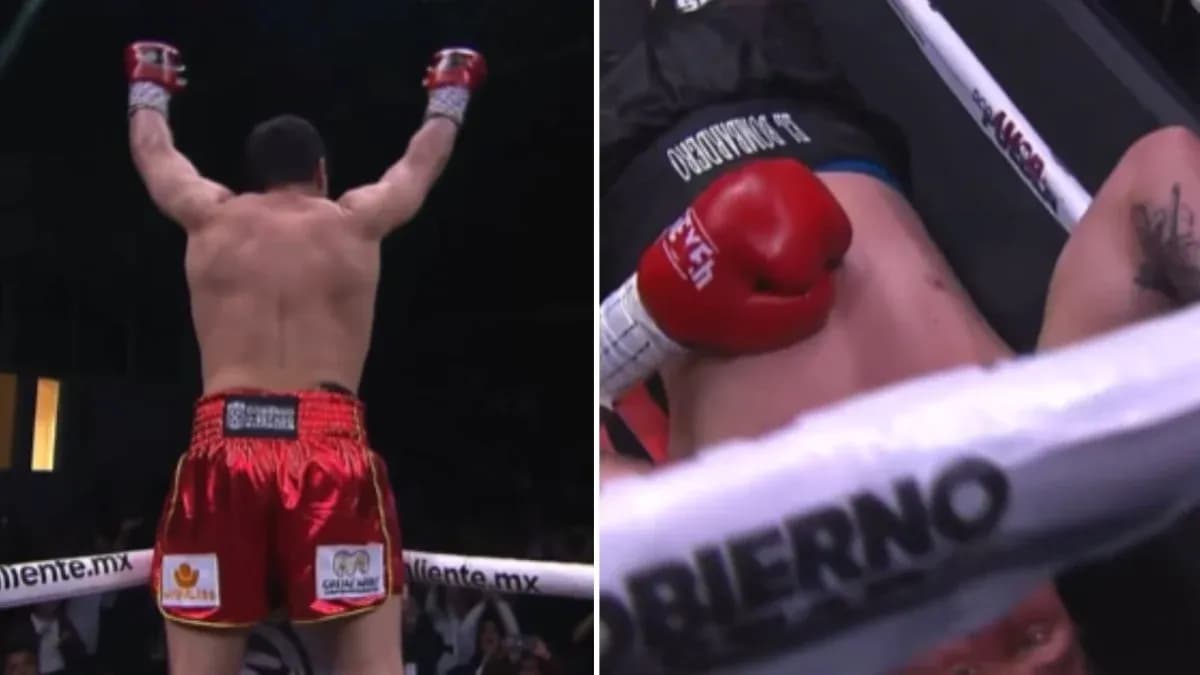
On Saturday night at the Miguel Hidalgo Gymnasium, under the glare of the local lights and the weight of his family name, the Mexican stopped Colombian Jeison Troncoso in 2 minutes and 59 seconds of the first round, a ruthless finish in a bout framed between the heavyweight and super middleweight divisions.
The “Son of the Legend” didn’t wait to warm into it. From the referee’s opening command he walked Troncoso down, cutting off the ring and driving him into a corner. The body was the first target: thudding shots to the midsection that forced the Colombian’s elbows to drop, followed by sharp combinations to the head that shook his high guard.
Troncoso tried to survive behind that shell, edging along the ropes, hoping to buy time. There was none. The pressure from the Sinaloa native was constant, heavy, suffocating. Each second that passed chipped away at Troncoso’s resistance and, with it, any notion that this would be a long night.
The breakthrough came with a brutal left hook. Chávez Jr. whipped it in clean, sending Troncoso staggering back into the ropes, his balance gone, his legs betraying him. Sensing the finish, Chávez Jr. stepped hard on the accelerator, unleashing a power combination that crashed through what remained of the Colombian’s defense and dumped him on the canvas.
Troncoso tried to respond, but his body told the truth. The referee watched closely, took a long look, and with the clock ticking down on the opening round, waved it off in the final second. Technical knockout. Statement made.
For those in the arena, it was a throwback to a time when the Chávez name meant inevitability. For those watching from afar, it was a reminder that the former world champion is not done chasing relevance among boxing’s elite. As chronicled by outlets such as Récord, Mediotiempo and Tribuna Noticias, Chávez Jr. had spoken with intent in the build-up; his actions in Puebla matched the words. He wanted a quick, emphatic finish to underline his ambitions. He delivered one.
A streak not seen in over a decade
Beneath the spectacle, the numbers tell their own story. This victory marks Chávez Jr.’s third consecutive win on the professional circuit, a modest streak on paper, but one that carries real weight in the context of his career. He had not strung together three straight victories since the 2010–2012 stretch, the period before Sergio “Maravilla” Martínez stripped him of both his undefeated record and his world title.
Now, on the other side of those turbulent years, the Puebla knockout pushes his professional tally to 56 wins, 36 of them before the limit. It is a résumé that still commands respect, particularly in a sport where longevity is as unforgiving as any opponent.
Récord highlighted a phrase that has become something of a personal banner for Chávez Jr. in the days leading up to the fight: “old are the hills.” With it, he brushed aside questions about age, wear, and whether his best days had long since passed. On this night, at least, his fists made the argument for him.
Questions about the rival, not the finish
Not everyone left the result untouched. As soon as the dust settled, analysts began to dissect the level of opposition. Coverage from Mediotiempo and others pointed out that Troncoso offered far less resistance than expected, portraying him as a fighter with limited defensive tools and few answers once Chávez Jr. turned up the heat.
That criticism hangs over the win. A first-round stoppage looks spectacular on the highlight reels, but within boxing circles, the name across the ring matters as much as the method of victory. For some, Troncoso simply did not represent the kind of test that can truly measure where Chávez Jr. stands in the current landscape.
Inside the Mexican’s camp, though, the tone is different. The satisfaction is not just about the knockout, but about rhythm: staying active, sharpening timing, and reinforcing the confidence that had eroded during the lean years. Those close to the Sinaloan’s team frame nights like this as deliberate steps—carefully chosen fights to rebuild form and self-belief before taking on opponents with bigger profiles and higher rankings.
The strategy is clear. Keep winning. Keep punching with authority. Then cash it in when the right name appears on the contract.
Eyes back on a world title
The Puebla performance slots neatly into that plan. A clean, dominant, early finish supports the narrative of a fighter on the rise again, not one merely clinging to his surname. For a boxer who once headlined major cards and carried a world title, the road back to that level runs through evenings like this: no drama, no doubt, no room for controversy in the result.
Behind the scenes, the goal remains fixed—another crack at a world championship. The recent consistency, rare in his post-title years, opens the door to negotiations with world-ranked contenders, the type of opponents that can propel him from regional attraction back into the global conversation.
The surname Chávez will always draw attention. What matters now is whether Julio César Chávez Jr. can turn that attention into one last, serious run at the summit. Nights like the one in Puebla won’t answer that question on their own.
They do, however, make sure it still gets asked.