.svg&w=384&q=75 "logo")
Japan's Rise in Cricket: From Curiosity to Strategic Venue
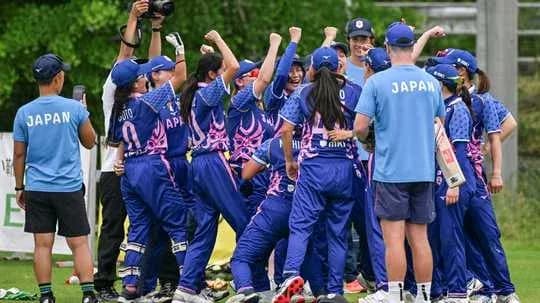
Japan does not yet move the cricketing world with bat and ball. But it is starting to move the people who run it.
For the International Cricket Council, the country is no longer a curiosity on the fringes of the game. It is a strategic project. A nation that has already shown it can host the world in other sports is now being quietly groomed to do the same for cricket.
This week’s Asian Games only sharpen that focus.
From Olympic host to ICC candidate
Japan has already staged the Olympic Games, the World Aquatics Championships and the World Athletics Championships. Now it adds the Asian Games to that list. Administrators at ICC headquarters have taken note.
“So part of our longer-term strategic planning with Japan is how do we work with them to build up their capabilities to host larger ICC events, and potentially one day… there might be an opportunity to host or co-host a Youth World Cup,” says William Glenwright, ICC’s GM – Development.
That is not idle talk. The ICC has started to treat Japan as a serious future venue, not simply an emerging team. To get there, it needs more than just better players. It needs administrators who understand what it means to welcome the world champions, broadcasters who can deliver a polished product, and facilities that stand up to global scrutiny.
Which is why India’s decision to play a bilateral T20I against Japan, ranked 41st in the world, matters so much inside the ICC.
India’s visit as a stress test
“India's tour of Japan is so important,” Glenwright explains. “Not only does it build the capability of the cricket team, but it builds the broader capabilities of the organisation around meeting the demands that come with hosting world champions.”
This is the real examination. Can the Japan Cricket Association (JCA) move players, media, security and fans with the efficiency expected at a major ICC event? Can it handle the glare that comes with India, the sport’s economic powerhouse, even for a single T20I?
For the ICC, a full member and reigning world champion stepping into an associate member’s backyard is a powerful endorsement.
“Having a full member and the world champions playing any associate member is hugely important to us from a cricket perspective,” Glenwright says. The fixture carries a second layer of meaning too: what it signals to Japan about cricket’s place in its sporting landscape, and what it signals to full members about the readiness of associates to host them.
Those are the ripples the ICC is banking on.
A quiet surge on the field
While the administrative groundwork is being laid, Japan’s teams have been steadily stacking results.
The men’s side has gone from occasional participant to regular competitor. In 2022 they played seven matches, winning five. In 2023 they played eight, splitting them four wins and four defeats. The schedule exploded in 2024: 25 games, 18 victories, six losses and one abandoned. In 2025 they played 11 times, winning six. So far in 2026, they have taken the field 10 times and won eight.
Those numbers are not padded with soft fixtures either. Japan have claimed wins over Kuwait (ranked 23rd), Bahrain (27th) and Papua New Guinea (22nd). For a side sitting 41st in the world, those are markers of genuine progress.
The women’s curve is just as telling, perhaps more so. Four matches in 2022, all lost. Then 16 in 2023, with four wins. In 2024 they turned a corner: 14 matches, 10 victories. In 2025 they played 11, winning seven. In 2026, five games so far, three wins.
The raw figures tell the story of a programme moving from survival to competitiveness.
A captain who has seen the shift
Mai Yanagida, captain of Japan’s women’s team, has lived that transformation.
“Yeah, Japan is not a cricket nation like India,” she says, “but I think over the last few years, or 10 years, I think the awareness of cricketers and the popularity of cricketers has increased. So hopefully there'll be a lot of crowd and people will watch us play. And hopefully, yeah, we'll compete with one of the top nations.”
That hope becomes a reality on Friday morning (IST), when Japan open their Asian Games campaign against India. It is a mismatch on paper. On the ground, it is the kind of game that can change how a country sees a sport.
Yanagida and her teammates have been doing their homework. They followed India’s march through the recent Asia Cup and have been regular viewers of the WPL, studying the very players they are about to face.
“Facing India is just unreal. And it's very exciting,” she says. “Of course, we've never played against them before. They are one of the top nations. We were watching the Asia Cup, we were following them. They just won the tournament. I know that all the players are top-class players. It can be intimidating. But it's more like an excitement to watch them and see them play and share the field with them.”
For Japan’s players, this is a once-in-a-generation opportunity. For the ICC, it is a live test of how far the game has travelled in a country still learning its rhythms.
Screens, streams and a new audience
The growth is not confined to the middle. It is on the screens too.
For the first time, the ICC live-streamed select matches into key emerging markets on YouTube and Facebook. The response in Japan was impossible to ignore: more than 1.1 million views across platforms.
The non-English feeds on YouTube drew 201,000 views from Japan and Indonesia combined. Japanese-language coverage accounted for 58 per cent of that total – 118,000 views – leaving the remaining 42 per cent to Hindi and Urdu.
On Facebook, the tilt was even more pronounced. Non-English streams across the two territories attracted 252,000 views, and Japanese feeds delivered 70 per cent of them.
Those are not numbers you file away and forget. They are the kind that force strategy meetings, the kind that tell you a dormant market has started to stir.
Asian Games as a gateway
The Asian Games sit under the Asian Cricket Council’s umbrella, but their significance stretches directly into ICC planning.
“For a number of reasons,” Glenwright says. “Firstly, because the Olympic Games is limited in size, as it is for all sports, the Asian Games or the regional games allow more of our members to participate in a multi-sport event. And secondly, that unlocks all sorts of funding from governments, from Olympic committees and from sponsors, in addition to the increased competitive opportunities that it provides.”
This is where development theory meets bricks and mortar.
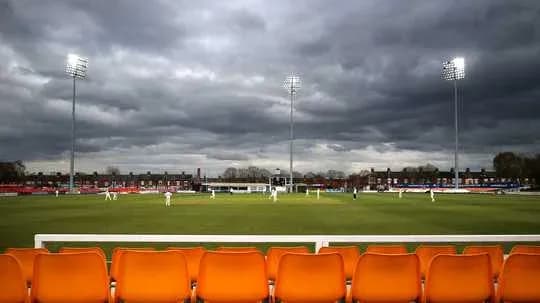
On the back of the Asian Games, Japan now has a second international-standard ground. Sano was the original hub. Nagoya is the new addition. Two proper facilities change the equation completely.
“So that means we have two international-standard facilities in Japan,” Glenwright points out, “which means all of a sudden, the capability and potential for Japan to host major ICC events, where by and large you need at least two international facilities, changes now, and it brings Japan into the equation.”
The venues themselves have attracted scrutiny. Reports of concerns around the Asian Games ground surfaced under the ACC’s watch. The ICC, which staged a World Cup qualifier there earlier in the year, is relaxed.
“The ground itself, we have no concerns with,” Glenwright says. “We held a World Cup qualifier there earlier this year. The reports are that the pitch and the outfield are excellent. We wouldn't have held a World Cup qualifier there if we weren't confident in it.”
The issues flagged, he says, sit around the edges: athletes’ enclosures, changing rooms, media areas. Not the playing surface.
“I believe they are being addressed. And the last update that we had is that they were being addressed. But in terms of the pitch itself and the outfield, the cricket facility, we're very confident that it's going to be a great facility that reflects the importance of this event and the members participating in it.”
From outpost to player
So where does that leave Japan?
A women’s team about to walk out against India at a major multi-sport event. A men’s side that now regularly beats teams ranked well above it. Two international grounds. Streaming figures that demand attention. An ICC development chief openly talking about Youth World Cups.
Japan is not yet a cricket nation. But the question no longer is whether it belongs in the game’s long-term picture.
The question now is how quickly it can turn opportunity into permanence.