.svg&w=384&q=75 "logo")
Humanoid Robots Shine at Nanning Football Carnival
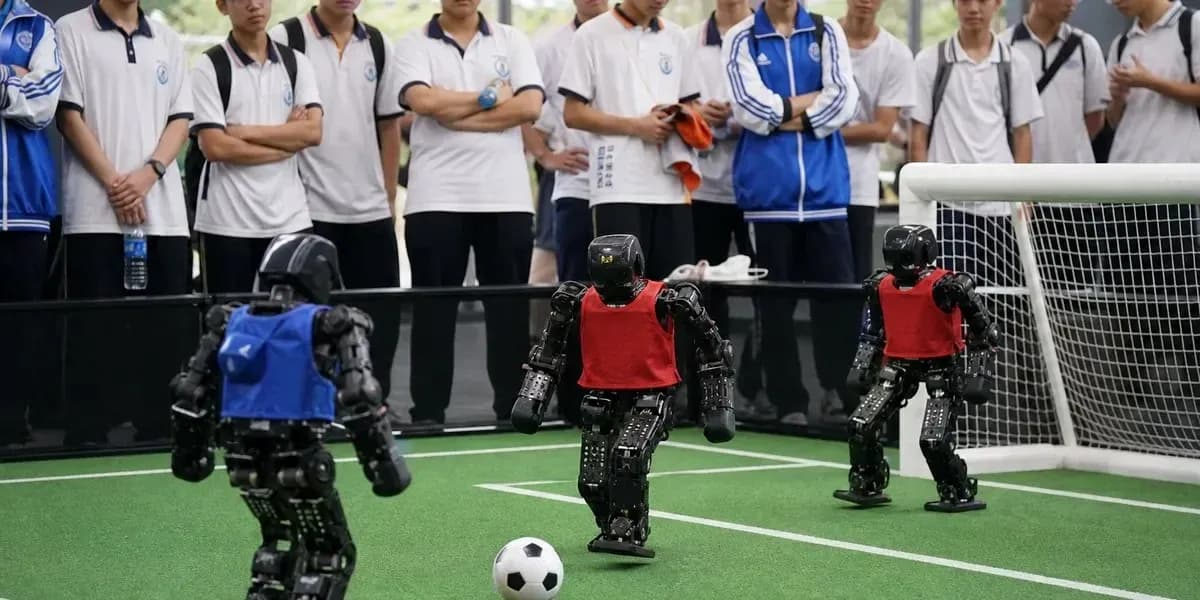
The whistle went in Nanning on Thursday, but the players charging into space weren’t teenagers in school kits. They were humanoid robots.
China’s southern city, capital of the Guangxi Zhuang Autonomous Region, staged its first humanoid robot football carnival for secondary school students, turning a standard school competition into a glimpse of where the sport — and technology — might be heading.
More than 40 students from 10 educational institutions lined the sidelines, not to sprint into tackles, but to watch their creations do it for them. Every team worked with the same model, the Booster K1 humanoid robot, then relied on code, not coaching shouts, to make the difference.
Three-on-three, no joysticks
The format is stripped back: three-on-three matches, small-sided, high tempo. But there’s a twist that would make even elite analysts pause — once the robots step onto the pitch, they are entirely on their own.
No remote controls. No mid-game tweaks. The robots operate fully autonomously, guided by artificial intelligence systems that handle everything from positioning to decision-making in real time. Students prepare them, program them, then watch the AI try to read the game like a seasoned playmaker.
For Guangxi, this is more than a novelty tournament. Organizers describe it as the largest and highest-level humanoid robot football event ever held in the region for secondary school students, a statement of intent in a field where education, sport, and cutting-edge tech collide.
A different kind of double-header
The timing is no accident. The carnival runs alongside the 23rd China-ASEAN Expo, held in Nanning from September 17 to 21, pulling the robot matches into a much broader stage.
While the robots trade passes, the surrounding program leans heavily into science and innovation. There are scientific events, interactive demonstrations, and organized China-ASEAN exchanges, with parents and children drawn into hands-on activities that sit somewhere between a lab, a classroom, and a fan zone.
One of the expo’s three main exhibition zones this year is devoted specifically to artificial intelligence and cooperation in that field, mirroring the action on the pitch. The theme — “CAFTA 3.0 Opportunities, Better Life” — hints at the bigger picture: this isn’t just about teaching kids to build robots; it’s about training a generation to think in algorithms and applications.
On a small pitch in Nanning, AI-powered humanoids are learning how to press, pass, and score. The real question is how quickly the students on the touchline will turn those lessons into the next wave of innovation beyond the stadium lights.