Harriet Dart Reaches First WTA Singles Final After Long Journey
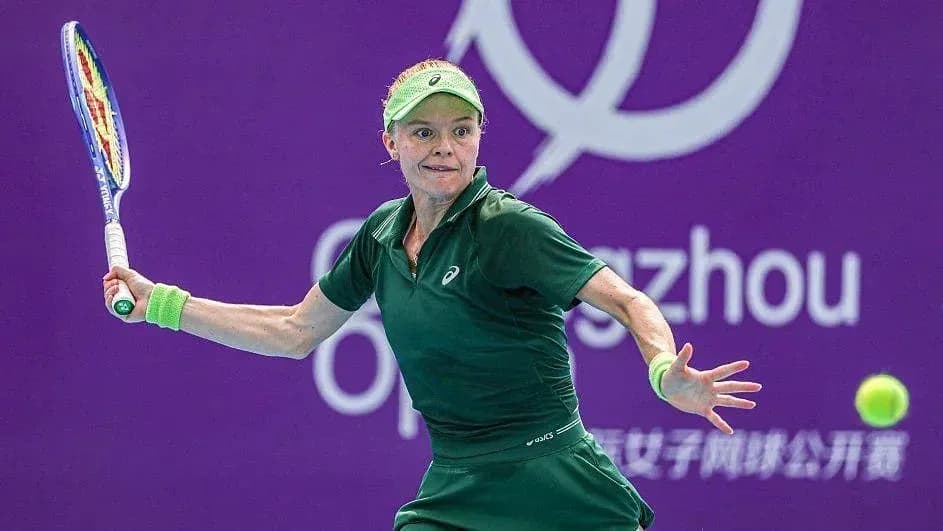
Harriet Dart held her towel to her face and tried, briefly, to hide it. The tears still came. After nine years on the WTA Tour, after setbacks, slips and stalled momentum, the Briton finally has what she has chased for so long: a place in a tour-level singles final.
“It’s been a really long journey… To finally be here means the world,” she said, voice cracking, after a 5-7 7-6 (7-1) 6-0 comeback win over Chinese wildcard Sun Xinran at the Guangzhou Open.
This was not a smooth ascent. It was a scrap.
A brutal start, a stubborn response
Dart walked on court as a 30-year-old qualifier, into only her second WTA semi-final after this year’s Transylvania Open. Across the net stood a 16-year-old reigning US Open junior champion playing at home, swinging free and backed by a noisy crowd.
The start was harsh. Dart double-faulted on break point in her opening service game and fell 3-0 behind, the match threatening to run away from her before it had settled. She barked at herself, glared at her box, then dug in.
From there, she began to own the baseline. Four straight games took her from 1-4 to 5-4, the British number five dictating rallies, driving Sun back and finally imposing her weight of shot. The chance to serve out the set felt like a turning point.
Instead, it turned into a flashback to old frustrations. Two more double faults crept in at 5-4, the arm tightening at the worst possible time. Sun pounced, broke again and then held to 15 to steal the opener 7-5. Dart walked to her chair shaking her head, the opportunity gone.
Match points faced, a tie-break seized
The second set became a tug of war. Dart broke in the first game. Sun broke straight back. Dart surged again in the fifth game. Again, the teenager replied immediately.
Every time Dart leaned in, Sun met her with fearless counterpunching and the roar of a home crowd. Every time Dart tried to settle, something – a loose serve, a shout from the stands – dragged her back into a fight.
She admitted she “found it tough out there,” calling it “a rollercoaster” and confessing she was “really battling with myself”. You could see it. She repeatedly complained to the chair umpire about the noise, her irritation spilling between points.
The pressure peaked late in the second set. Twice Dart had to serve to stay in the match. Multiple match points came and went for Sun, the teenager a point away from a statement win. Dart, though, refused to give her that final opening. First serves landed. Forehands found their mark. Each hold felt like an escape.
When the tie-break arrived, the tension snapped — and only for one player. Dart surged through it 7-1, suddenly unplayable, stripping errors from her game and silencing the crowd that had been in full voice all afternoon. The fist pump at set point was as much about survival as belief.
A teenager fades, a veteran takes over
From there, the contest turned sharply. Sun, who had pushed so hard for nearly two hours, began to struggle both physically and emotionally. She took a medical timeout for treatment on her left leg, her movement clearly compromised. Her shoulders dropped, her timing frayed.
Dart sensed it immediately.
She raced through the decider, reeling off game after game without a backward glance. The numbers tell the story: 28 of 41 points won in the third set, not a single game conceded. Her serve, so fragile early on, became a platform. Her groundstrokes pinned Sun in the corners. The match that had once hung on a knife-edge became a rout.
By the time she sealed the 6-0 set, the earlier chaos felt distant. This was a seasoned pro closing out a teenager whose tank had emptied.
Long road, big chance
For Dart, who first tasted WTA main-draw action in Eastbourne back in 2015, this final has been a long time coming. Years of qualifying draws, first-round exits and near-misses have built to this week in Guangzhou, where she has come through as a qualifier and now stands one win from a title.
She will face either fourth seed Lilli Tagger or Kaitlin Quevedo in Sunday’s final. Victory would do more than deliver silverware: it would haul her back into the world’s top 100, a place she has already all but reclaimed in the live rankings by climbing 14 spots to 101.
She spoke of wanting it “so much, so badly – sometimes too much.” On this evidence, the weight of that desire has not crushed her. It has hardened her.
She said she was “proud of the second set” and how quickly she turned it around. The third set underlined why. When the door finally opened, Harriet Dart didn’t hesitate. She walked straight through it, into the first WTA singles final of her career.