.svg&w=384&q=75 "logo")
Gianni Infantino Agrees to Independent Governance Review
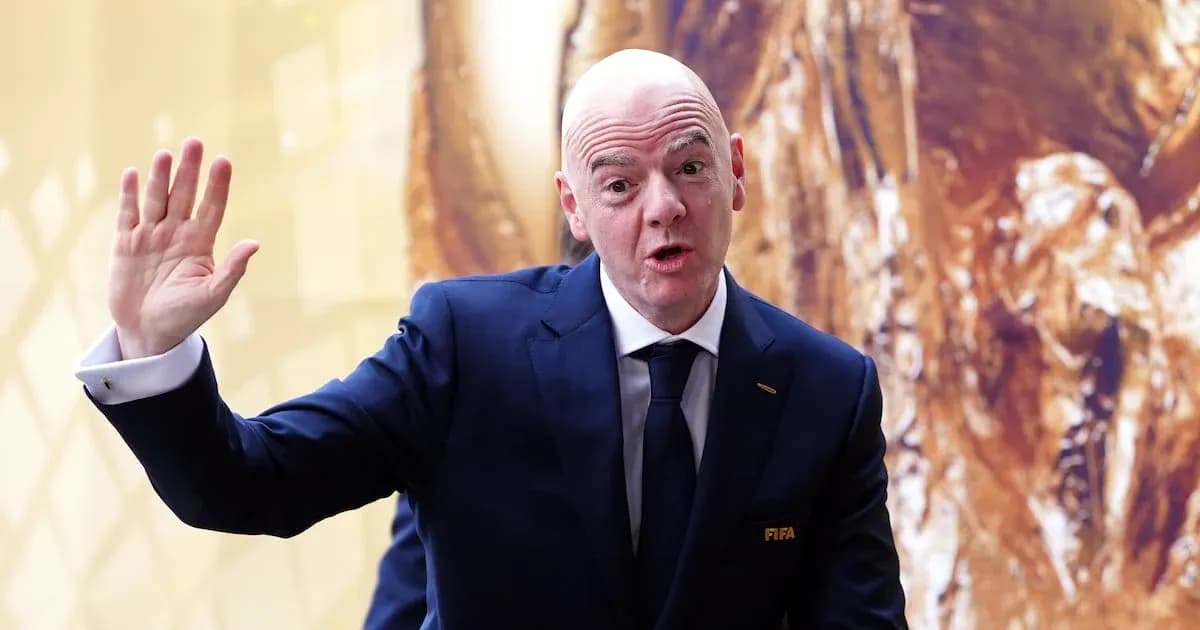
Gianni Infantino has finally blinked.
Under intense pressure over the World Cup sale storm and a growing revolt inside his own corridors of power, the Fifa president has agreed to commission an independent governance review – a step he has long resisted and one that will test how much scrutiny football’s most powerful man is really prepared to accept.
Infantino yields to calls for outside scrutiny
For weeks, council members had been pushing for an external investigation into two flashpoints: the proposed sell-off involving Fifa Forward Enterprise (FFE) and the handling of the Folarin Balogun controversy. Those calls hardened when Debbie Hewitt, the English FA chair and a Fifa Council member, wrote directly to Infantino last week demanding full disclosure of all documents tied to both issues.
Infantino chose not to deal with the dissenters head-on. No round-table, no public concession. Instead, he went over their heads.
In a letter sent to all 211 Fifa member associations, he signalled – for the first time – that he is prepared to submit Fifa’s governance to outside examination. It is a notable shift for a president who has spent much of his tenure centralising influence in Zurich.
“First, I will ask the council whether it wishes to commission an independent external review of Fifa’s current governance framework for major strategic initiatives and recommend potential improvements,” Infantino wrote.
The move doesn’t come from a position of comfort. It comes after weeks in which disquiet inside Fifa hardened into organised pressure.
A wider look at how Fifa makes its biggest calls
Infantino’s letter does more than nod to an external review. He also opened the door to a broader debate on who actually wields power inside Fifa and how.
He told associations he will invite proposals to overhaul internal decision-making, with the topic set for discussion at the next Fifa Council meeting in Zurich on 15 October.
“Second, I will propose that the council establish a direct, structured and time-limited consultation with confederations, member associations and relevant stakeholders on how Fifa’s decision-making can be further strengthened,” he wrote.
That consultation, he said, would focus on earlier involvement of institutions in major projects and the precise roles of the president, the bureau, the council and the congress. In plain terms: who gets a say, and when, on the biggest and most lucrative strategic initiatives.
Transparency. Participation. Accountability. All the right words are there. The question now is what survives the political grind of council debate and how far Infantino is genuinely willing to let go.
The key question: real reform or power play?
On paper, the Fifa Council is almost certain to back the commissioning of an external review. The body is made up of 28 representatives from the six confederations, eight vice-presidents and Infantino himself. With that line-up, a formal vote is unlikely to be the stumbling block.
The real battle lies in the small print.
The terms of reference for the review will reveal whether Fifa is prepared to open itself up to meaningful change or whether this is another tactical move by Infantino to tighten his grip ahead of the presidential election in March next year.
Crucially, in his letter to the member associations, Infantino did not promise that FFE or the Balogun affair will be examined specifically. He has left that door half-closed, stopping short of the direct, case-by-case scrutiny Hewitt demanded.
So the president has given ground. But not on the central flashpoints that triggered the revolt.
Money on the table – and confederations want their share
While governance dominates the headlines, another battle is building over Fifa’s vast cash pile.
Infantino is under growing pressure to unlock more of Fifa’s $6bn (£4.5bn) reserves and push it down to national associations. The presidents of Uefa and Concacaf, Aleksander Ceferin and Victor Montagliani, last week made a formal request for a payout of at least $10m to each member association.
That is not a polite suggestion. It is a coordinated demand from two powerful confederations that believe Fifa can – and should – share more of the wealth generated by the World Cup and its commercial machine.
On Monday, Asian Football Confederation president Sheikh Salman bin Ibrahim Al Khalifa joined the chorus, sending a similar letter and ensuring that funding will sit high on the agenda when the Fifa Council meets next month.
So Infantino walks into Zurich facing twin fronts: one over how Fifa makes decisions, the other over how it spends its money.
He has offered an independent review and promised a consultation on power structures. Now the game moves to the council chamber, where the wording of a mandate and the scale of a payout will show whether this is the start of real change – or just another carefully managed escape act.