.svg&w=384&q=75 "logo")
Croke Park's Transformation: From Ali to Katie Taylor
Eddie Hearn likes to talk. That much is well established.
But even he paused for effect at Croke Park last June, before launching into a nine-minute sermon about Katie Taylor, Amanda Serrano and the scale of the night he was trying to sell.
"It's not often I'm lost for words," he began, standing in a stadium that has seen more than its share of history and hyperbole.
Then he reached for the biggest name he could find.
"The last person to fight at this incredible stadium? Mohammad Ali."
It was a neat line. It was also wrong.
Ali did fight there, yes. But Croke Park has lived many sporting lives, some of which passed Hearn by, including the various international rules encounters that came long after Ali’s summer of 1972. Still, the comparison landed, because when Ali came to Dublin, he was treated less like a boxer and more like a visiting head of state.
He was mobbed at Leinster House. He met Taoiseach Jack Lynch in private. He sat down for a long, searching television interview with Cathal O'Shannon that has since become part of Irish sporting folklore. Eddie Keher showed him how to swing a hurl.
Ali, for his part, was determined to meet Bernadette Devlin. They had lunch on the day of the fight and talked politics, a subject on which they found instant common ground.
For Hearn, buried in the archives of that week was a warning.
Only 18,000 turned up to watch Ali fight Al “Blue” Lewis at Croke Park. A sizeable chunk got in for nothing. The night lost money for its promoter, Michael “Butty” Sugrue, the Killorglin publican and former “Ireland’s Strongest Man” from his days with Duffy’s Circus.
GAA director general Seán Ó Siocháin publicly rebuked Sugrue for charging too much. Dave Hannigan, in his book The Big Fight: When Ali Conquered Ireland, argued that Ali had been almost too accessible in the city beforehand. Dublin had already had its fill before the first bell rang.
All of this unfolded long before Rule 42 began to loosen its grip. The myth says it banned “foreign sports” from GAA grounds. The text said something narrower: no horse racing, no greyhound racing, and no “field games other than those sanctioned by Central Council.”
In reality, that meant the rival British codes – soccer and rugby – were locked out. Yet Croke Park still found room for four American football games and even a couple of baseball outings in the late 1940s. The line in the sand was never quite as clean as legend suggests.
The real shift came at Congress in 2005. Delegates, staring at the looming redevelopment of Lansdowne Road, were sufficiently horrified by the idea of Ireland’s home soccer matches being played at Anfield that they voted, at least temporarily, to open the gates.
An earlier effort in 2001 had fallen agonisingly short, two votes shy of the required two-thirds majority. President Seán McCague, no friend of the reform, ignored pleas for a recount. Tradition held, but only for a while.
Two decades on, the result is unmistakable.
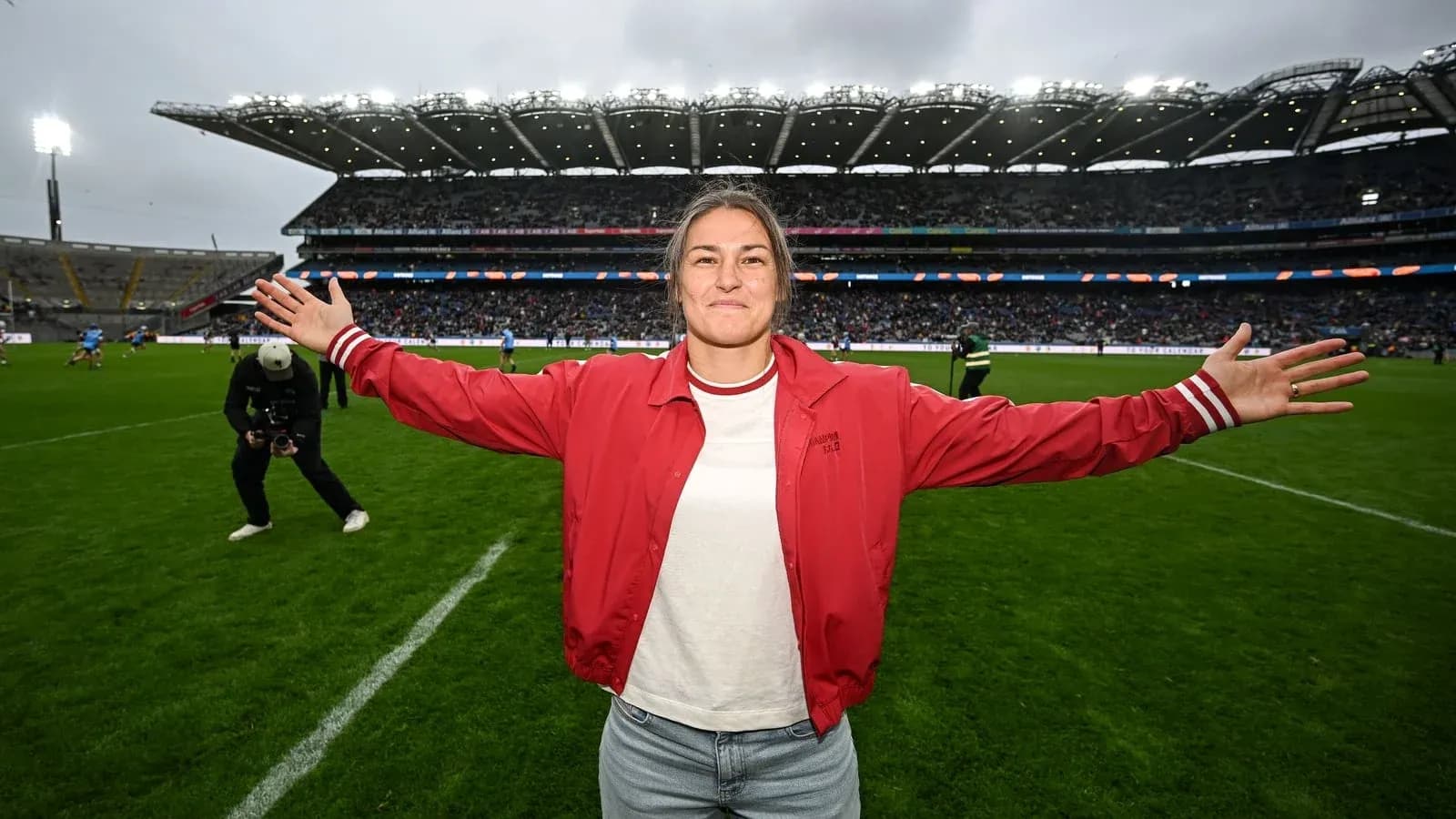
Katie Taylor will stride into a very different Croke Park to the one Ali knew 54 years ago. The old fortress of Gaelic games has evolved into a multi-purpose arena, as comfortable hosting rock giants and Premier League tourists as it is staging All-Ireland finals.
This summer underlined the transformation. What began as a stop-gap solution – a temporary home so that Ireland’s soccer and rugby teams wouldn’t be forced abroad – has become a lucrative, flexible stage.
This month, Manchester United and Leeds United turned up for a pre-season friendly. The fixture, once a snarling English rivalry, now carries a different footnote in Ireland: it drew the biggest attendance for a soccer match in the island’s history.
GAA President Jarlath Burns was there in an official capacity, enjoying the spectacle without emotional baggage. He has said openly he supports Arsenal. No attempt at camouflage. No forced allegiance to the visitors.
Compare that to John Downing in the late 1980s, who told a Sunday newspaper he wouldn’t be watching Ireland play England at Euro ’88 in Stuttgart because he planned to mow the lawn instead. The gesture was deliberate. The message was clear.
The landscape has changed again.
In 2026, the United–Leeds game riled sections of the League of Ireland support more than it did GAA traditionalists. There was grumbling in GAA circles, but the sharper anger came from those who see English clubs siphoning attention and money away from the domestic soccer scene.
Inside the GAA, the disquiet sounds different. Pat Gilroy told the Irish Times he has taken to calling Croke Park “Ceasar’s Palace,” a nod to its role as a cash machine rather than a pure temple of amateur sport.
“It’s just a revenue generator,” he said, adding that stadium director Peter McKenna was only playing the hand he’d been dealt: “we need more money.”
McKenna makes no attempt to hide his enthusiasm. He has spoken about bringing more Premier League pre-season games to Dublin and has even floated Croke Park as a potential Champions League final venue. The ambition is global, not parochial.
The financial logic is stark. The GAA’s 2024 annual review recorded a 19% jump in overall revenue, powered largely by a packed summer at Croke Park. Stadium revenue alone rose by 60% despite a fall in match-day attendances compared with the previous year.
The key difference? Concerts.
In 2024, Croke Park hosted seven major shows: Bruce Springsteen, AC/DC twice, and Coldplay across four sold-out nights. In 2023, there were none – unless you stretch the definition to include the Mary Wallopers as a pre-match act before the All-Ireland hurling final.
Critics of the split season point to that concert schedule as the real engine behind the calendar change. It’s easier to rail against Springsteen and Coldplay than to argue with club players who want certainty on when their championships start.
Yet when the GAA hierarchy recently floated a compromise to nudge the All-Ireland finals into August, it came from the top, not the grassroots. By the time Congress convened, the proposal looked so doomed it was pulled before delegates could even vote it down.
So Croke Park – or “Ceasar’s Palace,” if you prefer Gilroy’s label – remains free to chase its August and early September bonanza: global music acts, Premier League heavyweights, now a boxing super-show.
Taylor’s long-awaited homecoming lands on a weekend that once meant something very different in the GAA diary.
For generations, the first weekend of September belonged to the All-Ireland hurling final, with only brief detours between 1997 and 2005 and again in 2012–13, when the decider moved to the second Sunday.
From a traditionalist’s vantage point, this Saturday should have seen Galway and Limerick supporters pouring into Dublin, filling the pubs, trading stories about old finals. It should have been a night when Daithí and Jacqui sat down with Joe Connolly and Joe McKenna to revisit 1980 and all that followed.
Instead, the stadium will be dressed for a different kind of decider, with a different kind of Irish icon at its centre.
Even the staunchest GAA loyalist will struggle to begrudge Taylor her moment. She has carried Irish boxing for more than a decade, changed the conversation around women’s sport, and done it with a quiet, relentless intensity that stands in sharp contrast to the noise that often surrounds her.
Her insistence back in June was telling. The Aviva Stadium was never going to be enough. If that was the only option, she said, she would have walked away.
It was Croke Park or nothing.