.svg&w=384&q=75 "logo")
Cole Palmer's Premier League Resurgence: What Tuchel Missed
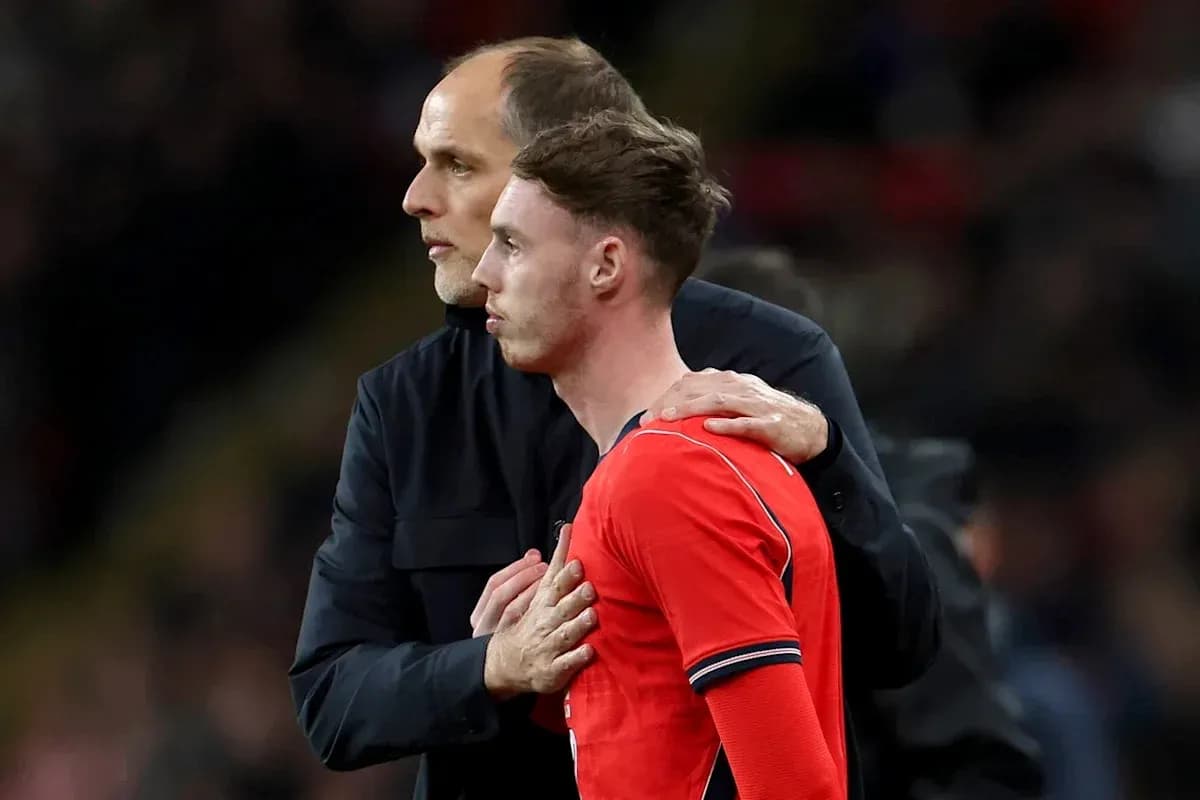
Cole Palmer is back gliding through Premier League backlines, flicking, feinting, finishing – and the obvious question hangs over it all.
What on earth was Thomas Tuchel thinking last summer?
The evidence is everywhere. The little first-time touch into Joao Pedro against Fulham, weighted so delicately it looked rehearsed. The ruthless, low strike under Bernd Leno. That surge of acceleration and 20-yard wrap past Brighton’s Bart Verbruggen. The way he ghosted to the edges of Hull’s defence, waited, then ripped around the outside to slide another chance on a plate for Pedro.
This version of Cole Palmer looks undroppable. Unignorable. World Cup material.
Only he didn’t exist a year ago.
The season that vanished
Palmer’s numbers tell the story of a player who fell off a cliff at the worst possible time. Forty-two goal contributions for Chelsea in 2023/24. Another 32 in 2024/25. Then the brakes slammed on: just 14 in 2025/26, with only two in his final 12 games.
The groin injury that disrupted the start of that campaign never really let go. He played, but he never quite moved the same way. The zip went. The risk went. The confidence drained. Tuchel wasn’t ignoring the Cole Palmer we see now; he was watching a pale imitation.
He didn’t take to the World Cup the kid who scored four against Brighton the previous season. He didn’t take the playmaker who dismantled PSG in the Club World Cup final, in the very New Jersey stadium that later staged the World Cup showpiece. That player was stuck somewhere between the treatment room and the memory bank.
Tuchel even tried to jolt him back to life before the tournament. He gave Palmer minutes in the March internationals, a chance to defy his Chelsea form and force the issue. Instead, the Wembley pitch swallowed him whole in a 1-0 defeat to Japan. The touch deserted him. The swagger disappeared. He drifted around like a man who’d gone upstairs and forgotten why.
So, does Tuchel regret leaving him at home?
“No,” he said. “I was very happy with the squad selection. I had a lot of sleepless nights [beforehand]. But I had not one sleepless night about our selection because I was more than seven weeks with this group of players, and they were nothing but fantastic.”
No apology. No hint of doubt. Tuchel backed his call and, in his mind, the discussion ended there.
A different Palmer walks back in
Now the door has swung open again. Palmer returns to the England squad for Nations League games against Spain, Croatia and Czechia, and this time he arrives armed with evidence.
“He has his numbers back,” Tuchel said. “He has assists back. He has decisive goals back. So that’s why he’s in the squad, and I think he has a point to prove.”
The numbers are one thing. The body language is another.
You see it in that wandering, predatory sway as he roams between the lines, scanning for weak seams in a back four. In the way a simple drop of the shoulder sends a defender striding off down a road that doesn’t exist. In those sudden bursts of acceleration that contradict his languid frame.
Palmer doesn’t move like a typical No 10. He’s all angles and limbs, a tall, wiry figure who looks like he should be ungainly but never is. Every joint seems to be working on the same wavelength. A stick insect with a grudge.
There’s an almost un-English flair to the way he solves problems on the pitch. He doesn’t just see passes; he invents them. He doesn’t just find space; he rearranges the pitch in his head until the gaps appear. In a national team that can sometimes look too rigid, too scripted, that kind of improvisation feels priceless.
The competition he beat
Palmer hasn’t walked back into a vacuum. He’s muscled his way past serious contenders.
Phil Foden, bright again at club level but sent off in the Manchester derby, has been left out. Fulham’s Joshua King came under consideration but stayed on the wrong side of the line. Morgan Gibbs-White has been outstanding for Nottingham Forest, dragging them clear of relegation and emerging as their key man, yet he still watches on from the outside.
Gibbs-White, Tuchel admitted, was particularly “close”.
“We can see the form that Morgan is in and he ended the season very, very strongly, and was the key player for Forrest to not be relegated. We can see him stepping up now. But it makes no sense to nominate three, four, five No 10s. It just does not help anyone.”
In other words: the door was crowded. Palmer forced it open anyway.
A warning wrapped in a recall
Tuchel, though, was careful not to let the recall sound like a coronation. In the middle of praising Palmer’s resurgence, he suddenly hit the brakes.
“It is one thing to be nominated, by the way, like with Cole, getting your ticket back in the squad. But it’s another thing to perform for England. Especially Cole, he needs to step up when he comes and needs to show these kind of numbers and these kind of performances to get his place, to keep his shirt, to justify the decision.”
This is the next test. Palmer’s England record is modest: two goals and one assist in 14 appearances. He could reasonably point out he has only started six of those games, rarely given the same licence he enjoys at Chelsea. But the cold facts remain. For all his club brilliance, he has not yet bent games to his will in an England shirt.
Now he has no excuses. He is fit. He is flying. He is trusted again.
And that, perhaps, is why Tuchel can speak so firmly about the World Cup omission. The Palmer tearing through Premier League defences today is, in part, forged by the disappointment of watching that tournament from home. The time away, the frustration, the nagging sense of injustice – all of it has fed into this sharper, harder-edged version.
“The quality of Cole Palmer, we don’t need to talk about it,” Tuchel said. “But [he needs] to show it … There are steps to be taken. The first step is to be nominated. The second step is to fight and perform on the highest level for that shirt.”
The door is open. The stage is set. Now we find out whether Cole Palmer is just a Premier League marvel – or the man who finally gives England’s attack a different kind of genius.