.svg&w=384&q=75 "logo")
Michael Carrick Faces Pressure as Manchester United Concedes Late Equalizer
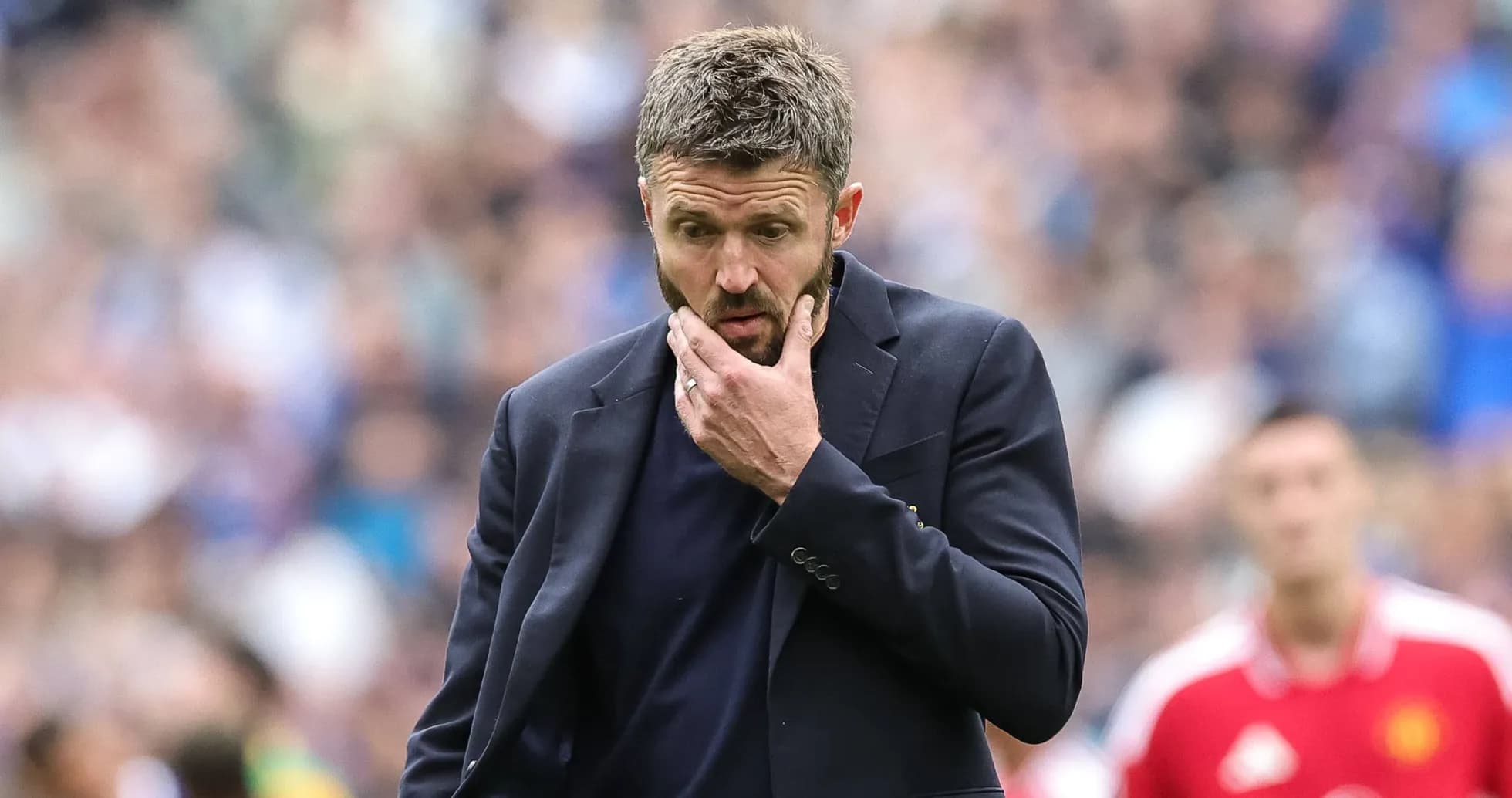
Michael Carrick walked into this season knowing the shadows of his predecessors would be long. Three games in, Gary Neville has already warned him they might be closing in.
At the Hill Dickinson Stadium, Manchester United had the match where they wanted it. In control, ahead, the away end relaxed enough to start enjoying themselves. Then came the familiar collapse. A late Everton surge, pressure piling with every attack, and in the 96th minute Ainsley Maitland-Niles drilled in an equaliser that felt inevitable the moment United started retreating.
Two points thrown away. Four from the first three Premier League fixtures. And a warning siren blaring over United’s ability to manage games when the temperature rises.
Neville’s warning: “It’s not going to go away”
On his podcast, Neville did not sugar-coat what he had just watched. The former United captain homed in on a trait that has haunted this club for years: a lack of ruthlessness.
“Teams think they've got a chance against them,” he said, laying bare the perception problem as much as the tactical one. United, in his eyes, eased off when they should have gone for the throat. “I thought they were a little bit complacent… they lacked that killer instinct before that period when Everton equalised and then they react again.”
The pattern is familiar. United play well in spells, lose their edge, invite pressure, then try to respond once the damage is done. Neville’s fear is that Carrick is drifting toward the same trap that swallowed Erik ten Hag and Ruben Amorim: constant defensive tinkering and a side that never quite looks secure.
The substitutions that changed everything
The turning point, for Neville, came not with Maitland-Niles’ strike but with Carrick’s changes at the back. Protecting a narrow lead, the United manager shuffled his defence in the closing stages, and the decision left Neville baffled.
Key defenders were withdrawn just as Everton were throwing everything forward. It felt, to Neville, like an invitation.
He singled out the removal of Luke Shaw and Diogo Dalot as a repeat of old mistakes. “I don't think it's going to go away and that's my big fear,” he admitted. “I think conceding goals is going to chase them and hunt them down the road and I don't know how Michael deals with it because he's got his best back four on the pitch. I don't know why Shaw went off with five minutes to go – hopefully he's not injured.”
That line cut to the heart of the issue. Carrick finally has what many would regard as his strongest back four on the pitch, yet United still look brittle in the decisive moments. Change it, and you risk chaos. Leave it, and you still don’t trust it. It’s a manager’s dilemma, but one United can no longer afford to get wrong.
Carrick faces the defensive reality
Carrick, to his credit, did not try to hide behind excuses. He acknowledged the obvious: this team concedes too many goals, and it does so at the worst possible times.
“Obviously, we can't ignore it,” he said afterwards. “We need to concede fewer goals to give us a better chance of winning games. We'll certainly look at that and keep improving. There's obviously things we need to get better at as a team.”
He pointed to the quality of Everton’s strikes. Two efforts from distance, both of high quality from the hosts’ point of view. On another day, those shots fly into the stands. Here, they found the top corner and the late equaliser that ripped the points away.
“There's been two strikes from distance really, two really good strikes from their point of view. Sometimes they fly in the top corner and more often than not they probably don't,” he reflected, before conceding the key point: “Yeah, for sure, it is [on conceding late].”
The admission matters. United have spent years trying to explain away collapses like this. Carrick chose to confront the problem. Now he has to fix it.
Rashford scare adds to United’s worries
As if the late goal and defensive questions were not enough, United left with another concern: Marcus Rashford’s fitness.
The forward, who had looked sharp on the left and built a dangerous partnership with Shaw down that flank, was withdrawn in the second half. Carrick later confirmed it was not tactical.
“He felt a little bit of something, so we had to change him,” the manager revealed. Rashford and Shaw had been one of United’s brightest combinations, repeatedly stretching Everton and giving United an outlet when they needed to relieve pressure.
“We had good connections pretty much all over the pitch at different times of the game,” Carrick added. “Marcus and Shaw have played together for a long period of time and have a good understanding. And you can see that, they look really dangerous down that side, and there is obviously more to come.”
United will hope “more to come” applies to Rashford’s season rather than his time on the treatment table. Losing him now would strip Carrick of one of his most reliable attacking weapons and further complicate his efforts to steady the side.
A familiar story, a new man under pressure
The setting is new, the manager is new, but the script feels painfully familiar. A promising performance, a late collapse, questions over substitutions, and a former captain in the studio warning that the same old problems are circling again.
Neville’s verdict carried a clear message: unless Carrick can harden this United team, the defensive frailty that “chases them and hunts them down the road” will define his reign as surely as it did those before him.
Three games in, United already look like a side walking a tightrope in the closing minutes of matches. The next question is brutal and simple: does Carrick have the steel and clarity to cut that rope before it snaps under him?