.svg&w=384&q=75 "logo")
Alexander Zverev Claims First US Open Title, Defeats Ben Shelton
The wait goes on for American men’s tennis. Twenty-three years and counting.
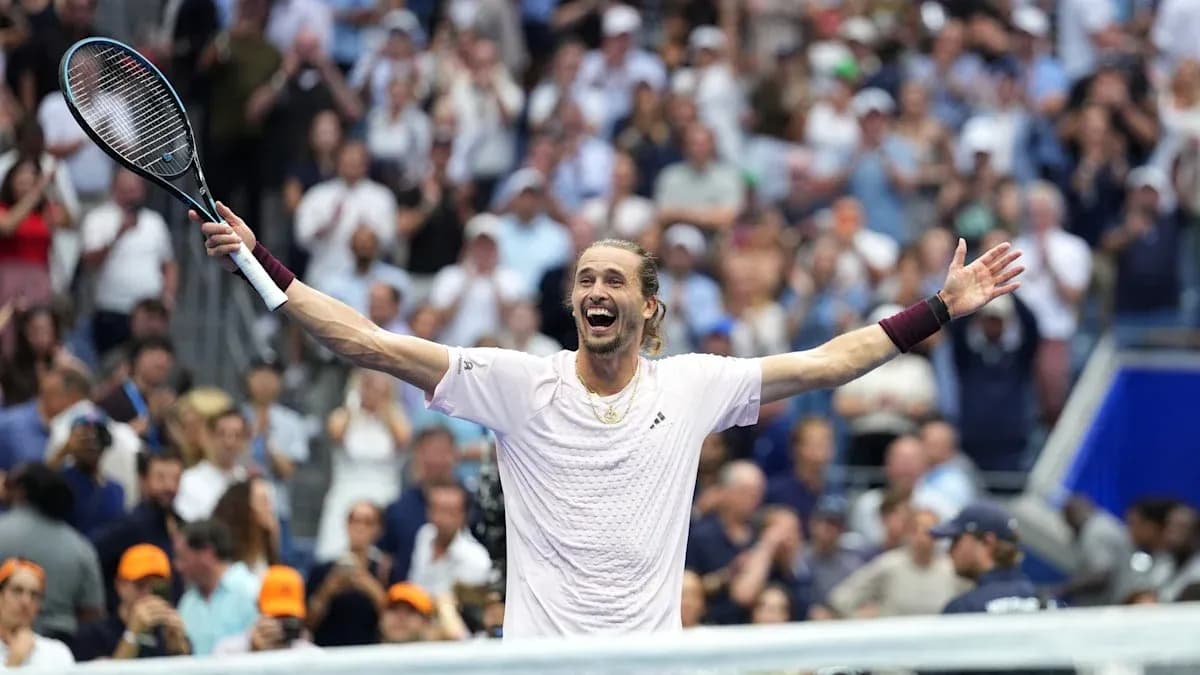
On a noisy Monday night in New York, with Arthur Ashe Stadium straining for a homegrown champion, Alexander Zverev walked into the hostility, shut out the noise and walked away with his first US Open crown – and his second grand slam title.
He beat Ben Shelton 6-3, 7-6, 5-7, 6-2, absorbing the American’s thunderous serve and raw energy, then handing him a lesson in big-match control.
A star in enemy territory
Shelton was chasing history, trying to become the first American man to win a major since Andy Roddick in 2003. Roddick himself sat courtside, watching the heir apparent run into a 29-year-old who has finally learned how to close the door on these nights.
From the start, Zverev looked like a man who has spent a decade hearing that he should be winning these trophies. He broke early, muted the crowd and took the first set 6-3, his return game cutting through Shelton’s huge delivery.
The second set turned into a knife-edge tiebreak. This was Shelton’s moment – the stadium roaring, Zverev’s ball toss occasionally faltering under the din. But the German held his nerve, edged the breaker, and with it, banked a two-set lead that felt like a stranglehold.
Shelton, though, doesn’t really do quiet exits.
A wobble, a lifeline, and a ruthless response
Zverev’s history in New York hovered over the third set. He had once led Dominic Thiem by two sets in the 2020 final and lost. When his level dipped, that scar tissue seemed to resurface.
Shelton pounced. The American upped the aggression, fed off the noise, and forced errors. He snatched the third set 7-5, and suddenly the place believed. For a few minutes, it felt like the script might flip.
Then Shelton blinked.
He dropped his opening service game of the fourth set, gifting Zverev an immediate break. The energy that had surged around Ashe stalled. The German, who had been rattled, steadied instantly. From there, it became one-way traffic.
“It’s been a loud crowd, but it hasn’t affected him. He’s been locked in, Zverev.”
Locked in, and relentless. Once he had the lead again, he didn’t offer Shelton a second chance.
From survival mode to champion
Zverev’s run to the title had already flirted with disaster. He came within two points of going out to Lorenzo Sonego in the first round at Flushing Meadows. Quentin Halys dragged him into a five-set scrap in the second.
Those early escapes hardened him. By the time he walked on court for the final, he had already lived with the idea that this fortnight could have ended before it began.
So focused was he in the last game that, when Shelton’s final ball missed, Zverev didn’t immediately realise he had won the championship. Only after a beat did he lift his arms, almost in disbelief.
“He didn’t know! My goodness. That is incredible,” Todd Woodbridge said on Nine. “That shows you how in the zone Zverev has been in this match today. He didn’t know the match was over, he didn’t know he had won the second grand slam title of his career. What a season it has become, and now time to celebrate.”
This season has changed the shape of his career. The first grand slam breakthrough came in June at Roland-Garros. With world No.1 Jannik Sinner out injured and defending champion Carlos Alcaraz knocked out by Shelton, Zverev saw another opening in New York and drove straight through it.
A complicated journey
For all the tennis, Zverev’s story has never been simple. His career has been overshadowed by domestic abuse allegations from ex-girlfriends Olya Sharypova and Brenda Patea. A trial in Germany involving Patea ended in 2024 with a settlement; the case was dropped without a verdict or admission of guilt.
Woodbridge alluded to that layered backdrop on air: “He’s had his battles on and off the court throughout his career and this year is turning into a magic moment for him.”
On court, Zverev tried to frame this season as a reward for years of grind.
“We went almost 30 years without winning a grand slam title, and now we’ve won two in a span of three months,” he said, turning to his team during the trophy presentation. “I think God has seen how hard we worked, how much we suffered, how much pain we went through, and I think 2026 is the outcome of all the years that happened before.”
The strongest person he knows
Then he went deeper, speaking about his diagnosis with diabetes as a child and the role his mother, Irina, played in refusing to let that define him.
“When your four-year-old son is diagnosed with diabetes and doctors in the office tell you that life and sports will be very limited for that child, it takes a very strong mother to say ‘my son will be whatever he wants to be’,” Zverev said.
“If he wants to be a tennis player, he’ll be a tennis player. If he wants to do something else, he’ll do something else, but this illness will not define us. I’m happy that we worked through it, and we’re doing things that we’re doing right now. My mother is the most important and strongest person I know because it takes an unbelievably strong woman to do what she did.”
On a night that could have belonged to an American, Zverev instead stood at the centre of Arthur Ashe Stadium and made it about his own long road – from prodigy, to nearly man, to multiple major champion.
Shelton’s time is coming
Shelton, 23, had to swallow the disappointment of a lost final, but he did so with the kind of clarity that suggests he’ll be back.
“You’re one of the very best players in the world, maybe the best player in the world this year,” he told Zverev.
He leaves New York without the trophy, but with the scalp of Alcaraz, a first grand slam final, and the sense that he belongs on these stages.
The United States still waits for its next men’s grand slam winner. Shelton looks as likely as anyone to end that drought. The question now is whether nights like this, under the lights in New York, will harden him the way they once hardened the man who just beat him.