.svg&w=384&q=75 "logo")
Alexander Zverev Wins Second Grand Slam Title at US Open
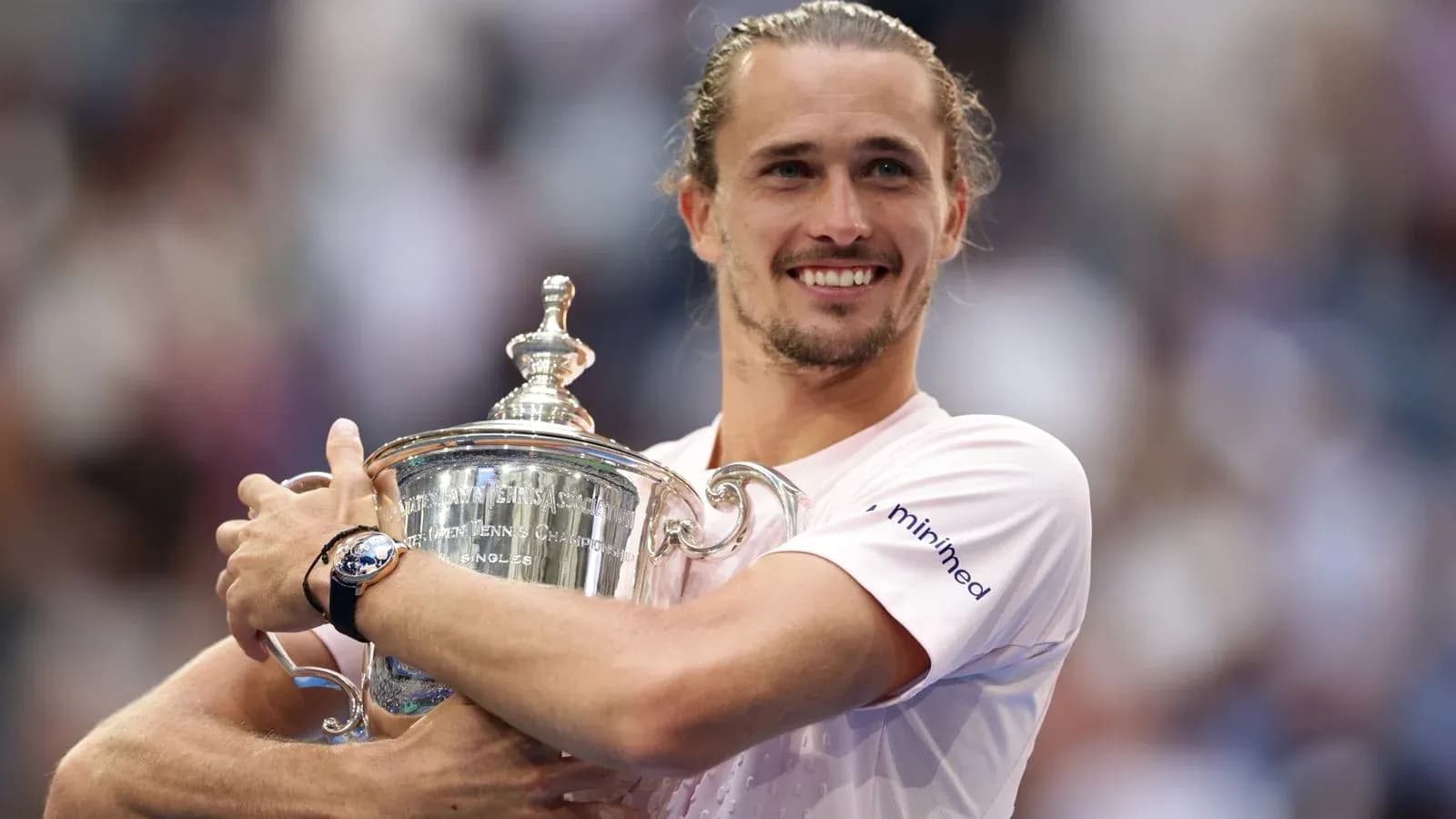
Alexander Zverev stood alone on Arthur Ashe Stadium, balls in hand, waiting to serve again. The crowd roared, Ben Shelton walked to his chair, and the scoreboard above his head quietly screamed the truth.
He was already the US Open champion.
For a few surreal seconds, the new world No 1 seed at a major didn’t realise he had just won his second Grand Slam title of the year. Shelton’s final return had flown long, the match had ended, and Zverev – locked in his own tunnel – simply kept hitting balls back as if a fifth set might be coming.
Only when he glanced up at the big screen did it hit him. Game, set, championship: 6-3 7-6 (7-2) 5-7 6-2 in three hours and 33 minutes. His first US Open crown. His second major in three months. The man once burdened by the label “best player never to win a major” had turned 2024 into his personal rewrite.
“I thought the score was 5-1,” he admitted afterwards, half-laughing at himself. He knew he’d broken twice in the fourth. He just miscounted Shelton’s lone hold. “It’s actually funny, teachers in tennis say play each point and forget about the score. Well I forgot about the score and it helped me.”
From suffering to domination
There was nothing absent-minded about the way he played.
Nineteen hours and 38 minutes on court before the final. The fourth-longest route to a Grand Slam title match since 1991. Yet Zverev burst out of the blocks like a man who had barely broken sweat all fortnight.
Shelton, 21, walking into Arthur Ashe Stadium as the great American hope, got the full noise. A partisan crowd of 23,000 inside the arena named after Arthur Ashe, desperate to see the first home men’s Grand Slam singles champion since Andy Roddick in 2003, and only the second black man to win a major after Ashe himself.
He won the toss. He chose to serve. Then the nerves bit.
Shelton reached 30-30 in the opening game, missed a routine shot, double-faulted, and gifted Zverev an instant break. The German pounced. He broke again on set point, closing out the opener with just one unforced error, suffocating Shelton with first-strike tennis and a heavy, accurate serve that never allowed the American a look at a break point in the first two sets.
From the stands, the star power watched on – Brad Pitt, Rami Malek, Pierce Brosnan catching a playful cutaway at 0:07 on the match clock – but the real box-office presence was on the baseline, bouncing the ball again and again and again.
By the numbers, Zverev spent roughly three hours of his 23-plus hours on court this fortnight simply bouncing the ball between serves. On this night, that ritual finally drew a time violation. It did nothing to rattle him.
Shelton’s surge, Zverev’s answer
Shelton came into the final with a 0-5 record against Zverev. He had never beaten Stefanos Tsitsipas or Carlos Alcaraz before this US Open. He knocked them both out in New York. That run gave him the belief that this time might be different.
For two sets, it wasn’t.
Zverev, serving like a man with a point to prove, marched through the second-set tie-break, ripping winners and tightening the screws. Shelton, whose explosive lefty game usually feeds off chaos and emotion, found only frustration. No break points, no foothold, just a wall of German resistance.
The match needed a jolt, and Shelton finally provided it.
At 4-5 in the third, Zverev’s serve blinked. Shelton carved out three set points, urged on by a crowd desperate for a contest. He took the second, thumping his way into the match at last. Ashe erupted. The American, who was not even a year old when Roddick won in 2003, had his moment.
Tim Henman, watching for Sky Sports Tennis, saw the turning point – and the response.
“Shelton did a great job getting that third set,” he said. “But losing his serve first game of the fourth settled Zverev down and gave him more energy. He coasted to the line from there.”
That early break in the fourth was the kill shot. The contest, as a genuine arm-wrestle, effectively ended right there.
Experience tells
The difference in experience sat heavy over the final from the first ball.
“The difference in their experience was absolutely massive,” Marion Bartoli said. “You’re coming out in front of your home crowd, first ever Grand Slam final, and you want to put on a show and play your best tennis. Zverev made only one unforced error in the first set, and it just made Shelton’s life so difficult.”
Shelton tried to redline his game, but Zverev had answers everywhere. He moved with authority, stepped into the court, and played the kind of proactive tennis that had been missing from his Slam campaigns a year ago.
Henman put it bluntly: “His game was going backwards. But he has transformed himself to be more aggressive.”
On Sunday night, that evolution carried him through the final stretch with almost clinical calm. Even the time violation on his serve – a flashpoint that might once have rattled him – barely registered. He tightened his focus, held, and kept marching.
When Shelton’s last ball sailed beyond the baseline, Zverev’s transformation had its exclamation mark.
A title, a family, a fight
The trophy ceremony revealed the other side of this story.
Zverev’s voice cracked when he spoke about his mother, Irina, a former professional who refused to let his type 1 diabetes define his life, or his tennis.
“When your four-year-old son is diagnosed with diabetes and doctors in the office tell you that life and sports will be very limited for that child, it takes a very strong mother to say ‘my son will be whatever he wants to be’,” he said.
“If he wants to be a tennis player, he’ll be a tennis player. If he wants to do something else, he’ll do something else but this illness will not define us.
“My mother is the most important and strongest person I know because it takes an unbelievably strong woman to do what she did.”
There was also warmth for the man across the net.
“Ben, you’re an incredible player and an incredible person,” Zverev told Shelton. “This was your first Grand Slam final but I already told you you’re going to be back here many more times and if I would have to bet all my money on it, I would bet that you would lift this trophy one day.”
Shelton, standing in front of a crowd that had lived and died with every forehand he ripped over the past fortnight, took the microphone and looked straight at the champion.
“Sascha, congrats on these two weeks, your second Grand Slam title and two in one year,” he said. “What you’re doing is incredible, the way you are serving and moving in play. You work harder than anyone I know, and do more hours on court than anyone else.
“You and your team do things the right way and I’m sincerely happy for you guys to hold this title.
“To New York, you guys drove me here today. I’m just getting started and I’ll be back here again.”
The new order?
Zverev’s season now carries a very different weight. French Open champion. US Open champion. No longer the nearly man, but a two-time major winner in the space of months, capitalising when Alcaraz and Jannik Sinner have faltered physically or been absent.
He spoke of “so much suffering for the Zverev family at Grand Slam level” and joked that maybe 2026 should be the year they simply enjoy it. The reality is they may not have to wait that long.
He has the game. He now has the proof. And he has a hard court in New York that finally belongs, in part, to him.
Shelton leaves with no trophy, but with something almost as valuable at 21: confirmation that he belongs on this stage, under these lights, in this kind of match.
Zverev leaves with silverware, scars turned into steel, and a question hanging over the rest of the field.
If this is the version of Alexander Zverev that the tour has to deal with at the majors from now on, who’s ready to stop him?