.svg&w=384&q=75 "logo")
Alexander Zverev's US Open Triumph Sparks Controversy Over Time Violations
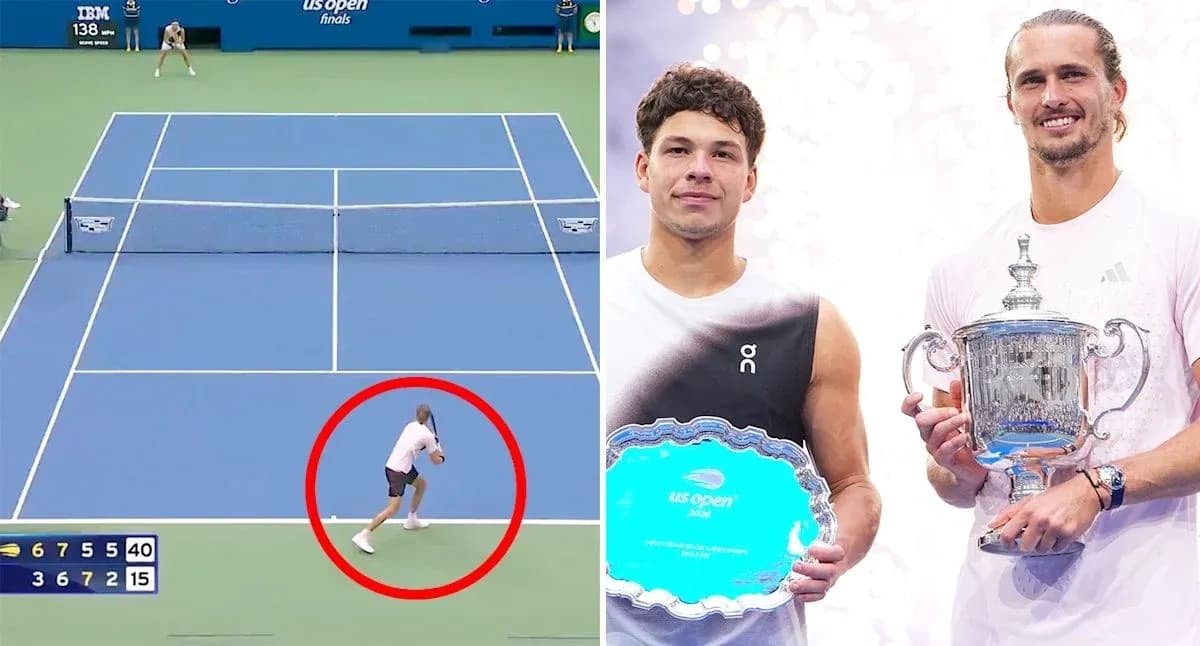
Alexander Zverev walked away with another grand slam title. The US Open trophy, a four-set win over Ben Shelton, back-to-back majors on his resume. On paper, it was a triumph.
On court, it sparked a very different conversation.
As Zverev ground out a 6-3 7-6 (7-2) 5-7 6-2 victory in the men’s final, the tennis itself shared the stage with something far more mundane: time. Specifically, how long it took the German to actually hit the ball.
Every point seemed to stretch. Bounce after bounce, ritual after ritual, the match dragged into a rhythm that grated on fans, commentators and, eventually, his opponent.
Under the current rules, players have 25 seconds from the end of one point to start the next. That clock governs the first serve. Once the first delivery misses, though, the sport steps into a grey area. The shot clock disappears. The only guidance is that the second serve should be taken “without delay”, a vague phrase that leaves umpires guessing and players pushing the limits.
Zverev pushed them hard.
He picked up multiple time violations in both his semi-final and the final, with chair umpires warning him as the crowd grew restless. Yet once the first serve missed, their power largely vanished. The German could bounce, reset, pause, and bounce again, all while everyone else waited.
By the time the tournament ended, the title was his – and so, it seems, was a rule-change movement.
Shelton leads fresh calls for a second-serve clock
Shelton, playing in his first grand slam final, did not hide his frustration when asked about the issue afterwards. He went straight to the heart of the loophole.
“For a first serve you should be able to do whatever you want and use the full 25 seconds every time,” he said. That part of the rule, he can live with.
The second serve is where he draws the line.
“There should be some sort of rule limiting time on second serves. There shouldn’t be unlimited time. It’s tough to be sitting there for that long for the next action to happen.”
Shelton’s point reflects what many watching felt in real time. The tension between points in a major final should come from the stakes, not from a server stretching the clock to breaking point. When the returner stands frozen, waiting for the ball to finally leave the strings, the spectacle starts to fray.
Roddick: “The rules should change”
Shelton is not alone. American great Andy Roddick has been on this beat already, and he didn’t soften his stance.
“The rules should change,” he said on his ‘Served’ podcast. He acknowledged the obvious: as long as a player operates within the 25-second window, the umpire has little room to intervene.
“As long as he's doing it within the 25-second shot clock, yeah, what are you going to say?” Roddick asked. That is the problem. The clock runs, then vanishes.
For him, the solution is clear.
“There needs to be a shot clock for the second serve,” he said. Then he went after the ritual itself. “You cannot bounce the ball 20-something times between first and second serve. And then act shocked when we finish at 3 in the morning. Like, we just can't do it.”
Roddick’s argument cuts to a wider issue. Tennis is fighting to keep matches sharp, watchable and broadcast-friendly. When a marquee final creeps deep into the night, not because of epic rallies but because of extended pre-serve routines, the sport hands ammunition to critics who call it slow and outdated.
McEnroe wants a harsher penalty
John McEnroe, on commentary duty for ESPN during the final, saw the same problem but offered a different fix.
He locked in on a related habit of Zverev’s: aborted ball tosses. Time and again, the German would toss, dislike the feel, pull out, and start again as the clock ticked down.
For McEnroe, that should come at a cost.
“This should be over the serve clock. It was at two (seconds left) when he tossed it. Should be a fault,” he said on air.
His solution is blunt: if the toss goes up with the clock almost gone and the player bails, the punishment should be automatic. No more re-sets. No more do-overs. You run out of time, you lose the point.
Patrick McEnroe added another layer, this time from the returner’s perspective. When a server drags out the routine, he argued, the player on the other side of the net should have some power too.
“As a returner, when a guy's doing this (bouncing the ball so many times) you should be able to step away, just before he serves,” he said.
That suggestion underlines the imbalance. The server controls the tempo. The returner is locked in, forced to hold focus through long, stuttering delays. Allowing the returner to reset would at least restore a measure of control.
Khachanov: “It takes so much time”
Zverev’s opponents feel it as sharply as the spectators.
After losing to the German in the semi-final, Karen Khachanov admitted the endless bouncing wears on him and others in the locker room.
Zverev’s routine, he said, “annoys” not only him but other players on tour. “It takes so much time,” Khachanov added.
Yet even he circled back to the same impasse.
“At the end of the day, if it's within the rules with the time between points, I cannot say anything against that,” he said. “If he extends the time, then he gets a time violation, so it's as simple as that.”
And that is where the sport stands: a champion pushing the boundaries of a flawed rule, rivals and legends calling for change, and umpires stuck with wording that leaves them exposed.
The US Open ended with Zverev lifting the trophy. The next battle may be fought in meeting rooms, not on hard courts, as tennis decides how long it is willing to let players wait before they finally pull the trigger on a second serve.