.svg&w=384&q=75 "logo")
Zverev Serves Notice as US Open Final Approaches
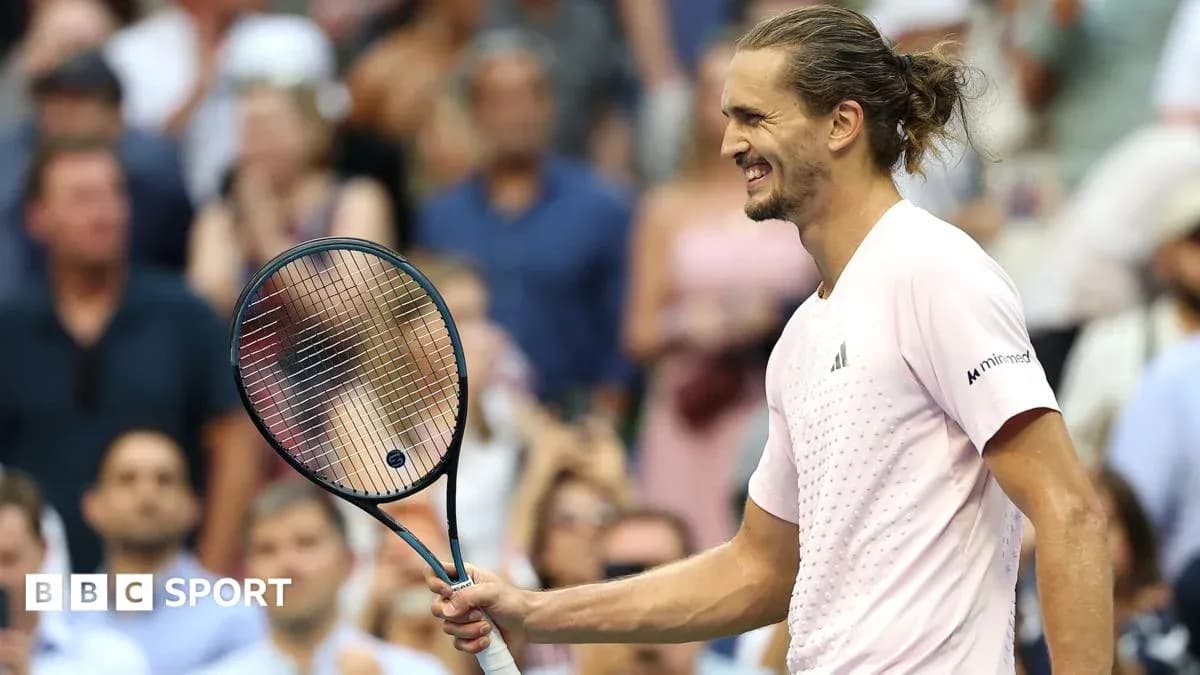
Alexander Zverev walked off Arthur Ashe Stadium with a smile that told its own story. The serving doubts, the early-tournament jitters, the long history of near-misses at the majors – all parked for another day. On this night, his serve roared, his nerve held, and Karen Khachanov was the one left wondering how this didn’t go the distance.
Zverev beat Khachanov 6-3 7-6 (9-7) 7-6 (8-6), a straight-sets win that looked routine only on the scoreboard. Twice the Russian had the upper hand in tie-breaks. Twice Zverev dragged him back, then slammed the door.
The numbers underline the story. Zverev coughed up six double faults to Khachanov’s three, but that risk came with a brutal reward: 15 aces to six, and an average second serve thudding in at 112mph – almost 20mph quicker than his opponent. When the tension tightened, that delivery bailed him out again and again.
“Where did that come from?” gasped former British number one Annabel Croft on BBC Radio 5 Sports Extra as Zverev uncorked his 15th and final ace in the biggest moment of the night. It was the defining shot of a performance built on big-point clarity.
Khachanov, though, will feel this one. He was cheered warmly from the court, signing autographs as he left Flushing Meadows, but the applause couldn’t drown out the what-ifs. He led in the tie-breaks of both the second and third sets. On another night, this is a four- or five-set war. Instead, it becomes a painful lesson in missed chances.
He did plenty right. He won 13 of 14 points at the net, picking his moments to come forward and finishing with authority. From the back of the court he unleashed heavy, penetrating forehands, at one point thundering a strike into the corner and celebrating like a nonchalant gladiator in front of a baying crowd. As in the second set, the third-set tie-break crackled with intensity – until Zverev found just enough.
At 2-5 down in that final breaker, Zverev looked like a man playing with the weight of the occasion on his shoulders, while Khachanov swung freely. Then came a stunning cross-court winner, his 37th of the match, ripped after being forced back by an attempted lob. From there, the German tightened the screws; the Russian blinked.
Croft summed it up succinctly: every time Zverev faced “questions and problems he really stepped up to the plate and served spectacularly.” The wobbles, she noted, were at the beginning of the tournament. Since then, the trajectory has been upward.
Zverev himself admitted the turnaround has been dramatic. Speaking on court, he recalled a low point earlier in the fortnight: “After the second round, at about 3am I was sitting with my team in the locker room and we were laughing at how bad I was playing, and that sense of humour helped me.
“In practice I started feeling the ball better, and then moving forward I was playing much better tennis. I obviously have improved a bit otherwise I would not be in the US Open final.”
He didn’t stop there. This run, he knows, sits against a backdrop of previous Grand Slam frustrations.
“Sometimes things just go your way, I have had a lot of struggles at the major level and I was so close so many times – and maybe this year God has said this is going to be my year and to enjoy my time on the court. I am enjoying it, I love playing these big finals and I can't wait for Sunday.”
Sunday brings an American, and with it a different kind of storm. Zverev will face the winner of the all‑US semi-final between Frances Tiafoe and Ben Shelton – two crowd favourites, two players who will have almost everyone inside Ashe roaring for them.
“I think it will be incredibly special, these two guys are crowd favourites and everyone loves them,” Zverev said, looking ahead. “Tonight will be an epic semi-final and I am looking forward to watching it. Hopefully I can not make their American dream come true.”
The line drew a smile, but the intent is clear. He has come too far, played through too many doubts, to become a supporting act in someone else’s home‑slam fairytale.
Hewett and Reid Forced to Chase in Wheelchair Doubles Final
Away from the glare of Ashe, on Court 11, a familiar British partnership found itself in unfamiliar trouble.
Alfie Hewett and Gordon Reid, chasing a sixth US Open men’s wheelchair doubles title, dropped the opening set 6-2 to Spain’s Martin de la Puente and Ruben Spaargaren of the Netherlands. The top seeds were hit by a six-game surge as De la Puente and Spaargaren seized control, reeling off six games in a row to snatch the set and silence the British momentum.
Hewett and Reid trailed again early in the second, staring at the prospect of a straight-sets defeat. Then, at the first opportunity, they broke back to level at 3-3. The second set, once slipping away, suddenly balanced on a knife edge.
They know this territory. Only yesterday they came from behind in a bruising semi-final to oust defending champions Gustavo Fernandez and Tokito Oda. That escape demanded resilience and belief; they will need every ounce of both again.
At 2-2 in the second set, with the memory of that six-game burst still fresh, the British pair began to dig in, lengthening rallies, tightening their returns. The question now is simple and brutal: can they force a decider, or will De la Puente and Spaargaren slam the door as ruthlessly as they opened it?
One story is already written: Zverev, serving like a man reborn, back in a major final with the chance to rewrite his Grand Slam narrative. The other is still unfolding on a side court, where Hewett and Reid are fighting to keep their dynasty alive. On a New York night thick with tension, both campaigns hinge on the same thing – who delivers when the pressure bites hardest.