.svg&w=384&q=75 "logo")
Alexander Zverev's Journey to the US Open Final
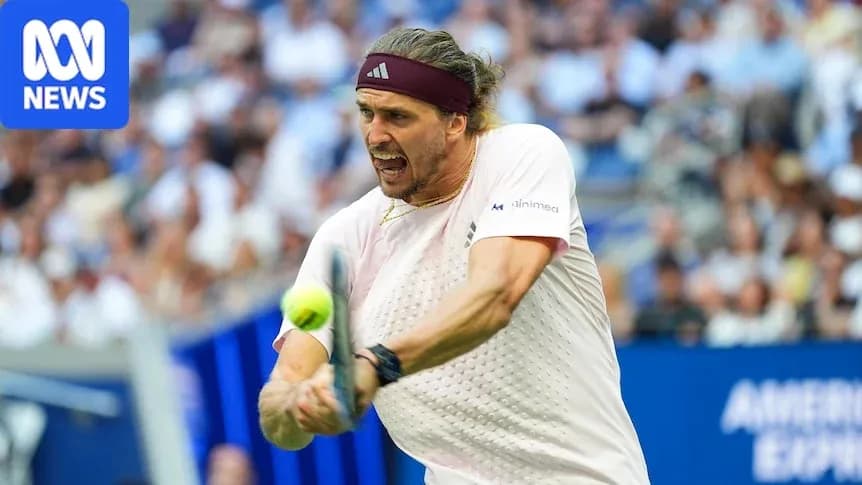
Alexander Zverev spent years as the man with the missing piece. The talent was never in doubt, the ranking always high, the questions relentless: when would the slam finally come?
Now it has — and he is in no mood to share the stage with American men’s tennis.
The German marched into the US Open final with a 6-3, 7-6 (9-7), 7-6 (8-6) win over Karen Khachanov, booking a shot at a second major title this season and keeping alive a drought that has haunted the host nation for more than two decades.
The United States has not produced a men’s grand slam champion since Andy Roddick in New York in 2003. On Monday morning (AEST), Zverev will stare down either No. 8 seed Ben Shelton or No. 11 Frances Tiafoe — both electric, both adored in Queens, neither yet a major finalist.
“Hopefully I can not make the American dream come true,” Zverev said, half-smiling, fully serious.
From nearly man to serial contender
For years Zverev wore the label: best men’s player without a major. That burden finally lifted in Paris this season, where he claimed his first grand slam at Roland Garros. He backed it up by reaching the Wimbledon final, losing to Jannik Sinner, and he now stands at 24-2 in grand slam matches this year.
“Sometimes just things go your way and I feel like I've had a lot of struggles at the major level. I was so close so many times and maybe this year God has said that this is going to be your year and just enjoy the time on the court,” he said.
Enjoyment is one thing. Exorcism is another.
Four years ago, Zverev walked off this same court in disbelief, having let the 2020 US Open final slip from a two-set lead against Dominic Thiem, then losing in a fifth-set tiebreak. Thiem became the first man since 1949 to win the title from two sets down. Zverev became the latest cautionary tale about closing on the biggest stage.
This time, once he went up two sets, he refused to blink.
Khachanov pushes, Zverev holds
Khachanov arrived in New York with a losing record on the season and almost no noise around him. He leaves with another deep run and a reminder of his big-stage pedigree: this was his third grand slam semifinal and his second at Flushing Meadows.
The Russian started flat, dropping the first set and quickly falling behind 2-0 in the second. Then he woke up. He broke Zverev to level the set and, suddenly, the rallies stretched, the ball-striking turned brutal, and the match tightened.
They played themselves into a tiebreak that felt like a test of nerve as much as shotmaking. Khachanov saved Zverev’s first two set points, dug in, and dragged him into a 34-shot exchange that had the crowd gasping. Zverev won that point, and with it the set, ripping away the Russian’s momentum in a single, lung-burning rally.
Still Khachanov refused to go quietly. In the third-set tiebreak he surged ahead 3-0, then 5-2, hinting at a late twist. Zverev shut the door again, reeling him in with the kind of calm, heavy hitting that has defined his grand slam season.
Khachanov’s level across the final two sets might well have undone the version of Zverev that stumbled through the first week. It just came too late against the one now playing like a hardened frontrunner.
From early struggles to a streak
Zverev came into New York as the No. 1 seed at a major for the first time, elevated when Sinner withdrew with a knee injury. The status didn’t immediately fit. He was dragged the distance by Lorenzo Sonego and Quentin Halys in his opening two rounds, spending nearly nine and a half hours on court and becoming the first top seed in slam history to go five sets in each of his first two matches.
He and his team didn’t panic. They laughed.
“He said he and his team laughed about how poorly he was playing after the second match,” the report noted, and Zverev added: “That kind of sense of humour, it helped me. Moving forward, I was playing much better tennis. Obviously I have improved a little bit. Otherwise, I wouldn't be in the US Open final.”
Since then, he has been ruthless. Thirteen consecutive sets. The loose errors trimmed, the serve tightened, the forehand holding up under pressure.
America waits, Zverev hunts
Across the grounds, the spotlight belonged to the all-American clash between Shelton and Tiafoe, a prime-time, crowd-pleasing semifinal landing on the 25th anniversary of the 9/11 attacks. That was the marquee for the ticket brokers and the TV promos.
Zverev vs Khachanov, by contrast, sold at unexpectedly low prices, a hard-core tennis fan’s semi rather than a box-office blockbuster. Khachanov was bidding to become the lowest-ranked US Open finalist since the ATP rankings began in 1973. Zverev was trying to return to the stage he still believes he should never have left empty-handed.
He got there, and he did it on his terms: controlled, defiant, with just enough scar tissue to know what can go wrong and just enough belief to think it won’t again.
Now comes the final act. One man trying to end a 21-year American wait. Another determined to extend it and stamp this season as his own.
The drought is still alive. Zverev intends to keep it that way.