.svg&w=384&q=75 "logo")
Alexander Zverev's Journey to Tennis Glory: From Next Big Thing to Champion
Alexander Zverev’s long, uneven march toward tennis’ summit has finally broken into a sprint.
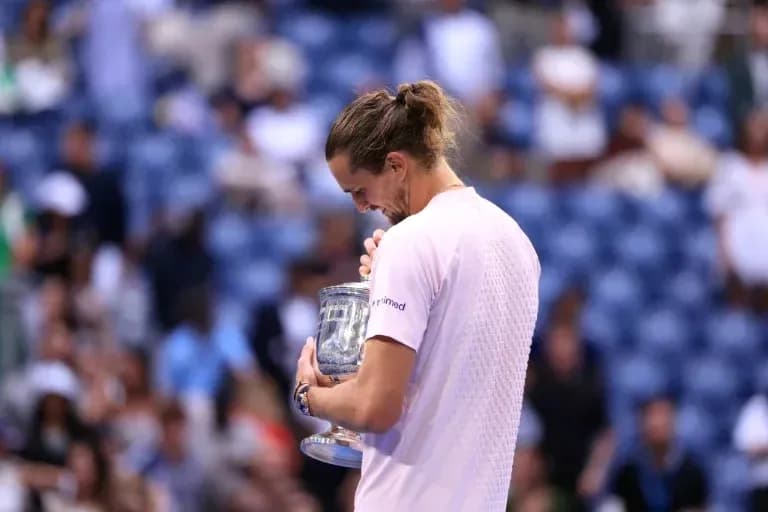
In New York, under the lights and the weight of a decade’s worth of expectation, the 29-year-old German claimed the US Open title, his second Grand Slam in less than four months. For a player once defined by near-misses, nerves and noise off the court, the dam has burst. The question that stalked his career — “Will he ever win one?” — has been answered twice in a single summer.
He had already called his French Open triumph in June his “happy end.” It turns out that was only the end of one chapter.
On Sunday, Zverev walked into his third consecutive Grand Slam final and walked out a two-time major champion, backing up his Wimbledon runner-up finish with victory over rising American Ben Shelton. The run itself tells a story: three straight majors, three straight finals. This is no longer a talented outlier crashing the party. This is a fixture at the sport’s sharpest edge.
Born into a tennis household, Zverev never had the luxury of anonymity. His parents, both high-level players in the former Soviet Union, built the court and the culture around him. The 6-foot-6 right-hander grew up with a racquet in his hand and expectation on his shoulders.
“For me, my family is everything and I owe them a lot for helping me to become the tennis player that I am today,” he has said. It sounds like a stock line until you trace the arc of his career — and how often that support has been tested.
Because the path, for all the early hype, has been jagged.
Zverev lives with diabetes. He has spent his career managing a chronic condition while trying to compete with the most physically demanding generation men’s tennis has ever seen. Then came the ankle. At Roland Garros in 2022, in the middle of a thunderous semi-final with Rafael Nadal, he crumpled to the clay, tearing ligaments and leaving the court in a wheelchair. The images felt like a cruel metaphor: just as he looked ready to crash the Big Three’s last fortress, his body gave way.
Surgery followed. So did doubt.
He returned in January 2023 and, slowly, the pieces began to fall back into place. A 20th career title in Hamburg marked a first step. The real surge came in 2024: a charge to the French Open final, a climb to world number two, and a growing sense that the old accusations of mental fragility no longer fit the player in front of us.
“In the life of a professional athlete, you will have the highest highs and the lowest lows,” Zverev has reflected. “Getting caught up in the lows is the biggest mistake that you can make. You shouldn't try to evaluate everything when times are tough, you should try to find ways to get better when you're on a high.”
Those words carry the scars of 2020. His first Grand Slam final, at the US Open, ended in heartbreak: two sets up on Dominic Thiem, then unraveling as his serve deserted him and the title slipped away.
“That was exactly the time when I had real struggles with my serve and my second serve,” he said of that night. “I knew that my serve could break down at any moment. That's one difference that I do feel now, luckily for me.”
The serve that once betrayed him now anchors his game. The player who used to glance nervously at the scoreboard now seems to lean into the pressure.
Yet the story around Zverev has never been confined to the baseline.
He continues to play in the shadow of domestic violence allegations from two former partners, Olga Sharypova and Brenda Patea, claims he has strenuously denied. The ATP Tour investigated one allegation and concluded there was insufficient evidence to sanction him. The case involving Patea, the mother of his daughter, led to a penalty order and fine from a German court in 2023. Zverev appealed. In June 2024, just hours before he stepped onto court for his French Open semi-final, he and Patea reached a settlement.
The timing underlined the dual existence he has lived: one of the sport’s central figures, carrying unresolved questions far beyond the lines of the court.
On court, the highs kept coming — and so did the blows. A third Grand Slam final defeat arrived at the 2025 Australian Open, where Jannik Sinner swept him aside in straight sets. Around him, a new order was taking shape. Sinner and Carlos Alcaraz stitched together nine consecutive majors between them, raising a fresh doubt: had the window already closed on Zverev’s chance to join them as a Slam winner?
He refused to accept that.
“I believed in it. I believed that it's possible,” he told reporters in New York, adding with a laugh: “I think not many of you guys did.”
The belief didn’t spring from nowhere. Tokyo in 2021 had given him a different kind of validation. At the Olympics, he stunned Novak Djokovic, then beat Karen Khachanov to win gold. It was not a Grand Slam, but it was a global stage, a gold medal, and a clear signal that he could handle the sport’s most intense moments.
Still, Olympic glory and tour titles were never going to silence the central critique. Only a major would do that. Now he has two.
The numbers alone — three straight Slam finals, a second major, world number two — place him squarely among the game’s elite. The manner of his resurgence, after injury, after crushing defeats, amid ongoing off-court scrutiny, gives his story a harder edge.
For more than a decade, Alexander Zverev was the player tennis kept in the “next” category: next big thing, next champion, next in line. In New York, he finally stepped out of that waiting room.
He is no longer the future. He is the present, and the rest of the field has to decide how long they are willing to let him stay there.