.svg&w=384&q=75 "logo")
Zverev and Shelton Set for US Open Final Showdown
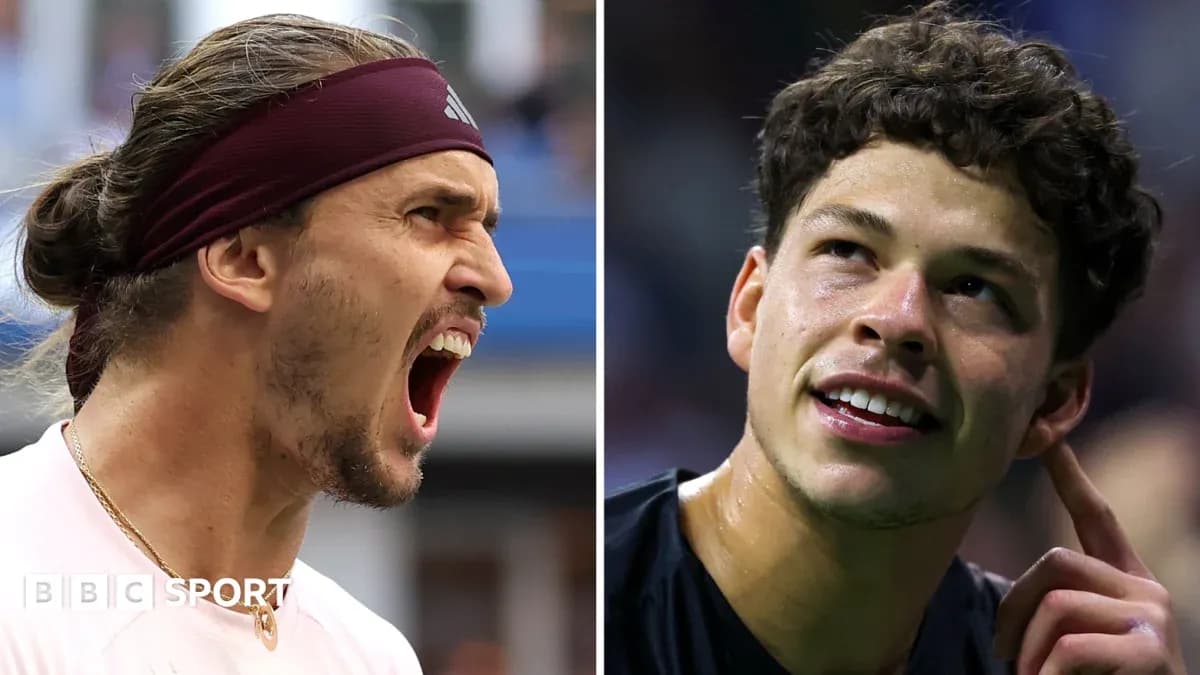
Alexander Zverev and Ben Shelton will walk into Sunday’s US Open final already changed men.
Whatever happens under the lights, 2026 has given Zverev the Grand Slam breakthrough many had quietly filed under “probably never” and confirmed Shelton as far more than a streaky showman with a huge serve and a bigger smile. One has finally stepped out of a shadow. The other has kicked down the door.
Zverev, at last, plays like a man who believes
For years, Zverev lived in the long, bright glare of Jannik Sinner and Carlos Alcaraz. They were the ones who “owned” the sport’s future, the pair so dominant across 2024 and 2025 that they picked up a joint nickname – “Sincaraz” – and an assumption: the biggest stages belonged to them.
Zverev was the nearly man. Three major finals, three defeats. The most painful of all came here in New York in 2020, when he led Dominic Thiem by two sets in the US Open final and still walked away with nothing. That scar lingered. You could see it in the tight shoulders, the hesitations in the biggest points, the sense of a player who didn’t quite trust that his moment would ever arrive.
This year, that story cracked. Then it flipped.
The French Open title against Flavio Cobolli at Roland Garros finally buried those doubts. Wimbledon brought another step: runner-up to Sinner, but with a level of consistency that had too often deserted him. Now he stands in his third straight Grand Slam final, chasing a second major of the year and of his career.
At the start of the season, the idea of Zverev winning two Slams in 2026 would have sounded fanciful. Not now. The injuries that sidelined Alcaraz from Roland Garros and Wimbledon and ruled Sinner out of this US Open created an opening. Zverev has driven straight through it.
Asked whether he believed he could finish the year with more majors than the two men who have defined this era, he did not blink.
“I believed in it. I believed that it's possible. I think not many of you guys did,” he said. “I think the question was always: Is Carlos and Jannik going to play all four Grand Slam finals between each other again? Of course, it was a very legit question with how the last two years went. I'm happy with how this year went so far, but I've got another big match on Sunday.”
That last line matters. Old Zverev might have savoured the French Open and settled for respectability here. This version wants to stack trophies.
His route in New York has been gritty rather than glamorous. A string of late-night marathons, patchy form, no top-20 opponent yet. A “below-par” Zverev, by his own standards, has still found ways to win. The level has crept up as the fortnight has gone on. The belief, for once, has stayed.
Shelton is a clear jump in quality and threat. He is also, like Cobolli in Paris, a man walking into his first Grand Slam final with the full weight of the occasion on his shoulders. Zverev knows exactly how heavy that can feel.
Shelton’s stage, Shelton’s city
If Zverev carries the scars of 2020, Shelton carries something else: the energy of a home crowd that has been waiting more than two decades for a man to finish this job.
No American man has won the US Open since Andy Roddick in 2003. No American man of colour has lifted a Grand Slam singles trophy since Arthur Ashe in 1975. Shelton stands 23 years old, eighth seed, and one win away from rewriting both of those lines in the history books.
He does not pretend the moment is small.
“For me, this whole tournament has been uncharted territory,” he said. “I'm in positions I've never been in before. I've beaten guys I've never beaten before.”
He will need to add Zverev to that list. The German has beaten him in all five of their previous meetings. If Shelton is to walk away on Sunday night with the trophy, he must snap that streak in the most pressurised match of his life.
The setting could hardly be more charged. A partisan, 24,000-strong crowd ready to roar every ace, every fist pump, every sprinted get. The kind of noise that rattles opponents and inflates a young man’s lungs.
Former world number four James Blake knows what that picture could mean beyond the result.
“Having another black American in the final leaves you wondering how many kids and adults are watching that maybe wouldn't have been otherwise,” he told BBC Sport. “They are going to be inspired to hear Ben's story and see someone that looks like them out there playing and competing in a sport that has historically been dominated by the sense of a country club white sport.”
Shelton has not arrived here on adrenaline alone. The serve, of course, is the headline act. It has thundered above 140mph throughout the fortnight, a lefty cannon that can blow open games in seconds. But the raw power that turned heads in his early breakout has been backed up by work in the shadows.
His backhand, once a glaring weakness, has tightened. His defence, once a liability, now allows him to stay in rallies, to “suffer a little bit”, as his father and coach Bryan Shelton put it. That willingness to dig has underpinned a season that already includes four titles on four different surfaces: Dallas indoors on hard courts, Munich on clay, Stuttgart on grass, and the Canadian Open on outdoor hard.
“Ben has been trending in the right direction throughout this year. I think four titles on different surfaces is evidence of it,” Bryan said. “He's willing to suffer a little bit in the rallies, go deeper and really use his athleticism.”
The watershed came here with his quarter-final win over Alcaraz. Until that night, Shelton had never beaten a top-three player. He chose a brutal way to change that, outlasting the seven-time major champion – playing his first tournament in almost five months – in a match that finished at 3:34am. It was chaotic, electric, and defining.
You do not beat Alcaraz in New York at that hour without serious nerve.
A final that belongs to the moment
So the stage is set: the French Open champion, slight favourite, chasing authority and validation; the home hope, chasing history and something larger than himself.
Zverev knows exactly what it feels like to freeze in a first US Open final. Shelton knows exactly how it feels to ride a wave so big it could either carry him or crush him. One of them will leave with a second Grand Slam title, the other with a first. Both, in their own ways, have already altered the shape of the season.
The question now is simple, and brutal.
Whose story gets to define this era – the man who finally refused to let it pass him by, or the one determined to rip it out of his hands on home soil?