.svg&w=384&q=75 "logo")
Zverev Ends U.S. Open Drought, Shelton's Dream Run Falls Short
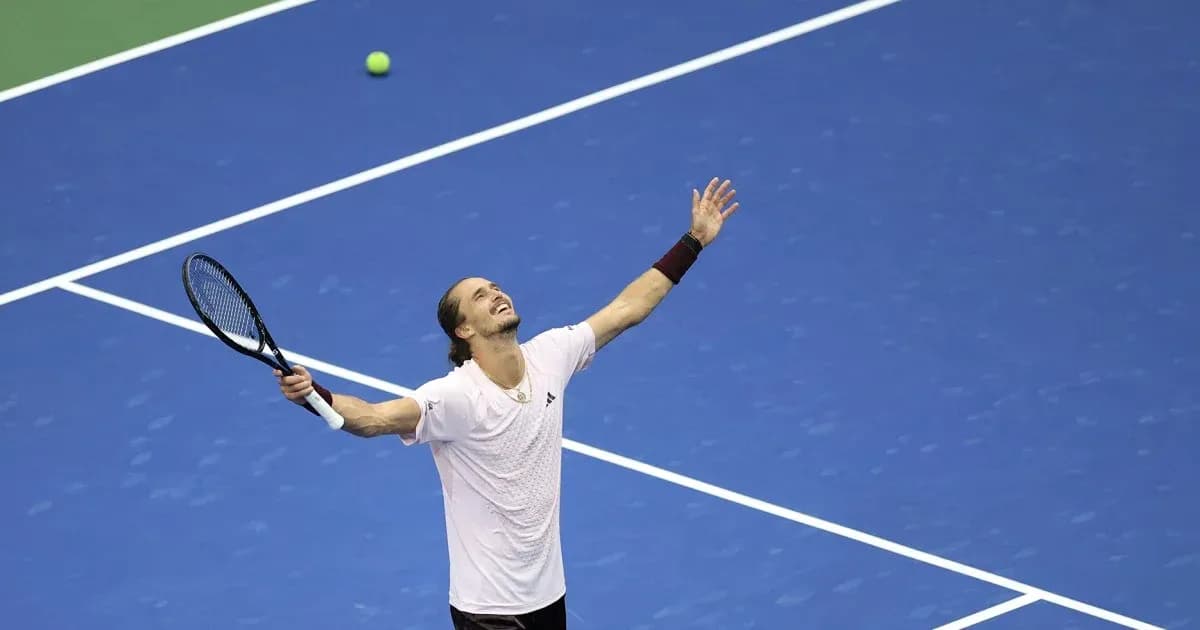
Alexander Zverev walked into Arthur Ashe Stadium as the man with scars. He walked out with his second Grand Slam title and 23,000 people watching an American dream dissolve under the lights.
The German beat Ben Shelton 6-3, 7-6 (2), 5-7, 6-2 on Sunday night, ending a 21-year wait for a homegrown men’s champion to no avail and reminding the sport that experience, when wielded with this much control, still bites.
Zverev’s moment, years in the making
When Jimmy Connors handed him the Tiffany & Co. trophy and the $5.5 million winner’s check, Zverev looked less like a man celebrating a surprise and more like someone finally cashing in on a long-running promise.
He had been here before. Five previous major finals, one title already banked at Roland Garros in June, and a reputation as one of the game’s great nearly-men slowly turning into something more substantial.
The most revealing moment came not in a roar but in a tribute. Zverev thanked his mother, recalling her resolve when he was diagnosed with diabetes at age 4 and insisted his future would not be limited.
“‘If he wants to be a tennis player, he’ll be a tennis player,’” Zverev said, quoting her. “My mother is the most important and strongest person I know.”
On court, that same steel ran through his performance. His serve thudded into the corners, his patterns were deliberate, his temperament largely unshaken, even when Shelton began swinging freely and the stadium tilted heavily toward the American.
A final built on power and pressure
From the first game, this was a heavyweight serving contest with a layer of narrative history on top. Two big arms, two very different resumes, one stage that has a way of exposing nerves.
Shelton started tight. Zverev did not. The German’s methodical baseline game smothered the early exchanges, his depth and weight of shot pinning Shelton back and drawing errors. The first set went 6-3, and it felt straightforward.
Then the night changed.
Shelton, 23 and playing in his first Grand Slam final, loosened his shoulders. His returns bit a little harder. His forehand, struck with that explosive whip that has made him a fan favorite, began to sting Zverev’s defenses. He forced a tiebreak in the second set, the crowd roaring with every hold, every daring strike.
The noise hit a new level as the breaker began. But Zverev shut it down. He played it like a man who had lived this tension before and learned from it, edging ahead early and never letting Shelton breathe. The German closed it out 7-6 (2), and suddenly Shelton trailed by two sets, staring at a mountain.
Shelton refuses to go quietly
He didn’t shrink. He dug in.
The third set turned ragged and emotional. Shelton chased everything, pumping his fist, talking to himself, riding the crowd’s energy. His return game finally cracked Zverev’s rhythm, and the German, so composed for two sets, looked rattled for the first time.
Shelton clawed his way back into the match, taking the third set 7-5 and blowing the roof off Ashe. The belief in the stands was tangible now, a sense that American men’s tennis might just be on the brink of its first U.S. Open champion since Andy Roddick beat Juan Carlos Ferrero in 2003.
Shelton’s run to this point had already been punishing. He’d gone 4 hours and 28 minutes with two-time U.S. Open champion Carlos Alcaraz in the quarterfinals, a bruising, late-night epic that ended at 3:33 a.m. Wednesday. He’d then backed it up with a statement win over fellow American Frances Tiafoe, 4-6, 6-3, 6-3, 7-5, on Friday night.
The tank, though, only has so much in it.
Fourth set: the champion closes
The fourth set began with tension. Zverev picked up a time violation and argued, but the flashpoint fizzled quickly. The warning could have become a turning point. Instead, it became a footnote.
The German reset, tightened his patterns, and ripped away any remaining sense of inevitability around the American comeback. He broke early, surged to a 3-1 lead, and never loosened his grip. Shelton’s serve, such a weapon all fortnight, cracked at 4-2; Zverev broke again for 5-2 and then served out the title with the cool of a man who knew exactly what he’d come for.
There was no wild collapse, no late twist. Just a seasoned champion finishing the job.
Faith, family, and a new American standard
For Shelton, the night ended in defeat but not in disappointment.
He stood on the podium and framed the whole experience through gratitude, not frustration.
“My successes are a gift, the failures are a gift, and being here playing in front of you guys is a gift,” he said, thanking God and soaking in an atmosphere that had carried him all week.
In the stands, his girlfriend Trinity Rodman, a professional soccer player for the Washington Spirit, wore a Shelton shirt. She had started in her club’s 3-0 home loss to the Boston Legacy earlier in the day, then made it to New York in time to watch him chase history.
History loomed large everywhere you looked. Shelton was trying to become the first American man in more than two decades to win this title and only the second Black man ever to lift the U.S. Open men’s trophy. The first was Arthur Ashe, whose name towers over the stadium and whose 1968 triumph still stands alone.
For many in the crowd, that context mattered as much as the scoreline.
Tracie Saundera, in the stands before the match, spoke about what it meant to see a Black man in the final for the first time since 1972 — a moment that predates her own life. Shelton’s style, his fire, his youth, pulled her in as much as the symbolism.
“He just plays with so much passion and energy,” she said. “He’s so fun to watch play, and he’s young and enthusiastic. ... I’m old. Most of my players are retiring, so it’s good to see some of the young kids coming in and just being powerhouses.”
A crowd that sounded like a turning point
Arthur Ashe Stadium felt less like a neutral Grand Slam venue and more like a home arena for Shelton. Fans had driven and flown in from across the country.
University of Florida supporter Junior Pulayya made the long drive from Florida to New York to back the former Gator. For him, Shelton’s rise marks more than one player’s breakthrough.
There had been, he said, a drought of “really solid” American men’s players. Shelton, along with a growing cast of compatriots, offers a different horizon.
“This is, just, it gets that new generation of kids that follow tennis, that get involved in tennis, that want to get involved in tennis,” Pulayya said. “It does so much just for today, but long term for the sport.”
From Maryland, longtime tennis fan Shameka Littles watched the moment unfold with a sense of scale. Shelton, the first Black man in over 50 years to reach this stage at the U.S. Open, carried a weight that goes beyond a single match.
She admitted she couldn’t fully imagine what that must feel like. What she could feel was the surge of American relevance this fortnight delivered.
“To have so many of the top seeds, you know, make it to the semifinals, the quarterfinals — that was exciting in and of itself,” she said. “Hopefully, it just kind of gives, you know, a big boost of energy and excitement for each other.”
One champion crowned, another contender born
Zverev leaves Queens with back-to-back Slam titles in his pocket and the look of a man building a legacy at last, not just a reputation.
Shelton leaves without the trophy, but with something that can’t be bought or rushed: the sense that this won’t be his only shot on a stage like this.
The drought for an American men’s U.S. Open champion goes on. The wait for the next genuine contender might just be over.