.svg&w=384&q=75 "logo")
Zverev Dominates Khachanov in US Open Semi-Final
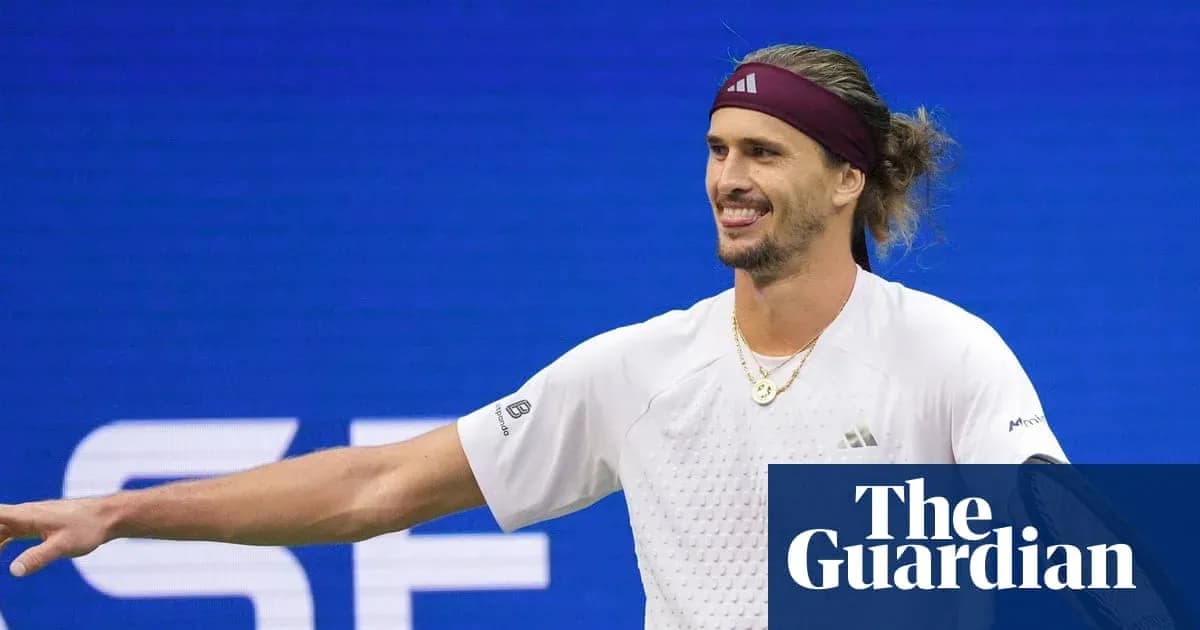
By the time tension finally seeped into Arthur Ashe Stadium, the men’s semi-final had already felt like a foregone conclusion.
It arrived 107 minutes in, with Karen Khachanov clinging to the match and to his pride. Down a set and a break, his reunion with old rival Alexander Zverev had been sliding towards a rout. Then came the resistance. Khachanov clawed his way into a second-set tie-break, and with it, at last, a sense of jeopardy.
At 5-6, serving to stay in the set, he uncorked a fearless forehand winner. At 6-7, he lashed a screaming backhand pass and let out a roar that echoed around the sparsely filled arena. For a brief moment, it felt as if the semi-final might finally catch fire.
Zverev stamped it out.
The German reset, shut the door on the comeback, and walked off the court with a straight-sets win: 6-3, 7-6 (7), 7-6 (6). Two tie-breaks negotiated, two surges resisted, one more step taken towards a second grand slam title in his last three majors.
Zverev’s new normal
There was a time when that wobble might have undone him. Zverev’s history is littered with matches where tension seeped into his arm and chaos followed. Not this season. Not this version.
He has won too many big matches in 2024 to be rattled by a lower-ranked opponent mounting a late stand. When the tie-breaks tightened, he trusted his serve, trusted his patterns, and trusted the weight of his ball from the back of the court. The pressure that once crushed him now seems to sharpen his focus.
The numbers tell the story of a player who has moved into a different phase of his career. This run in New York gives him three consecutive grand slam finals for the first time. He arrived here as the reigning Roland Garros champion, then backed it up with a first Wimbledon final in July. Now he is back where his grand slam story truly began.
In 2020, in a silent, pandemic-era US Open, Zverev reached his first major final on this court and led Dominic Thiem by two sets, then served for the title. He lost in five. Six years and a rebuilt career later, he returns to the same stage chasing a sixth grand slam final and a second major trophy.
The scars of that night haven’t vanished. They’ve hardened.
Khachanov’s pedigree, Zverev’s edge
On paper, this was a mismatch. Zverev, the world No 2, against the No 50. In reality, Khachanov’s ranking disguises the heft of his résumé.
The 30-year-old Russian has lived in the game’s top tier. He climbed as high as No 8 in the world, won the Paris Masters in 2018 and took Olympic silver in Tokyo, finishing runner-up to Zverev. He arrived with a 3-6 record against the German but more wins over him than the other two semi-finalists combined, including a victory as recently as last year in Canada.
So this was no walkover on name alone. Yet from the baseline exchanges to the big points, the gap between them looked larger than the rankings suggested.
Zverev’s serve set the tone. It bailed him out of awkward moments and gave him free points when he needed to reset. Off the ground, he was relentlessly solid, driving heavy, deep balls that kept Khachanov pinned back and pressing.
Khachanov’s forehand, by contrast, betrayed him. The stroke that once bullied top players misfired badly, spilling errors at precisely the wrong times. When the second-set and third-set tie-breaks demanded clarity and nerve, that wing wobbled. Zverev didn’t have to do anything spectacular. He just had to keep asking the question.
The answer, from Khachanov’s forehand, was too often the same: another mistake.
A soft draw, ruthless execution
Zverev’s path through this tournament has only strengthened the sense that the draw has opened up for him at the majors this year. At Roland Garros, the exits of Jannik Sinner and Carlos Alcaraz, and Novak Djokovic’s late-career struggles, left him as the man to beat. The story has echoed in New York.
From the top half of the draw, Zverev has not faced a top-20 opponent. His highest-ranked hurdles en route to the final have been No 22 Luciano Darderi and No 28 Alejandro Tabilo. If he lifts the trophy on Sunday, he will have collected his first two grand slam titles without facing a top-eight player.
It is an odd quirk, and one that will be debated. But a player can only beat the opponents across the net, and Zverev has done that with increasing authority. After surviving two bruising five-setters in his opening rounds, he has not dropped a set since.
The final offers him more reasons to believe. Whether it is Ben Shelton or Frances Tiafoe standing opposite him, the head-to-head ledger tilts heavily in his favour: 15 wins and just one defeat combined, with that solitary loss to Tiafoe coming nine years ago, in another phase of his life and career.
He will walk into Sunday’s final not just as the higher seed, but as a man who knows he has already solved these puzzles many times before.
A semi-final that barely registered
For all that was at stake, this was a grand slam semi-final that barely rippled beyond the lines of the court.
Zverev is the world No 2. Khachanov is a former semi-finalist here. Yet it is hard to recall many men’s last-four matches at a major in recent years that have generated so little noise, so little anticipation.
The stands told their own story. One of the dominant off-court themes of this US Open has been the fury around the secondary ticket market, with resale prices for marquee sessions soaring to eye-watering levels. Not for this one. On StubHub, seats for Zverev v Khachanov dropped as low as $21 (£15.50) before the first ball was struck.
It was a semi-final hiding in plain sight: high stakes, low buzz.
Zverev did not seem bothered. He played with the calm of a man who has grown used to the rhythm of the last weekend at majors, who knows that the only roar that matters is the one that comes when you win the last point of the last match.
Now he is one victory away from changing the conversation around him yet again. The first US Open final broke him. The next one might define him.