.svg&w=384&q=75 "logo")
Venus Williams Returns to US Open: A Wildcard Controversy
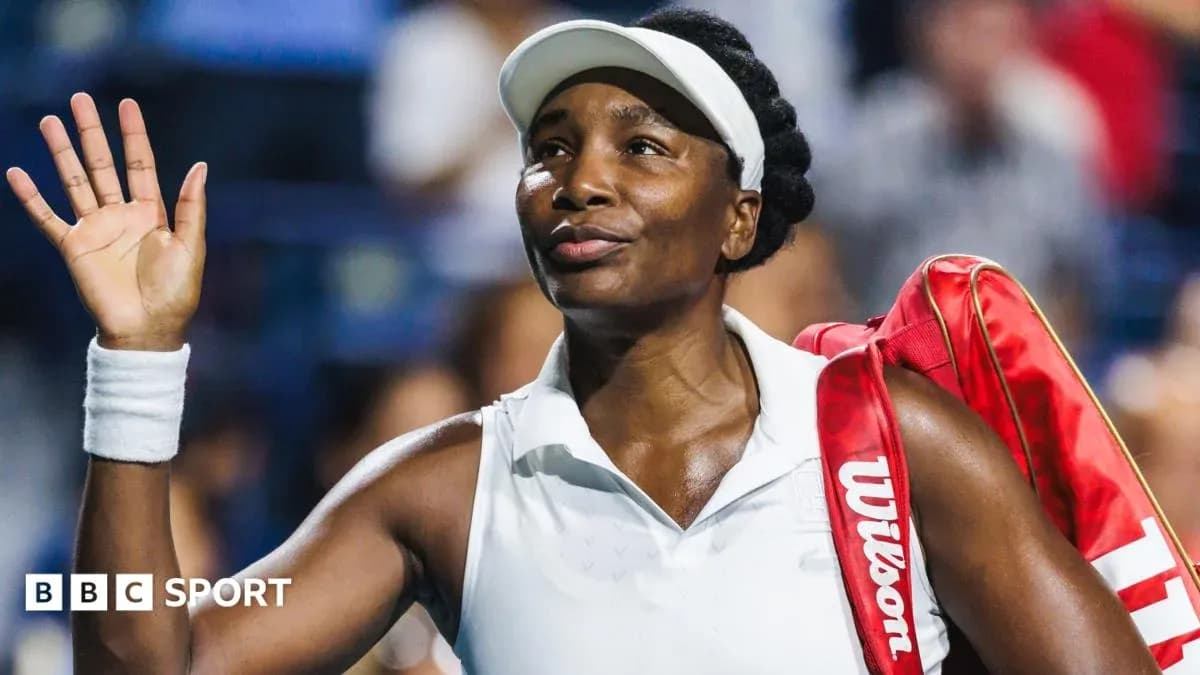
Venus Williams walks back into Flushing Meadows this year as both legend and lightning rod. At 46, with five Wimbledon singles titles and two US Open crowns behind her, she remains one of the defining figures of modern tennis. She also arrives ranked 611 in the world and on a run that would have retired most players long ago: 14 straight singles defeats, 18 losses in her past 19 matches.
Yet here she is again, invited back.
The United States Tennis Association has handed Williams her 12th wildcard of the season so she can play the US Open singles draw, where she will face fellow Grand Slam champion Sofia Kenin in the first round. No qualifying grind, no protected ranking. Just her name, her history and a tournament that still believes she belongs on its marquee.
Not everyone agrees.
There is a growing chorus that says enough is enough. No wins, no ranking, no business taking one of the eight precious wildcard spots in a 128-player Grand Slam draw. Wildcards, the argument goes, should be for rising prospects or hardened tour players clawing their way back, not icons chasing one last run.
Tennis, though, has written its own rules for its royalty.
There is no cap on the number of wildcards a Grand Slam champion can receive. And for many events, the calculation is brutally simple: a Williams sister still moves the needle. She fills night sessions, drives TV interest, bumps ticket sales and gives a tournament an immediate sense of occasion.
Karl Hale, tournament director in Toronto, did not hesitate when he had the chance to bring Venus to his WTA 1000 event this month.
"I think it's good for tennis to have these generational icons," he said. "That they are still allocating wildcards for them says something to their intrinsic value to the tournaments."
Hale’s view is shared in boardrooms across the tour. This season alone, directors in New Zealand, Australia, Spain, Germany, Canada and the United States have all opened the door for Williams. They know exactly what they are getting: not a title contender, but a story.
On court, the numbers are stark. Williams has not qualified for a Grand Slam on ranking since Wimbledon 2021. That tournament also delivered her last singles win at a major. Since then, the victories have almost completely dried up. The only singles highlight in the past year came in Washington last July, when she beat Peyton Stearns.
The defeats keep stacking up. Her loss to qualifier Emiliana Arango in Cincinnati this month made it 18 losses in 19 singles matches. Yet buried inside that record is just enough resistance to keep hope alive. At last year’s US Open she dragged 11th seed Karolina Muchova to three sets. In January, at the Australian Open, she went the distance again before losing narrowly to Olga Danilovic. She also reached the doubles quarter-finals in New York last year.
To Hale, that still matters.
"You never want to put a player out there that you are unsure about," he said. "Venus lost 6-4 6-1 to Kamilla Rakhimova, and the first set was really competitive. She's still competitive, but just not winning these matches."
For tournament directors, the wildcard is a powerful tool. Typically, eight spots in a Slam draw are reserved for them. At WTA and ATP events, the number usually sits between four and eight depending on the field size. Those places can launch careers, reward national players, or be used as currency in the sport’s quiet backroom trade.
Hale is open about how it works. Most events will first look after their own – domestic players who can energise home crowds. Then come the big names, the former champions, the players who guarantee headlines. And behind all that, a network of favours.
There are the so-called “trades” between national federations and agencies such as IMG, which manages players and until recently owned the Miami and Madrid Opens. The most visible example is the reciprocal wildcard pact between the USTA, Tennis Australia and the French Tennis Federation. Each offers one men’s and one women’s wildcard to the others, knowing that when the tour swings back to their Slam, their players will get the same courtesy.
Wildcards, then, are part merit, part market, part politics.
Williams sits at the intersection of all three. She no longer has the results, but she has a legacy few can touch. She remains a draw in every market. And she has earned the kind of institutional goodwill that keeps doors open long after the ranking points disappear.
"The way we looked at Venus is that her legacy is phenomenal," Hale told BBC Sport. "She's done so much for the sport and is really popular here in Toronto and our markets specifically - so we thought it was really good to announce it early that we have a Williams sister coming."
The effect was immediate. Media interest spiked. Opening day suddenly had a hook.
"The wildcards always play first-round matches, and with the bigger draw [size] now, it adds more notable names and stars for the beginning of the tournament," Hale said. "Venus played opening day. She kicked off our tournament, so it added a lot of value."
Other sports have been less forgiving with their greats. Golf’s Open Championship once allowed any former champion under 65 to return whenever they chose. Now the cut-off is 55, a change designed to free up places for younger, higher-ranked players. Golfers can remain competitive deep into their 40s and beyond, yet even there the door has been nudged closer to shut.
Tennis has never imposed such limits. Martina Navratilova accepted wildcards into the French Open and Wimbledon singles draws in 2004 at the age of 47, and still managed to win a round on grass. The sport has long accepted that if a legend wants one more dance, someone will usually provide the music.
So where is the line? When does a tournament director say no to a past champion in favour of a 23-year-old ranked 80 in the world and desperate for a chance?
Hale believes that call will not be his to make.
"When the time comes that Venus is not competitive in sets, then I think she will make that call," he said. In his view, the Williams sisters have earned the right to decide their own exit.
"Venus and Serena have done so much for women's tennis and the sport that they should be able to play as long as they want. I'm very happy they are continuing and they make their decision when they are ready, or each tournament makes their decision when they are ready."
Players feel it too. British number one Katie Boulter, who partnered Williams in doubles in Madrid this April, spoke with the reverence of a younger generation that grew up watching her dominate.
"Venus has given so much to our sport that she deserves to get what she needs back," Boulter said. "We have to be grateful that she is still out there, doing the best she can."
That is the tension wrapped inside this latest wildcard. On one side, a hard-nosed argument about opportunity, merit and the finite nature of main-draw spots. On the other, a sport acknowledging one of its true pioneers and choosing, again, to let her walk through the door.
Venus Williams will step onto Arthur Ashe or one of the outside courts in New York not as a favourite, not even as a genuine contender, but as a living bridge to an era she helped create. Whether this wildcard leads to another brief surge or another early exit, the question for tennis is no longer what she owes the game.
It is how much longer the game wants to keep saying yes.