.svg&w=384&q=75 "logo")
U.S. Open's Influencer Culture Disrupts Matches
The Arthur Ashe dance floor was never meant to be this literal.
On Monday night at the U.S. Open, Naomi Osaka’s match against Anastasia Zakharova was briefly dragged out of its usual cocoon of silence and tension and into the glare of ring lights and TikTok choreography. High above the baseline, in one of Arthur Ashe Stadium’s suites, a group of influencers filmed what looked like a dance video under a piercing white light. The umpire stopped watching the points and started watching them.
Repeatedly, the chair official turned toward the suite and asked for quiet. The request had to cut through music, chatter, and the whirr of content creation. Osaka and Zakharova were trying to serve; the suite was trying to go viral.
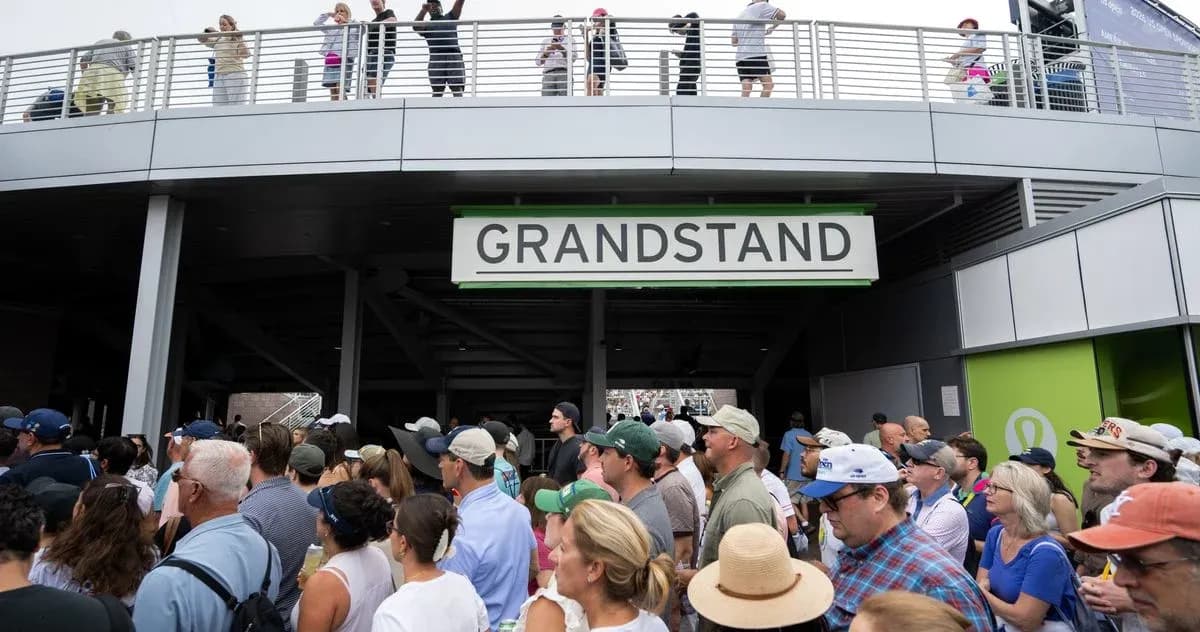
The scene, captured on video by Katherine, a lifelong tennis fan, ricocheted around social media within hours. The clip drew more than 1,500 comments, many of them from fed‑up fans who feel the U.S. Open has tipped too far into spectacle. For years, the tournament has leaned into its reputation as tennis’s loudest major. This felt different. This felt like a line being crossed.
“All around the stadium, there were people — in the middle of serves and in the middle of points — getting up, walking through the crowd down to the closest they could get to the court in their section, and taking pictures, taking videos, using ring lights,” Katherine said.
For anyone raised on tennis etiquette, it was jarring. Movement is supposed to wait until the end of a game, a set, at least a point. In 2024, the U.S. Open relaxed those rules. The ripple effect is now crashing into the core of the sport.
From Katherine’s vantage point, one suite became the flashpoint. Around a dozen people, noisy and animated, drew the umpire’s attention. They were being filmed by a U.S. Open usher holding a bright, phone-sized light — a portable studio in the middle of live play.
“It didn’t seem like they were aware that the umpire was talking to them because they weren’t really watching the match,” she said. “I’ve never seen that in the middle of a point. The flash was the craziest thing.”
The video doesn’t just show the influencers. It also shows another fan, standing in the aisle, angling for the perfect selfie while Osaka plays behind her. That fan, fashion and lifestyle influencer Mriganka Chawla, later stepped forward in the comments to say: that was me.
Chawla insists she wasn’t part of the rowdy suite that drew the umpire’s ire. She attended the Open for the first time with her fiancé’s tennis-obsessed family, not on an official influencer invite. She says she left her seat to grab an ice-cream sandwich, spotted a relatively empty section, and asked an usher to snap a quick photo “because my man can’t take a photo to save his life.”
She thought she was out of the way. She thought no one would notice.
“I was seriously so far away,” she said. “I’m really sorry if I disrupted any playing.”
When she identified herself online and initially denied that her flash had bothered anyone, the reaction came fast and ugly: a swirl of “death threats” alongside curious DMs asking which selfie light she used. (For the record, it’s the same one popularized by Alix Earle.) The absurdity wasn’t lost on her.
“This is such an influencer thing, and I understand that now, but everybody has really cute photos [from the Open]. I just wanted one cute photo,” she said. “I wish somebody had told me, ‘You can’t do that.’ This is also on me. I should have researched it. I wish there were some guidelines or something.”
The backlash didn’t come out of nowhere. It’s been building, year after year, as the Open has rebranded itself from a grand slam into what the USTA’s CEO once called “tennis Disneyland” — a place of Honey Deuces, celebrity sightings, sponsor activations, and Instagram-ready backdrops. The tennis is still elite. The environment around it increasingly resembles a festival.
Influencers are now a formal part of the business plan. According to Sportico, the USTA handed out media credentials to 100 influencers and podcasters this year, double last year’s number. That tally doesn’t include creators invited by sponsors to corporate suites, where the line between guest and content machine blurs completely.
For many long-time fans, the numbers tell their own story: more influencers, higher ticket prices, heavier crowds, and a noticeable rise in people who seem more invested in their camera roll than the rally unfolding below. The Open has always welcomed noise — New York’s major prides itself on being the rowdy cousin of Wimbledon — but phones held high and ring lights flashing mid-point feel like a different kind of intrusion.
A recent piece in culture magazine the Mercer Edition labeled it the U.S. Open’s “influencer problem” and captured the core tension: “This sport is built around a level of concentration that can’t be understood until fully observed, and as such, brands should take that into consideration when offering to open the doors for vanity metrics and corporate satisfaction.”
Katherine feels that shift acutely. “Tennis fans have gotten really fatigued with influencer culture” at the Open over the past two years, she said. The tournament’s chaos used to come from the crowd riding the drama of a fifth set. Now, too often, it comes from people turning their backs on the court to face their phones.
“Once it’s impacting the play of the game, that’s a breaking point.”
For all the noise, there’s one last twist of irony. The selfie that helped ignite the debate? It didn’t even deliver the payoff.
“It looks like I’m mid-sneeze,” Chawla said, laughing. “Hey, everyone knows I went to the U.S. Open now, so I guess I don’t have to post anything.”