.svg&w=384&q=75 "logo")
US Open Finals Weekend: Sabalenka Defends Title Against Rybakina
Finals weekend at the US Open rarely tiptoes in. It crashes through the gates.
On Saturday in New York, the Arthur Ashe Stadium schedule offers a full-blooded double bill: men’s doubles champions crowned in the afternoon, a heavyweight women’s singles showdown under the lights.
Skupski hunts second Slam of the season
First up, British eyes will lock onto the men’s doubles final, where Neal Skupski and American partner Christian Harrison chase a second Major of a rapidly blossoming season.
They barely knew each other at the start of the year. Weeks into their partnership, they left Melbourne as Australian Open champions. Now the No. 6 seeds stand one win from adding the US Open to that haul, confirmation that January was no early-season fluke but the start of a serious alliance.
Waiting for them is one of the most reliable pairings on tour: Germany’s Kevin Krawietz and Tim Puetz. Krawietz has built a reputation as a doubles specialist who knows how to handle Grand Slam pressure; Puetz brings the same steely calm and sharp instincts at the net. Together, they are exactly the kind of duo that punishes hesitation.
Skupski and Harrison will walk onto Ashe at 12pm local time (5pm UK), a prime slot on finals weekend. The stage is big, the stakes are simple. Win, and they become multiple Slam champions in the same season. Lose, and the German duo tighten their own grip on the doubles landscape.
“This is her house”: Sabalenka defends her New York throne
Once the doubles trophies are lifted and the court cleared, attention swings to the main act: Aryna Sabalenka against Elena Rybakina for the women’s singles title.
The storyline writes itself. Sabalenka is chasing a third straight US Open crown, a rare kind of dominance at Flushing Meadows. Rybakina arrives as the new world No. 1, the player who has just taken Sabalenka’s ranking and now wants her title too.
Power against power. A reigning queen against the challenger who has already taken her crown on paper and wants to make it official on hard court.
Inside Sabalenka’s camp, the message is blunt. Her performance coach Jason Stacy made it clear after she reached a fourth consecutive final in New York that they see this court as her territory.
“The way I like to put it, no disrespect to anybody, is that, like, this is her house, and all the other girls are just guests, and it’s time for them to go home,” he said, drawing a clear line around Sabalenka’s domain.
He framed the task in simple, ruthless terms: Sabalenka must dictate, not react. “Her showing up and understanding that, hey, it’s her job to dictate the pace, to understand what her strategy is, and to not go to the level of the person across the net, not to meet them where they’re at, but I’m here to just do my job, and that’s it.”
Rybakina, armed with the No. 1 ranking and one of the cleanest ball-strikes in the game, is hardly a guest who scares easily. But on this court, in this city, Sabalenka believes she still holds the keys.
Rodman’s dilemma: finals clash on two continents
Away from the baseline battles, one storyline stretches beyond tennis. Trinity Rodman, star forward for Washington Spirit and partner of US Open finalist Ben Shelton, faces a scheduling collision that any professional athlete in a relationship with another elite athlete knows too well.
Shelton will contest the men’s singles final against Alexander Zverev. At the very same time, Rodman is due to play for Washington Spirit against Boston Legacy.
Two big stages. One evening. No easy solution.
Everyone wants to be there for their partner on nights like this. But Rodman has her own career, her own responsibilities, her own jersey to honour. The question hangs in the air with a smile: what are the chances of her pulling a sickie? The reality is far more complicated than the joke suggests.
Zverev’s late-night turning point
On the other side of the net from Shelton stands a man riding a wave of Grand Slam consistency. Alexander Zverev has reached a third straight Major final, a run that speaks to resilience as much as talent.
It hasn’t all been smooth. He admitted that earlier in the fortnight, his level had dipped to a point that was almost comical inside his own team.
“After the second round at 3am, me and my team were in the dressing room actually laughing at how bad I was playing,” he said after his Friday night win. That dark humour, he explained, helped reset the mood.
From there, he climbed. “I have improved a little bit, otherwise I wouldn’t be in the US Open final.” Understatement, but pointed. A player who once struggled to close the biggest matches now stands one victory from another shot at a Slam title.
Shelton’s flashpoint with the chair
Shelton’s path to the final carried its own drama. During his semi-final against Frances Tiafoe, he clashed with chair umpire Aurelie Tourte over a controversial replayed point.
Tourte allowed Tiafoe to replay the point after the American raised his hands to signal an issue. Shelton felt the call came too late and marched to the chair to make his case.
“Why did you not say something then? How are you going to call it after. You’ve got to say something immediately,” he argued, frustration boiling over in the heat of a Grand Slam semi-final.
Tourte stood by her decision, pointing to Tiafoe’s gesture. Shelton, unconvinced, had to swallow the ruling and channel the anger into his tennis. He did enough to reach the final, but the flashpoint underlined his competitive edge and his willingness to challenge authority when the stakes spike.
Eala caught in WTA–Asian Games crossfire
Beyond New York, another battle is unfolding, this one on the calendar rather than the court.
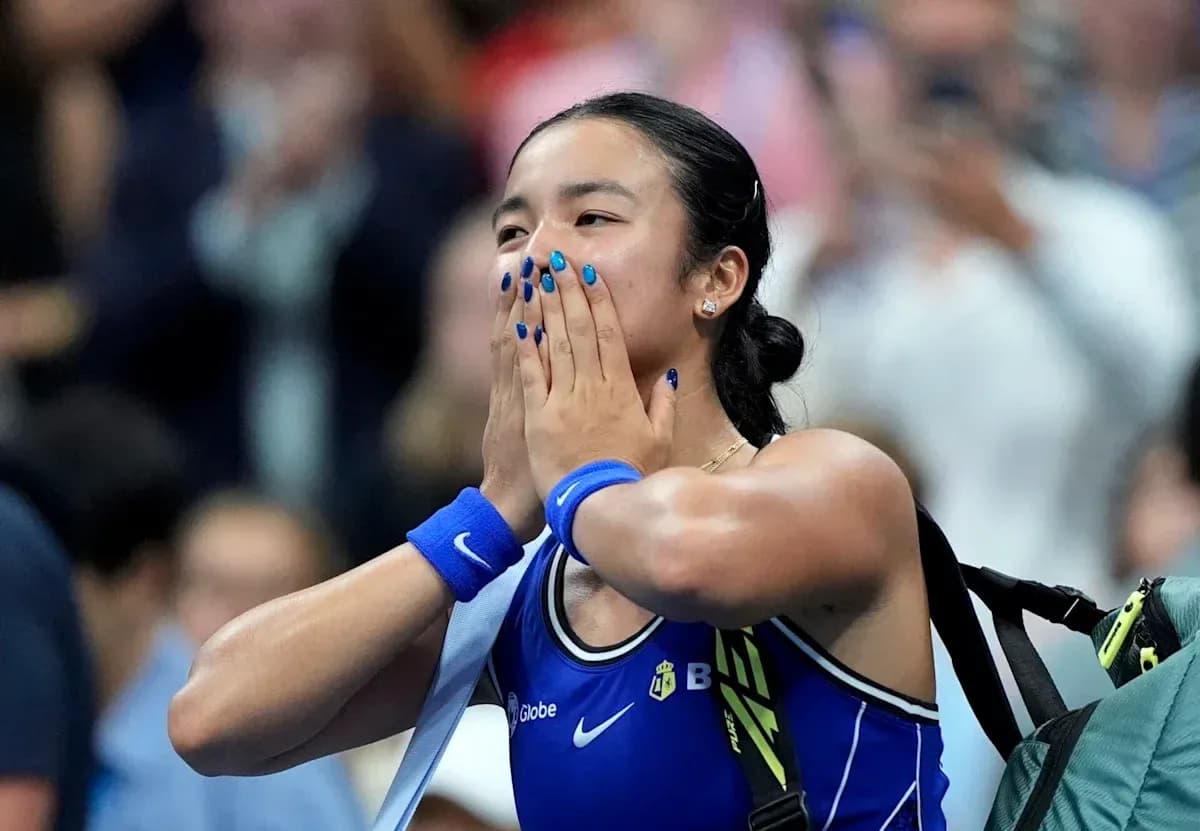
Filipino talent Alex Eala is reportedly unlikely to receive a WTA exemption to play the Asian Games, a decision that could cost her ranking points. The problem is simple and brutal: the Games in Japan clash with a mandatory WTA 1000 event in China.
Skipping Beijing without an exemption means a penalty. Eala now faces the kind of choice no young player wants—national duty or tour obligations, pride in the flag or protection of hard-earned ranking.
She is not alone. Indonesia’s Janice Tjen, world No. 36, has already been denied an exemption. In an Instagram post, Tjen spelled out the consequence.
“After a lot of consideration, I’ve had to make the difficult decision that I won’t be able to compete at the Asian Games this year which take place at the same time as the mandatory WTA 1000 event in Beijing,” she wrote. “We have received confirmation from the WTA that unfortunately, I have not been granted an exemption to compete at the Asian Games.”
It is a stark reminder that for many players, especially those outside the very top tier, the biggest battles can be fought in boardrooms and scheduling sheets as much as on centre court.
Back in New York, though, there is no such ambiguity. Titles are on the line, legacies in motion. Sabalenka defends her “house,” Rybakina tries to rearrange the furniture, Skupski chases another Slam, and Shelton and Zverev step into a final shaped by late-night laughter, on-court fury, and the unforgiving glare of Arthur Ashe.