.svg&w=384&q=75 "logo")
Ukraine Explores Joint World Cup Bid with Poland for the 2040s
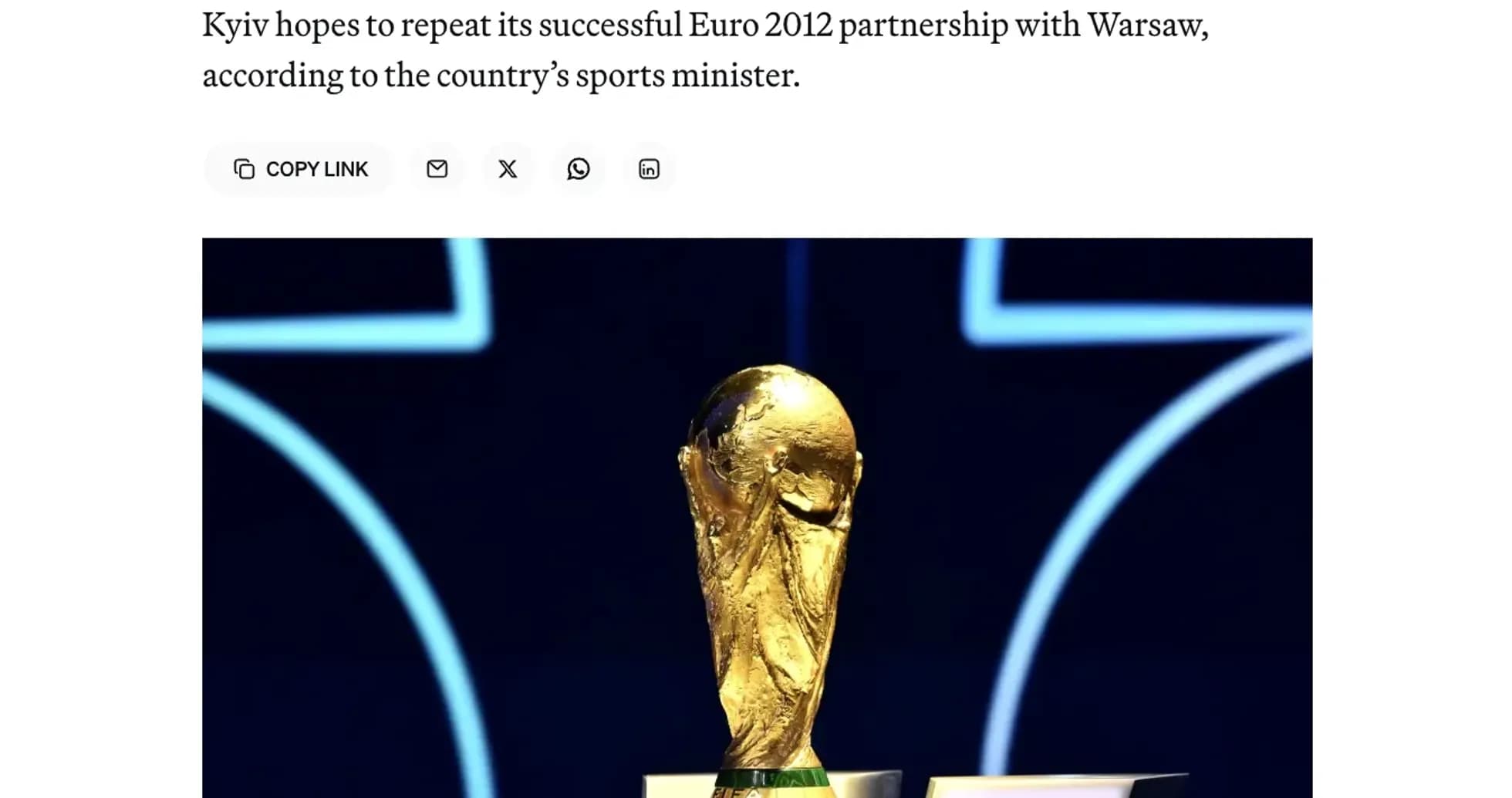
Ukraine has set its sights on the biggest stage in world football, exploring the idea of a joint World Cup bid with Poland sometime in the 2040s – a bold vision emerging from a country still at war and in the midst of reconstruction.
The prospect surfaced through Ukraine’s Minister of Youth and Sports, Matviy Bidnyy, in an interview with Politico. He spoke not about the next cycle or even the one after that, but about a tournament that lies more than a decade and a half away.
“The next available date for the World Cup is sometime in the 2040s. We need to start planning for that now,” Bidnyy said, framing the World Cup not as a quick political slogan, but as part of a long-range national project.
For Ukraine, the conversation is about more than hosting football matches. Bidnyy underlined that major international sporting events must be woven into the country’s broader reconstruction strategy. Stadiums, infrastructure, transport, security – all of it sits inside a bigger question: what Ukraine will look like when the war is over.
“We will work on this… We continue to be a country focused on the greatest sporting achievements. This is part of our national culture, and we want to develop it despite all these difficulties,” he noted, tying sport to identity as much as to economics or diplomacy.
The idea of linking up with Poland is no coincidence. Poland has become one of Ukraine’s key partners since the full-scale invasion began, and it already has recent experience as a co-host, having staged Euro 2012 alongside Ukraine. That tournament left a legacy of modern stadiums and upgraded infrastructure on both sides of the border, a template that naturally returns to the table when World Cup dreams are discussed.
Yet once Bidnyy’s comments began to circulate, the brakes were quickly applied.
After the interview was published, Ukraine’s Ministry of Youth and Sports issued a clarification: there are no official negotiations or consultations currently under way with Poland about a joint World Cup bid. The discussions exist in principle, not in paperwork.
The ministry also stressed that any formal bid cannot simply be a political decree. It must originate from within the game itself – from the football community or the relevant federation – and then be built up through the proper sporting and governmental channels.
That distinction matters. For now, this is a vision, not a campaign.
The ministry’s statement drew a firm line under the country’s immediate reality. Ukraine’s top priorities, it emphasized, remain victory in the war and the safety of its citizens. Only once those foundations are secure can the country seriously commit to the enormous logistical and financial demands of a World Cup.
So the World Cup conversation sits on a distant horizon, deliberately so. While the political and sporting calendar for the next decade is already locked, the 2040s remain open terrain.
FIFA has already awarded the upcoming tournaments. The 2030 World Cup will be shared by Spain, Portugal, and Morocco in a sprawling, cross-continental edition that will also include opening matches in South America. The 2034 World Cup will head to Saudi Arabia, confirming a rapid shift of football’s showpiece event toward multi-host formats and ambitious geopolitical projects.
In that evolving landscape, a Ukraine–Poland bid would fit the modern pattern: joint hosting, regional partnerships, and tournaments used as statements of national revival or global positioning.
But for Ukraine, the symbolism would cut deeper. A World Cup on its soil in the 2040s would not just be another stop on FIFA’s carousel. It would mark a country that has moved from survival to renewal, from defending its cities to inviting the world into them.
For now, it remains an idea voiced by a minister, clarified by a ministry, and parked firmly in the realm of long-term planning. The real question is whether, by the time those 2040s come around, Ukraine will be ready – and determined – to turn that distant ambition into a bid that can actually win.