.svg&w=384&q=75 "logo")
Tory Burch's New York Fashion Week Show Redefines Florals and Femininity

NEW YORK – Ready or not, Tory Burch has fully entered her imperial phase.
Just when her playbook seems predictable, she swerves. Again. On Thursday night she dropped her New York Fashion Week show into the Sunken Garden by Isamu Noguchi in downtown Manhattan, a cool, sculptural bowl of concrete and shadow that suited a designer intent on digging beneath the surface of her own brand.
The set was subterranean, but the guest list and ambition were sky‑high.
Lauryn Hill arrived like a quiet earthquake, in oversized sunglasses, an olive-green cinched top and tiered skirt, a silk scarf gliding over her head. Cameras snapped from every direction. Perched on her lap: Burch’s new Bunny Knot bag, butter yellow with dark knot detailing that read like playful polka dots. The same bag dotted the front row, clutched and cradled like a new trophy.
Hill sat flanked by daughter Sara Marley and niece Kymora Marley, part of a front row that blended fashion power and pop-cultural timing. Amanda Seyfried slid into her seat, Chloe Fineman brought a downtown looseness, and Anna Wintour took her customary position, the quiet barometer of New York fashion’s center of gravity.
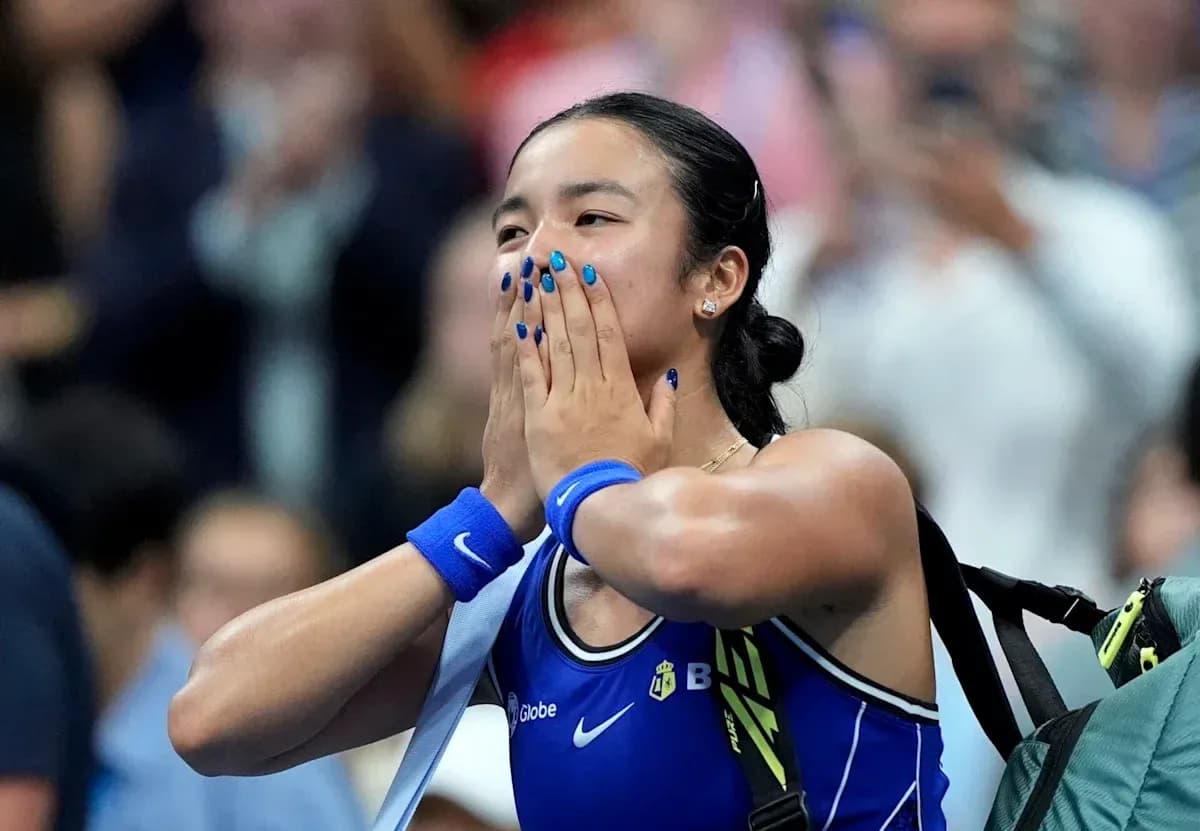
US Open breakout Alex Eala, fresh from a stirring run halted only by best friend Iva Jovic, added a new‑guard athletic edge. Music talent Ravyn Lenae and established names like Padma Lakshmi and director Janicza Bravo rounded out a crowd that felt curated, not just invited.
Then the soundtrack hit.
Burch, who has turned her show playlists into a talking point of their own, opened with “Bad Moon Rising” by Creedence Clearwater Revival, a nervy, rolling choice that unsettled the air. The mood then slipped into Enya’s “Boadicea,” the haunting instrumental Hill and The Fugees sampled for “Ready or Not” on “The Score.” With Hill in the front row, the reference landed like a wink and a thesis statement: this was a show about control, confidence and arrival.
The last time Burch staged a collection in a striking circular space — the Gilder Center at the American Museum of Natural History in September 2023 — it signaled the start of what’s been dubbed the “Tory‑ssance.” Out went the safe, polished preppy; in came a cooler, sharper, more subversive woman. Thursday night confirmed that shift wasn’t a phase. It’s the new baseline.
And then she did the unthinkable in fashion: she made florals for spring feel new.
On the first official day of New York Fashion Week, Burch turned a cliché into a weapon. Florals appeared in unexpected color clashes — lavender with teal, aubergine with emerald green — embroidered across dresses and threaded through looks as garlands. Some were draped around the neck like gajra, others wrapped around wrists or gripped alongside handbags, as if the models had just torn them from a garden and refused to let go.
Color did a lot of the talking. Butter yellow bumped up against deep grays. Kelly green sparred with eggplant purple. A golden-brown textured jacket, its surface rippling like a plant in mid-bloom, became one of the night’s standout pieces, a literal embodiment of the collection’s organic, growing energy.
Silhouettes balanced that opulence with ease. Burch’s familiar draped bodices softened into skirts that moved, not marched, catching air as models circled the concrete bowl. There was no stiffness, no overworked drama — just clothes that looked ready to live in the real world while still claiming their space on a runway.
Emily Ratajkowski, one of Burch’s recurring muses, underlined that point. She walked in a slightly sheer navy tank edged in red, paired with a matching pleated navy midi skirt and a brown medallion belt. The look was simple, almost disarmingly so, but it carried the collection’s thesis: sensual, functional, unfussy — and unmistakably intentional.
Burch spelled it out in her show notes: “Opulent femininity meets American pragmatism, seen through the collector’s eye.” The spring/summer 2027 collection, she wrote, “explores the psychology of how women pull things together. They want beauty, utility, and humor – the joy of getting dressed.”
That line — the joy of getting dressed — hung over the finale. Models looped the circular space one last time, florals trailing, skirts swaying, Bunny Knot bags tucked into elbows and palms. Nothing felt theoretical. These were clothes for women who have somewhere to be and something to say, and who don’t intend to choose between romance and practicality.
In a city that churns out trends by the hour, Burch didn’t chase one. She tightened her grip on something rarer: a clear, evolving identity. The Tory‑ssance isn’t just about being cool anymore. It’s about what happens when a legacy American brand decides it’s not finished rewriting its own story.