.svg&w=384&q=75 "logo")
Toby Samuel's Remarkable US Open Debut
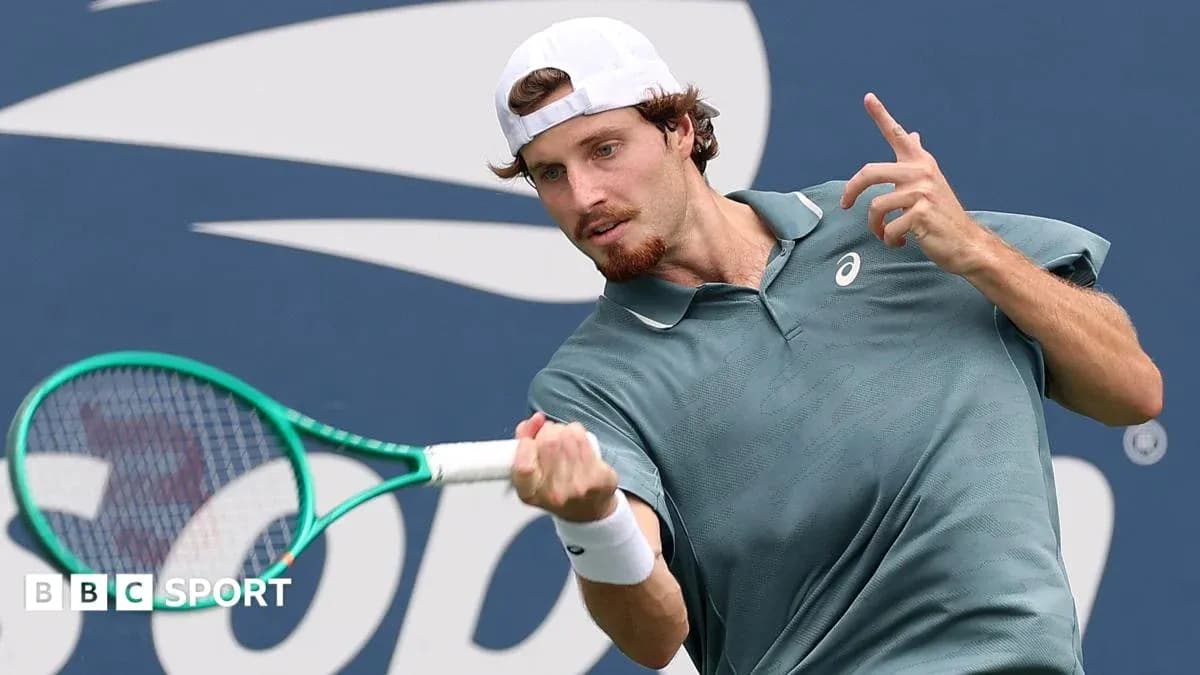
Toby Samuel walked into his first US Open main draw match with the grind of three comebacks in his legs and the weight of a childhood dream on his shoulders. Ninety-odd minutes later, he walked off Arthur Ashe territory as if he had been doing this for years.
The British qualifier, 23 and on his Grand Slam main-draw debut in New York, dismantled Tomas Machac 6-2 6-3 6-2 to claim his first win at a major. No drama this time. No escape act. Just clean, ruthless tennis against a former world number 20.
“It means everything to me. It's what I dreamt of as a kid watching these big tournaments,” he told BBC Radio 5 Live. “Being able to win my first Grand Slam match is unbelievable.”
Only two years ago, this sort of stage felt a long way off. Samuel had sunk towards 2,000th in the world rankings, his 2024 season shredded by bone bruising in his right arm. He was stuck on the sidelines while the sport moved on without him.
Now he is inside the live ATP top 100, staring at automatic entry into the sport’s biggest events and banking $140,000 in prize money for his week’s work in New York – the biggest cheque of his career by some distance.
The turnaround began on the less glamorous courts of the ATP Challenger Tour. Samuel ripped through that level last year, winning 36 of 39 matches to haul himself back into the top 300. That surge set the platform. What has followed in 2026 has pushed him into a different conversation.
He fought through qualifying to make his Grand Slam debut at Roland Garros, having never previously played a single match on the ATP Tour. From obscurity to the red clay of Paris in one leap. The rise didn’t stall there. A semi-final run in Eastbourne, a wildcard into Wimbledon, and a third Challenger title of the year on the hard courts of Winnipeg all fed into the belief that this wasn’t a one-off spike.
New York has confirmed it. With his new ranking, Samuel is on course to walk into next January’s Australian Open without needing a wildcard or a qualifying run, completing the full set of majors barely a year after cracking the top 250.
Match Performance
On Monday, the step up in stage did not shake him. Against Machac, Samuel’s serve became a shield and a weapon. Across the first two sets he dropped just five points on serve in nine games, reeling off three consecutive holds to love during a seven-game surge that broke the match open. Every time Machac looked for a foothold, Samuel kicked it away.
The only wobble came early in the third set when he fell 2-0 behind. It lasted minutes. Samuel reset, tightened his patterns, and reeled off the next six games, saving two break points along the way. The pressure finally told on Machac, and the Briton sprinted through the tape to set up a second-round meeting with Czech 18th seed Jiri Lehecka.
He will not walk into that match wide-eyed. Not anymore.
Growth and Experience
At Roland Garros, Samuel admitted he felt starstruck in the locker room, suddenly sharing space with the likes of Alexander Zverev, players he had only ever watched on television. That sense of awe is slowly being replaced by something more dangerous for the rest of the field: belonging.
“I'm still a little bit but I'm definitely more comfortable being around those top guys because I could be playing them the next day,” he said. “I have to start thinking of them not as stars but people I can play against.”
He is not the first Briton to find his launchpad in the American collegiate system, and he will not be the last. Like Arthur Fery, his partner in the 2019 Wimbledon boys’ doubles and a surprise semi-finalist at SW19 this year, Samuel has ridden the wave of US college tennis into the professional game.
Encouraged by his parents to combine sport and study, he headed to the University of South Carolina, where the former junior world number 57 claimed an All American doubles title and learned to feed off “super lively” crowds. Those college atmospheres, loud and partisan, have proved a useful apprenticeship for nights like this in New York.
Several of his South Carolina team-mates were in the stands for his first-round win, their voices cutting through the New York noise. Samuel credited their “fighting energy” with helping him “get the job done” against Machac. It felt less like a solo act and more like a travelling college team crashing a Grand Slam.
Family, though, had to divide its attention. His parents had been courtside throughout qualifying, riding every point as he clawed his way into the main draw. By the time he played Machac, they were on another campus, helping his brother begin his own college journey in the United States.
“My brother's just started university in America so they flew out to help him settle in, and I think my dad will fly back out for the second round,” Samuel said.
From almost 2,000 in the world to a seeded opponent at the US Open in the space of two bruising, transformative years. The next question is no longer whether Toby Samuel belongs at this level. It’s how far, and how fast, he can climb from here.