.svg&w=384&q=75 "logo")
Team USA Women’s Basketball Eyes Fifth Straight Gold at 2026 World Cup

The lights go on in Berlin in less than a day, and the most dominant program in women’s basketball walks into another World Cup with something heavier than expectation on its shoulders: a four-tournament gold streak and a roster that suddenly has to bend without breaking.
On Friday, Sept. 4, Team USA opens its 2026 FIBA Women’s Basketball World Cup campaign against China (8:15 a.m. ET, TruTV/TNT/HBO Max), chasing a fifth straight title and doing it without two of its most reliable stars, A'ja Wilson and Kelsey Plum.
The gap is real. The ambition is bigger.
A new look, same standard
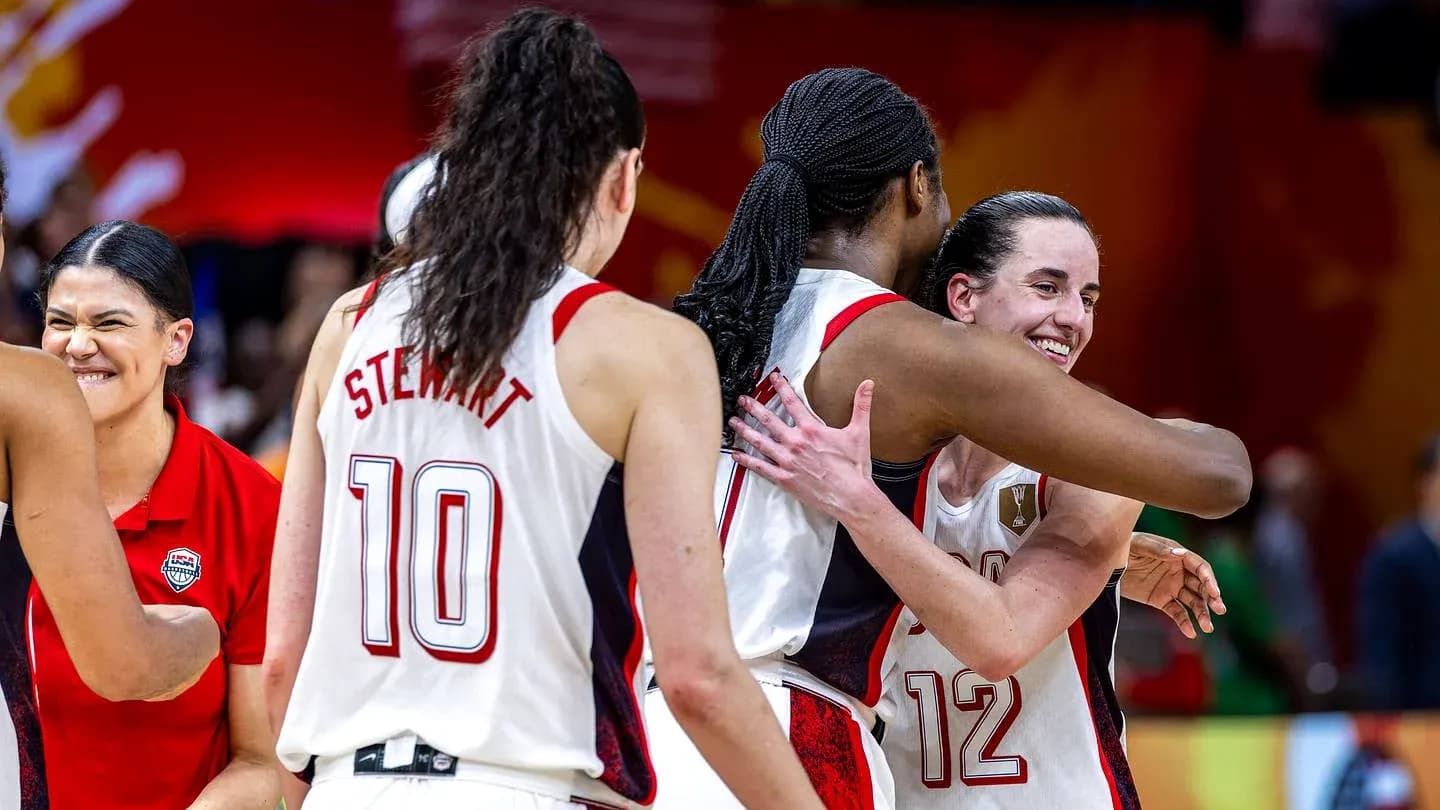
“Even getting to play here in the World Cup, that's special within itself, too,” Caitlin Clark told FIBA. She called it a tougher competition than the Olympics, a stage where the global talent pool deepens and the margin for error shrinks. She’s right. The World Cup doesn’t forgive slow starts or sloppy rotations.
Kara Lawson knows that. With Wilson and Plum sidelined, the head coach has to redraw the map without tearing up the identity. The plan: keep players in their natural roles as much as possible, lean on experience where she has it, and let the team’s depth do the talking.
On paper, that produces a starting five that blends championship scars with fresh ambition.
The projected starting five
Point guard: Chelsea Gray (Las Vegas Aces)
Lawson’s first decision should be her most straightforward. With a young guard group that hasn’t yet carried the senior national team through a World Cup or Olympics, Chelsea Gray’s presence matters as much as her numbers.
She didn’t light up the stat sheet in the March qualifying tournament — 5.6 points and 4.8 assists across five games, used sparingly as coaches evaluated the pool — but that’s not the whole story. Gray organizes. She calms. She dictates pace. The only real question is volume: how many minutes Lawson trusts her with and how much of the offense she hands over to her floor general.
Shooting guard: Jackie Young (Las Vegas Aces)
No World Cup experience, but no hesitation. Jackie Young looks like the clear favorite to start at the two.
She brings something this roster badly needs without Plum: a true two-way guard who can score at all three levels, facilitate, and guard up. In Paris with the 2024 U.S. Olympic team, she averaged 9.5 points, 2.3 rebounds, 2.3 assists and tied for the team lead with 1.5 steals per game. Those are the numbers of a player who doesn’t just fill a role; she stretches it.
Lawson can throw Young at the opponent’s best perimeter threat and still expect efficient offense on the other end. That’s the kind of versatility that cements a starting spot.
Small forward: Napheesa Collier (Minnesota Lynx)
Here’s where the adjustment starts. Napheesa Collier is a natural power forward, but in Berlin she may slide to the three, giving the U.S. a bigger, more physical wing without sacrificing mobility.
Collier has never played in a World Cup for the senior national team, yet she’s no stranger to the moment. She owns two Olympic gold medals — Tokyo 2020 and Paris 2024 — and averaged 6.7 points, 6.5 rebounds and 1.3 assists in Paris. She defends, rebounds, and moves the ball. She doesn’t need a play called for her to impact the game.
At small forward, her two-way reliability becomes a stabilizing force between the guards and the frontcourt. It’s a subtle shift that could pay off in the knockout rounds.
Power forward: Breanna Stewart (New York Liberty)
This is still Breanna Stewart’s tournament.
Three World Cup gold medals. A 2022 run where she averaged 12.8 points, 6.6 rebounds, 3.0 assists, 1.3 steals and 1.4 blocks and walked away on the All-Star Five. Lawson can start her at power forward, then slide her to center whenever the game demands a different look.
Stewart will be asked to anchor the defense, protect the rim, and carry a heavy load in the paint, especially with Wilson out. She remains the most decorated World Cup veteran on the roster, the player teammates will look at when the game tightens and the crowd turns hostile.
Center: Aliyah Boston (Indiana Fever)
With no A’ja Wilson, the middle belongs to Aliyah Boston.
Lawson will want her to lean into the things that made her elite long before she pulled on a USA senior jersey: one-on-one defense, sharp positioning, and an ability to out-think and outwork opponents in the paint. Boston wasn’t part of the 2026 World Cup Qualifying roster — she withdrew before the competition — but she did feature in the 2024 Olympic Qualifying tournament, averaging 5.0 points, 5.5 rebounds, 1.0 steal and 1.0 block in nearly 23 minutes per game.
Those numbers hint at a player who doesn’t chase stats, she shapes possessions. With Stewart beside her, Boston gives the U.S. a frontcourt that can both wall off the rim and run the floor.
Firepower off the bench
The intrigue doesn’t stop with the starters. The rotation is where Lawson’s creativity will show.
The most obvious storyline sits at point guard.
Caitlin Clark (Indiana Fever)
Even if Gray starts, Caitlin Clark is going to own large stretches of the ball. Fresh off being named MVP of the World Cup qualifying tournament in March, she averaged 11.6 points and 6.4 assists there, blending deep-range shooting with sharp playmaking.
When she checks in for Gray, the tempo shifts. The floor widens. Her three-level scoring stretches defenses, and her vision turns simple actions into high-value shots. How many minutes she gets at the point could define the rhythm of this team.
Paige Bueckers (Dallas Wings)
Behind Jackie Young, Paige Bueckers should carve out a key role. Her two-way game mirrors some of Young’s strengths: smart defense, clean reads, and an ability to slide between scorer and facilitator depending on the lineup.
She doesn’t need the ball in her hands every possession to be effective, which makes her a natural fit next to Clark in certain combinations or as a stabilizer when the offense sputters.
Kahleah Copper (Phoenix Mercury)
If Collier starts at the three, Kahleah Copper is the punch off the bench. She brings aggression, downhill force, and a scorer’s mentality that can change the tone of a game in a few possessions.
As the likely backup small forward, she and Collier form a strong one-two option on the wing: Collier the steady two-way presence, Copper the spark who can attack mismatches and pressure defenses in transition.
Kiki Iriafen (Washington Mystics)
In the frontcourt, Kiki Iriafen should be one of the first names off the bench behind Breanna Stewart. Her minutes may fluctuate, but her impact won’t be subtle when she’s on the floor. Iriafen offers energy, length, and the kind of activity that wears opponents down over 40 minutes.
How Lawson uses her — whether in smaller, quicker lineups or as part of a bigger, bruising frontcourt — remains one of the more intriguing tactical questions.
Angel Reese (Atlanta Dream)
Then there’s Angel Reese, likely to spell Aliyah Boston but also capable of sliding to center for extended stretches. She’s already been playing that role with the Dream as they’ve battled injuries, so the adjustment won’t be foreign.
Reese brings rebounding, physicality, and an edge that tends to show up in the toughest moments. If Lawson leans into smaller lineups, Reese at the five with Stewart or Collier beside her could become a weapon.
A deeper field, a familiar target
What Lawson won’t have, at least early, is total clarity on rotations. Minutes will be earned in real time, not guaranteed by reputation. Clark’s workload. Gray’s usage. How often Stewart moves to the five. How many frontcourt minutes Reese and Iriafen share. All of it will be tested from the opening tip.
The world has closed the gap. Clark knows it. So does every veteran who’s worn USA across their chest in the last decade.
The United States still arrives in Berlin as the team everyone measures themselves against. The question now is simple: with a reshaped core and rising global competition, can this group keep the gold run alive for one more World Cup?